Q.We can shield a charge from electric fields by putting it inside a hollow conductor. Can we shield a body from the gravitational influence of nearby matter by putting it inside a hollow sphere or by some other means?
🔒You're viewing a preview — the full solution, concept, methods & PYQ mapping are locked.
🔒 Start your 14-day free trial to unlock the full solution →Concept understanding — Gravitational Field Direction
Gravitational Field Direction: From Intuition to Precision
Imagine you're holding a ball in your hand. The moment you let go, it falls straight down toward the floor. Not sideways, not up — straight down. That "down" direction is the direction of the gravitational field at that point.
Now picture yourself on the other side of the Earth — in Australia, for instance. If you drop a ball there, it also falls "down" — but from your perspective, that "down" is toward the ground beneath your feet, which points toward the centre of the Earth. So the direction of the gravitational field is always toward the centre of the Earth.
This is the core intuition: gravity pulls things toward the source of the field.
The Precise Statement
The gravitational field at any point in space points directly toward the mass that creates it. For a point mass M, the field direction is radially inward — along the line joining the point to M, pointing from the point toward M.
Mathematically, if you place a test mass m at a position r relative to a source mass M, the gravitational field g at that point is:
g=−r2GMr^
Here:
- r^ is a unit vector pointing away from M (radially outward).
- The minus sign flips that direction: the field points toward M (radially inward).
So the direction of g is always toward the source mass.
Why "Toward the Source"?
Think of a single massive object — say, the Sun. A small rock anywhere near the Sun feels a pull straight toward the Sun's centre. If you place the rock to the left of the Sun, it gets pulled right. If you place it above, it gets pulled down. The pull is always along the line connecting the rock to the Sun's centre, and it always points toward the Sun.
This is because gravity is a central force — it acts along the line joining two masses, and it's always attractive. There's no repulsive gravity.
What About Multiple Masses?
If you have two or more masses (like the Earth and the Moon), the net gravitational field at a point is the vector sum of the fields from each mass. The direction of the net field is the direction of that sum — it points toward the combined effective centre of all the masses, weighted by their distances and sizes.
For example, on the surface of the Earth, the Moon's gravity also pulls on you, but it's much weaker than Earth's. So the net field points almost exactly toward Earth's centre, with a tiny tilt toward the Moon.
The direction of the net gravitational field is not necessarily toward the centre of the nearest large mass — it's the vector sum of all contributions. But in most everyday situations, Earth's field dominates, so "down" is toward Earth's centre.
A Common Misconception …
The key idea is the Equivalence Principle — gravitational and inertial mass are identical, so gravity cannot be blocked like electric fields.
- Inside a hollow conducting sphere, the electric field is zero because charges rearrange on the surface to cancel the field inside. This works because electric forces can be both attractive and repulsive, allowing cancellation.
- Gravity is only attractive. Inside a hollow spherical shell, the net gravitational force on a body is zero due to the shell theorem — the mass of the shell pulls equally in all directions, cancelling out. …
The Equivalence Principle tells us gravity cannot be shielded — unlike electric charge, gravitational “charge” (mass) is inseparable from inertia, so a hollow sphere offers no gravitational protection. The answer is no.
The question touches on a deep difference between electromagnetism and gravity. In electrostatics, a hollow conductor works as a Faraday cage because free charges in the conductor rearrange themselves to cancel the internal field. Gravity has no such “free” counterpart — there is no negative mass to rearrange. But the real reason goes deeper.
The core idea: the Equivalence Principle
Einstein’s Equivalence Principle states that gravitational mass and inertial mass are the same thing. This is not a coincidence — it is the foundation of general relativity. Because of this, any attempt to “shield” gravity runs into a fundamental problem: if you put an object inside a hollow sphere, the sphere’s gravity acts on the object, and the object’s inertia responds identically. There is no way to cancel one without cancelling the other.
Think of it this way: inside a hollow spherical shell, the net gravitational force from the shell is zero (Newton’s shell theorem). But that does not shield the object from other masses outside. The shell itself is transparent to gravity — it does not block or absorb gravitational field lines the way a conductor blocks electric field lines.
Step-by-step reasoning
-
Newton’s shell theorem
For a uniform spherical shell, the gravitational field inside the shell is exactly zero. This is a mathematical result: the contributions from all parts of the shell cancel. So if you place a body inside a hollow sphere, the sphere itself exerts no net force on it.
But this is not shielding — it is just cancellation due to symmetry. The body still feels the gravity of every other mass outside the sphere (the Moon, the Sun, distant galaxies) because those fields pass straight through the shell.
-
Why electric shielding works
In electrostatics, a hollow conductor shields because free electrons in the metal rearrange to create an opposing field that exactly cancels the external field inside. This is possible because charge can be separated — positive and negative charges can move independently. Gravity has no negative mass; there is no “gravitational charge” of opposite sign to rearrange. So no cancellation can occur.
-
The Equivalence Principle forbids it
Suppose you tried to build a gravitational shield. You would need a material that somehow alters the gravitational field of a nearby mass without affecting the mass itself. But the Equivalence Principle says that gravitational effects are indistinguishable from inertial effects in a local frame. Any device that “blocks” gravity would also have to block inertia — which is impossible, because inertia is a property of all matter.
-
What about a hollow sphere around the Earth?
If you put a hollow sphere around the Earth, the sphere’s gravity would add to the Earth’s gravity outside, but inside the sphere (between the sphere and the Earth) the field would be the sum of both. There is no region where the Earth’s field is cancelled — the sphere cannot “absorb” the Earth’s gravitational influence. …
Step 1: electrostatic shielding works because a conductor's free charges (both signs) rearrange to cancel the field inside. Step 2: gravitational 'charge' is mass, always positive -- no negative mass exists to cancel an external field. Step 3: Newton's shell theorem gives zero force from the SHELL's OWN gravity inside it, not screening of outside sources. Step 4: mass outside t …
Showing the 12 most recent of 14 on this concept.
- TG EAPCET 2026Set ap-2026-05-04-FN1 markMCQQ.The centre of a thin uniform circular plate A of circumference 88 cm lies at the origin. From the plate A, a circular portion B of radius 3.5 cm is removed such that the centre of mass of the removed portion is at (5 cm, 5 cm). The distance between the centre of plate A and the centre of mass of the remaining portion is (A) 25 cm (B) 52 cm (C) 32 cm (D) 32 cm
›Reveal solutionSolution
Use the principle of superposition for centre of mass: treat the remaining plate as the full plate minus the removed disc. The shift of the COM is given by d=Mremainingmremoved×separation, leading to 32 cm.
The key idea here is that centre of mass problems with holes or cutouts are solved by treating the cutout as a negative mass. The full plate has its COM at the origin. Removing a piece shifts the COM of the remainder away from the cutout. The shift depends only on the mass ratio and the distance between the two centres.
Let’s work through it.
-
Find the mass of the full plate and the removed portion.
The plate is uniform and thin, so mass is proportional to area.
Full plate circumference =88 cm, so its radius R satisfies 2πR=88, giving R=2π88=π44 cm.
Area of full plate Afull=πR2=π(π44)2=π1936 cm².
Removed portion has radius r=3.5=27 cm, so its area Aremoved=π(27)2=449π cm².
Let σ be mass per unit area. Then
Mfull=σ⋅π1936,
mremoved=σ⋅449π.
-
Mass of the remaining portion.
Mremaining=Mfull−mremoved=σ(π1936−449π).
We’ll keep this symbolic for now — the ratio is what matters.
-
Apply the COM formula for a system with a negative mass.
For the full plate (COM at origin),
Mfull⋅0=Mremaining⋅Rremaining+mremoved⋅rremoved.
So
Rremaining=−Mremainingmremoved⋅rremoved.
Here rremoved=(5,5) cm, so its magnitude is 52+52=52 cm.
-
Find the mass ratio.
Mremainingmremoved=Mfull−mremovedmremoved.
Compute Mfull/mremoved first:
mremovedMfull=49π/41936/π=π1936⋅49π4=49π21936×4=49π27744.
Using π≈722 (standard for such problems), π2=49484, so …
-
- TG EAPCET 2025Set ap-2025-04-29-AN1 markMCQQ.The height of a television transmitting antenna is 70 m. If the receiving antenna is at the ground level, then the service area covered by the transmitting antenna is nearly (Radius of the earth = 6400 km) (A) 2236×106 m2 (B) 1408×106 m2 (C) 3348×106 m2 (D) 2816×106 m2
›Reveal solutionSolution
The service area of a transmitting antenna is limited by the Earth's curvature, creating a circular region on the ground. We calculate the radius of this region using the antenna height and Earth's radius, then find the area. The service area is 2816×106 m2.
When a television signal is transmitted from an antenna, it travels in a straight line. This is known as line-of-sight communication. However, because the Earth is curved, the signal cannot travel indefinitely far along the surface. Eventually, the signal will go off into space, unable to reach receivers beyond a certain distance. This maximum distance defines the radius of the service area on the ground.
The service area is a circular region on the Earth's surface where the signal can be received. The maximum line-of-sight distance (d) from a transmitting antenna of height hT to a receiver at ground level is determined by the Earth's radius (Re) and the antenna's height.
Consider a right-angled triangle formed by the center of the Earth (O), the top of the transmitting antenna (A), and the point on the Earth's surface where the signal just touches tangentially (T).
- The distance from the center of the Earth to the tangent point T is Re.
- The distance from the center of the Earth to the top of the antenna A is Re+hT.
- The line-of-sight distance from the antenna to the tangent point T is d. Since the radius OT is perpendicular to the tangent AT, we have a right-angled triangle OAT.
›Proof
Derivation of Line-of-Sight Distance
By the Pythagorean theorem in △OAT:
(Re+hT)2=Re2+d2
Expanding the left side:
Re2+2RehT+hT2=Re2+d2
Subtracting Re2 from both sides:
2RehT+hT2=d2
Since the antenna height hT (70 m) is much smaller than the Earth's radius Re (6400 km), the term hT2 is negligible compared to 2RehT.
So, we can approximate:
d2≈2RehT
d=2RehT
The maximum line-of-sight distance d from an antenna of height hT is given by:
d=2RehT
where Re is the radius of the Earth.
Once we find this maximum distance d, it represents the radius of the circular service area on the ground. The area of this circle can then be calculated using the standard formula for the area of a circle, A=πd2.
Here's how to solve the problem step-by-step:
- Identify the given values and ensure consistent units:
- Height of the transmitting antenna, hT=70 m.
- Radius of the Earth, Re=6400 km. We need to convert this to meters: Re=6400×1000 m=6.4×10⁶ m. …
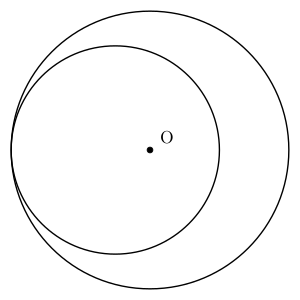
- TG EAPCET 2023Set ap-2023-05-10-FN1 markMCQQ.A circular plate of uniform thickness has a radius of 14 cm. A circular portion of diameter 21 cm is removed from one edge from the plate as shown in the figure. If ‘O’ is the centre of mass of the complete plate, then the distance of centre of mass of remaining portion from ‘O’ is [FIGURE] (A) 5 cm (B) 9 cm (C) 4.5 cm (D) 5.5 cm
›Reveal solutionSolution
Treat the removed circle as a negative mass and use the centre-of-mass formula for a composite system. The COM of the remaining portion lies 4.5 cm from O, so the correct option is (C).
Concept & Intuition
When a symmetric object has a piece cut out, the original object equals the remaining part plus the removed part. For centre-of-mass calculations we can treat the removed piece as having negative mass. The COM of the original plate is at its geometric centre O, so writing the COM equation for the whole plate in terms of the remaining and removed parts lets us solve for the shift of the remaining part's COM.
Step-by-step solution
-
Geometry and masses.
The original plate is a uniform disc of radius R=14 cm, centred at O. The removed piece is a disc of diameter 21 cm, so its radius is r=10.5 cm. With uniform density, mass is proportional to area (mass per unit area σ):
- Original plate: M=σπR2=196πσ.
- Removed piece: m=σπr2=σπ(10.5)2=110.25πσ.
-
Locate the removed piece's centre.
The removed circle is cut from one edge, so it touches the outer rim. Its centre therefore lies a distance
d=R−r=14−10.5=3.5 cm
from O, along the radius toward that edge.
- Centre-of-mass equation. The original plate's COM is at O (position 0). Let the remaining part (mass M−m) have its COM at distance x from O on the side opposite the hole, and the removed piece (mass m) sits at +d. For the whole plate:
-
- TG EAPCET 2023Set ap-2023-05-11-AN1 markMCQQ.Three identical spheres A, B and C each of mass M and radius R are placed along a straight line such that, adjacent spheres touch each other. The position of the center of mass of the system of 3 spheres from the center of the sphere A is (A) 32R (B) 2R (C) 35R (D) 34R
›Reveal solutionSolution
For three identical spheres touching in a line, the center of mass lies at the geometric center of the system. By symmetry and the center-of-mass formula, it is located 34R from the center of sphere A.
The center of mass of a system is the weighted average position of all the mass. When objects are identical, the center of mass reduces to the simple average of their positions—the geometric center. The key is to set up a coordinate system and apply the definition carefully.
Since the three spheres are identical and touch each other along a straight line, we can place the center of sphere A at the origin and measure all positions from there.
-
Establish coordinates for each sphere's center.
Place sphere A's center at xA=0. Because adjacent spheres touch and each has radius R, the distance between adjacent centers is 2R.
- Sphere A: xA=0
- Sphere B: xB=2R
- Sphere C: xC=4R
-
Apply the center-of-mass formula.
For a system of particles (or spheres treated as point masses at their centers), the position of the center of mass is
xcm=M+M+MMxA+MxB+MxC=3MM(xA+xB+xC)=3xA+xB+xC.
- Substitute the coordinates. …
-
- TG EAPCET 2023Set eng-2023-05-14-AN1 markMCQQ.Match the following. (Take the relative strength of the strongest fundamental forces in nature as one) I Fundamental forces in nature A) Strong nuclear force B) Weak nuclear force C) Electromagnetic force D) Gravitational force II Relative strengthe) 10−2f) 1g) 1010h) 10−13i) 10−39 (A) A-f, B-i, C-e, D-h (B) A-f, B-h, C-e, D-g (C) A-f, B-h, C-e, D-i (D) A-f, B-e, C-h, D-i
›Reveal solutionSolution
The problem asks to match each fundamental force (Strong, Weak, Electromagnetic, Gravitational) with its relative strength, taking the strongest force as 1. The correct pairing is: Strong = 1, Weak = 10−13, Electromagnetic = 10−2, Gravitational = 10−39, which corresponds to option (C).
The key idea is that the four fundamental forces have vastly different strengths. Physicists often compare them by setting the strongest — the strong nuclear force — as the reference (relative strength = 1). Then the others are given as powers of ten relative to it.
Why this approach works:
The relative strengths are not arbitrary; they come from experimental measurements of how strongly each force binds particles. The strong force holds atomic nuclei together, the electromagnetic force binds electrons to atoms, the weak force governs certain decays, and gravity is by far the weakest — though it dominates on large scales because it is always attractive and has infinite range.
Let’s match them step by step.
-
Strong nuclear force — This is the strongest force, holding protons and neutrons together in the nucleus. By definition, its relative strength is taken as 1. So it matches with f (which is 1).
→ A-f.
-
Electromagnetic force — This is about 1/100th the strength of the strong force. Its relative strength is 10−2, which is e.
→ C-e.
-
Weak nuclear force — Responsible for radioactive beta decay, it is much weaker than the strong force. Its relative strength is about 10−13, which is h.
→ B-h. …
-
- TG EAPCET 2022Set ap-2022-07-30-FN1 markMCQQ.Which of the following forces has the highest strength? (A) Gravitational force (B) Electromagnetic force (C) Strong nuclear force (D) Frictional force
›Reveal solutionSolution
The strong nuclear force is the strongest of the four fundamental forces, far exceeding gravity, electromagnetism, and friction. The correct option is (C).
Why This Approach Works
This question tests your understanding of the relative strengths of the fundamental forces in physics. The key insight is that forces operate on vastly different scales: gravity dominates the cosmos but is incredibly weak at the particle level, while the strong nuclear force is negligible over large distances but overwhelmingly powerful inside atomic nuclei. Friction, though important in daily life, is not a fundamental force—it’s a macroscopic effect of electromagnetism. By comparing their typical interaction strengths (using the strong force as a reference), we can rank them definitively.
Step-by-Step Reasoning
-
Identify the fundamental forces
The four fundamental forces of nature are: gravitational, electromagnetic, strong nuclear, and weak nuclear. Frictional force is not fundamental—it arises from electromagnetic interactions between atoms. So (D) is automatically weaker than the electromagnetic force itself.
-
Recall the relative strength scale
Physicists compare forces by looking at how strongly they act between two protons at a typical nuclear distance (about 10−15 m). If we set the strong nuclear force’s strength as 1, the approximate relative strengths are:
- Strong nuclear: 1
- Electromagnetic: 10−2 (about 1/100 as strong)
- Weak nuclear: 10−5 (not listed here)
- Gravitational: 10−38 (astronomically weaker)
-
Eliminate the weaker contenders
- Gravitational force is the weakest of all fundamental forces—it only seems strong because planets and stars are huge.
- Electromagnetic force is much stronger than gravity but still 100 times weaker than the strong force at short range. …
-
- TG EAPCET 2022Set eng-2022-07-20-FN1 markMCQQ.Which of the following statements is true? (A) The range for weak nuclear force is shortest among all four forces (B) The range for electromagnetic force is smaller than that for gravitation force (C) The relative strength of gravitational force is higher than that for weak nuclear force (D) The relative strength for weak nuclear force is larger than that for strong nuclear force
›Reveal solutionSolution
The weak nuclear force has the shortest range among all four fundamental forces, making statement (A) true. Its range is approximately 10−18 m, significantly smaller than even the strong nuclear force's range of 10−15 m.
The universe operates through four fundamental forces: the strong nuclear force, the electromagnetic force, the weak nuclear force, and the gravitational force. Each force governs different interactions and phenomena, characterized by its relative strength and the distance over which it acts (its range). Understanding these properties is crucial for describing everything from subatomic particles to galaxies.
Here's a breakdown of the properties of these forces, which will help us evaluate the given statements:
Force Relative Strength (approx.) Range (approx.) Strong Nuclear Force 1 10−15 m (nuclear dimensions) Electromagnetic Force 10−2 Infinite Weak Nuclear Force 10−13 10−18 m (sub-nuclear dimensions) Gravitational Force 10−39 Infinite Now, let's evaluate each statement:
-
Statement (A): The range for weak nuclear force is shortest among all four forces.
- From the table, the range of the weak nuclear force is approximately 10−18 m.
- The strong nuclear force has a range of about 10−15 m.
- Both electromagnetic and gravitational forces have infinite ranges.
- Comparing the finite ranges, 10−18 m is indeed shorter than 10−15 m. Therefore, the weak nuclear force has the shortest range among all four fundamental forces. This statement is true.
-
Statement (B): The range for electromagnetic force is smaller than that for gravitation force.
- Both the electromagnetic force and the gravitational force have infinite ranges. …
-
- TG EAPCET 2022Set ap-2022-07-31-AN1 markMCQQ.Two particles having equal mass and charge are separated by a distance r. The force(s) they experience is (are) (A) Attractive electromagnetic force only (B) Repulsive electromagnetic force only (C) Attractive electromagnetic force and attractive gravitational force (D) Repulsive electromagnetic force and attractive gravitational force
›Reveal solutionSolution
Two like-charged particles experience a repulsive electrostatic force and an attractive gravitational force. The net electromagnetic force is repulsive, so the correct option is (D).
The key here is to recognise that the particles have equal mass and equal charge. Mass is always positive, so the gravitational force between any two masses is always attractive. Charge, on the other hand, can be positive or negative — but the problem says they have "equal charge", which means they are either both positive or both negative. Like charges repel each other. So the electromagnetic force is repulsive, and the gravitational force is attractive.
Let’s walk through it step by step.
-
Identify the forces at play.
Two particles with mass and charge interact via two fundamental forces: the gravitational force and the electromagnetic (specifically electrostatic) force. Both obey inverse-square laws, but they act in opposite directions depending on the signs of the charges.
-
Nature of the gravitational force.
Gravitational force between two masses m1 and m2 separated by distance r is given by
Fg=Gr2m1m2
where G is the gravitational constant. Since mass is always positive, Fg is always attractive — the particles pull each other together.
- Nature of the electromagnetic force. The electrostatic force between two charges q1 and q2 separated by r is
Fe=kr2q1q2
where k=4πε01. The sign of Fe depends on the product q1q2:
- If q1 and q2 have the same sign (both positive or both negative), q1q2>0, so Fe>0 — the force is repulsive.
- If they have opposite signs, q1q2<0, so Fe<0 — the force is attractive. The problem states the particles have "equal charge", meaning they are like-charged. Hence the electrostatic force is repulsive.
- Combine the forces. So the two forces acting are: …
-
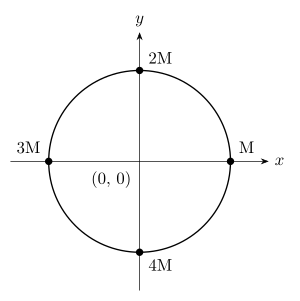
- TG EAPCET 2022Set eng-2022-07-18-FN1 markMCQQ.Four masses are arranged along a circle of radius 1 m as shown in the figure. The center of mass of this system of masses is at [FIGURE] (A) −51i^−51j^ (B) 51i^+j^ (C) i^−51j^ (D) 51i^+51j^
›Reveal solutionSolution
Weighting each position by its mass gives xcm=(1⋅M−1⋅3M)/10M=−1/5 and ycm=(1⋅2M−1⋅4M)/10M=−1/5, so the centre of mass is at −51i^−51j^ — option (A).
The concept first
The centre of mass is the single point that moves as if all the mass were concentrated there and all external forces acted there. Mathematically it is nothing more exotic than a weighted average of position:
Rcm=m1+m2+…m1r1+m2r2+….
Because it is a vector equation you may handle each Cartesian component separately, and any mass lying on an axis contributes zero to the other coordinate. That is what makes this problem almost arithmetic-free if you set it up cleanly.
Do also expect the answer to lie inside the circle: the CM of a set of points always lies inside their convex hull, so a magnitude much smaller than the radius 1m is exactly what we should get.
Step-by-step
- Write the coordinates. Radius =1 m, centre at the origin:
2M→(0,1),M→(1,0),3M→(−1,0),4M→(0,−1).
- Total mass.
∑mi=2M+M+3M+4M=10M.
- x-coordinate. Only the masses on the x-axis matter (M at +1, 3M at −1):
xcm=10M2M(0)+M(1)+3M(−1)+4M(0)=10MM−3M=10M−2M=−51 m.
- y-coordinate. Only the masses on the y-axis matter (2M at +1, 4M at −1): …
- TG EAPCET 2021Set ap-2021-08-10-FN1 markMCQQ.Which of the following forces have highest range?(a) Gravitational force(b) Weak Nuclear force(c) Electromagnetic force(d) Strong Nuclear force (A)(a) and(b) only (B)(a) and(c) only (C)(a) and(d) only (D)(c) and(b) only
›Reveal solutionSolution
The range of a force is determined by the mass of its exchange particle: massless mediators (graviton, photon) give infinite range, while massive mediators (W/Z bosons, gluons) give very short range. Thus gravitational and electromagnetic forces have the highest (infinite) range, so the correct option is (B).
The key concept here is the relationship between the mass of a force’s mediator particle and the force’s range. In quantum field theory, the range R of a force is inversely proportional to the mass m of the particle that carries it:
R≈mcℏ
where ℏ is the reduced Planck constant and c is the speed of light. If the mediator has zero mass, the range is infinite; if it has mass, the range is finite and typically very short.
Let’s apply this to each force:
-
Gravitational force – Mediated by the hypothetical graviton, which is massless. Therefore its range is infinite. It acts over cosmic distances.
-
Electromagnetic force – Mediated by the photon, which is also massless. Its range is infinite as well (though it can be shielded, the force itself extends without limit).
-
Weak nuclear force – Mediated by the massive W and Z bosons (about 80–90 GeV/c²). Their large mass gives a range of roughly 10−18 m (about 0.1% of a proton’s diameter). Very short. …
-
- TG EAPCET 2021Set eng-2021-08-06-AN1 markMCQQ.In uniform circular motion which of following statement is wrong? (A) Work done during one complete cycle is zero (B) Centripetal force acting towards the centre of circle (C) Angular velocity is constant (D) Tangential velocity is constant
›Reveal solutionSolution
In uniform circular motion, the speed is constant but the direction of tangential velocity changes continuously, so the velocity vector is not constant — making statement (D) the wrong one.
The key idea is the difference between speed (a scalar) and velocity (a vector). Uniform circular motion means the particle moves around a circle at a constant speed, but because the direction of motion keeps changing, the velocity is never constant. Let’s check each statement carefully.
-
Statement (A): Work done during one complete cycle is zero
Work is force times displacement in the direction of the force. In uniform circular motion, the centripetal force is always perpendicular to the instantaneous displacement (which is along the tangent). Since F⋅s=0 at every instant, the total work over a full cycle is zero. This is correct.
-
Statement (B): Centripetal force acting towards the centre of circle
By definition, centripetal force is the net inward force that keeps an object moving in a circle. It always points radially inward toward the centre. This is correct.
-
Statement (C): Angular velocity is constant
Angular velocity ω is the rate of change of angular displacement. In uniform circular motion, the particle covers equal angles in equal times, so ω is constant in magnitude and direction (the axis is fixed). This is correct.
-
Statement (D): Tangential velocity is constant …
-
- TG EAPCET 2021Set eng-2021-08-06-AN1 markMCQQ.Match the following Column-1 A) Potential energy of satellite B) Total energy of satellite C) Kinetic energy of satellite D) Gravitational potential energy of satellite at infinity Column-2 I) Positive II) Negative III) Zero IV) Infinity The correct match is (A) A B C D IV II I III (B) A B C D III I IV II (C) A B C D II II I III (D) A B C D II I IV III
›Reveal solutionSolution
The signs of a satellite’s energies are fixed by the convention that potential energy is zero at infinity. Potential and total energy are negative, kinetic energy is positive, and gravitational potential energy at infinity is zero. The correct match is (C).
The key idea is the convention for gravitational potential energy: we define it to be zero when the satellite is infinitely far from the Earth. Because gravity is attractive, bringing the satellite closer releases energy, so the potential energy becomes negative. The total energy is the sum of kinetic (always positive for a bound orbit) and potential (negative), and for a stable circular orbit the total is also negative — exactly half the potential energy in magnitude.
Let’s match each entry step by step.
- A) Potential energy of a satellite For a satellite of mass m at a distance r from Earth’s centre (mass M), the gravitational potential energy is
U=−rGMm
Since r is finite and positive, U is negative. So A matches II.
- B) Total energy of a satellite For a satellite in a circular orbit, kinetic energy is K=2rGMm and potential energy is U=−rGMm. Adding them:
E=K+U=2rGMm−rGMm=−2rGMm
This is also negative. So B matches II as well.
Watch outA common mistake is to think total energy is zero for a bound orbit. Zero total energy corresponds to an escape trajectory (parabolic orbit), not a bound satellite.
- C) Kinetic energy of a satellite …
🎓Unlock everything free for 14 days
- ✓Full step-by-step solutions
- ✓Concept-first explanations
- ✓Methods, shortcuts & mistakes
- ✓PYQ mapping + timed mock tests
Full access for 14 days. No credit card required.