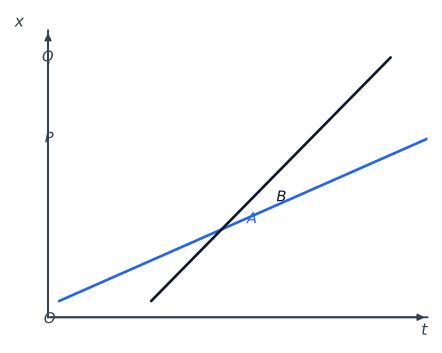
Q.The position-time (x-t) graphs for two children A and B returning from their school O to their homes P and Q respectively are shown in Fig. 2.9. Choose the correct entries in the brackets below:
Concept understanding — Instantaneous Velocity
Instantaneous Velocity: From "How Fast" to "How Fast Right Now"
You already know average velocity. If a car travels 120 km in 2 hours, its average velocity is 60 km/h. That tells you the overall rate, but it hides everything that happened in between — the traffic jams, the sudden bursts of speed, the moments the car was completely stopped.
Now imagine you want to know the car's velocity at exactly 10:15 AM, not averaged over an hour or a minute. That's instantaneous velocity — the velocity at a single instant of time.
The Intuition: Zooming In
Think of a speedometer needle. When you drive, the needle doesn't stay fixed at 60 km/h. It jumps up when you accelerate, drops when you brake. At any given moment, the needle points to a specific number. That number is your instantaneous speed (velocity, if direction matters).
But here's the puzzle: at a single instant, the car hasn't moved any distance. How can you have a speed if Δt=0? You can't divide by zero.
The trick is to shrink the time interval smaller and smaller, and see what the average velocity approaches.
The Precise Definition
Let s(t) be the position of an object at time t. The average velocity over a time interval [t,t+h] is:
vavg=hs(t+h)−s(t)
Now, let h get closer and closer to 0 (but never equal to 0). If the average velocity settles down to a single number as h→0, that number is the instantaneous velocity at time t:
v(t)=limh→0hs(t+h)−s(t)
v(t)=limh→0hs(t+h)−s(t)
This limit is exactly the derivative of position with respect to time. In calculus notation: v(t)=s′(t).
A Concrete Example
Suppose a ball is dropped from rest, and its height (in meters) after t seconds is s(t)=4.9t2 (ignoring air resistance).
Average velocity from t=2 to t=2.1 seconds:
vavg=0.14.9(2.1)2−4.9(2)2=0.14.9(4.41−4)=0.14.9×0.41=20.09 m/s
Average velocity from t=2 to t=2.01:
vavg=0.014.9(2.01)2−4.9(2)2=0.014.9(4.0401−4)=19.649 m/s
Average velocity from t=2 to t=2.001:
vavg=0.0014.9(2.001)2−4.9(2)2=19.6049 m/s
The numbers are converging to 19.6 m/s. That's the instantaneous velocity at t=2 seconds.
Using the derivative: v(t)=9.8t, so v(2)=19.6 m/s. Matches perfectly.
Key Takeaways for Exams
| Concept | Meaning | Formula |
|---|---|---|
| Average velocity | Total displacement ÷ total time | ΔtΔs |
| Instantaneous velocity | Velocity at a single moment | limh→0hs(t+h)−s(t) |
Do not confuse instantaneous velocity with average velocity. A common exam trap: "A car travels 100 km in 2 hours. What is its velocity at the 1-hour mark?" The answer is not 50 km/h — that's the average. You need more information (or a position function) to find the instantaneous value.
Instantaneous velocity is a vector — it has both magnitude (speed) and direction. If the object reverses direction, the instantaneous velocity changes sign. The speedometer only shows magnitude.
Why This Matters
Instantaneous velocity is the foundation of all of kinematics and dynamics. Newton's second law (F=ma) uses acceleration, which is the instantaneous rate of change of velocity. Without this concept, you can't describe motion that changes — which is almost all real motion.
When you see a graph of position vs. time, the instantaneous velocity at any point is the slope of the tangent line at that point. That geometric interpretation will serve you well in both physics and calculus.
Instantaneous Velocity bridges the NCERT Class 11 Physics chapter on Motion in a Straight Line with the calculus taught in Class 11 Mathematics' Limits and Derivatives chapter, matching searches like "instantaneous velocity: definition and formula" or "kinematics important questions class 11 physics". This distinction from average velocity is a classic conceptual question in CBSE boards and a common numerical setup for JEE Main and NEET.
Read off each fact from the slopes and end-points of the two straight lines. A (from the origin, gentle slope, ends at the nearer house P) starts earlier but walks slower; B (starts later, steep slope, ends at the farther house Q) is faster and overtakes A once, both arriving together.
House P is nearer the school than Q, and A's line ends at P, so A lives closer. A's line begins at t=0 while B's begins later, so A starts earlier. B's line is steeper, so B is faster. Both lines end at the same time, so they reach home together. B's line crosses A's exactly once, so B overtakes A once.
- A lives closer to the school than B.
- A starts from the school earlier than B.
- B walks faster than A.
- A and B reach home at the same time. (e) B overtakes A on the road once.
On a position-time graph the slope is velocity and the height reached is the distance travelled. A's line rises gently from the origin to the nearer house P; B's line starts later, rises steeply, and reaches the farther house Q, crossing A's line once, with both lines ending at the same instant. From this: A is closer and starts earlier, B is faster and overtakes A once, and they reach home together.
Concept
For one-dimensional motion, an x-t graph encodes everything:
- the height of a point gives the position (distance from O),
- the slope ΔtΔx gives the velocity (steeper = faster),
- where two lines intersect, the two bodies are at the same place at the same time (an overtaking event).
Reading each part
- Who lives closer? House P is marked nearer to O than house Q. A's line terminates at P and B's at Q, and OP<OQ, so A's home is nearer. A lives closer.
- Who starts earlier? A's line leaves the origin at t=0; B's line meets the time axis at a later instant tB>0, meaning B is still at the school (x=0) until then. A starts earlier.
- Who walks faster? Speed is the magnitude of the slope. B's line is distinctly steeper than A's, so ∣vB∣>∣vA∣. B walks faster.
- Same or different arrival time? Both straight lines end at the same value of t (their upper end-points lie on the same vertical), so the two children arrive at their respective homes at the same instant.
- Overtaking. The two lines intersect exactly once. Since B starts behind A in position (B leaves later from O) but is faster, B catches up, and at the crossing B draws level with and then passes A. Hence B overtakes A, once.
✓Final answer
- A lives closer to the school than B.
- A starts from the school earlier than B.
- B walks faster than A.
- They reach home at the same time. (e) B overtakes A once.
Concept: Verifying a Qualitative Graph-Reading Conclusion with a Concrete Numerical Model
Method: Build a Consistent Numeric Example, Then Check Each Statement by Calculation
The description (steeper/gentler slopes, later start, single crossing, simultaneous arrival) can be read directly off the sketch. This method instead manufactures one concrete, numerically consistent version of that graph and checks every one of the five statements by plugging in numbers — a useful cross-check technique whenever a "read the graph" answer needs to be verified rather than just eyeballed.
Steps
-
Assign consistent numeric values. Let house P (child A's home) be at x=1 km and house Q (child B's home, farther) at x=2 km. Let A leave the school at t=0 and both children arrive home together at t=20 min; let B leave later, at t=5 min.
-
Write each child's position as a straight line, from these numbers:
xA(t)=20 min1 kmt=0.05t(t in min,0≤t≤20)
xB(t)=20−5 min2 km(t−5)=0.133(t−5)(5≤t≤20)
-
Check (c): who walks faster? Compare slopes: vB=0.133 km/min>vA=0.05 km/min. B is faster — confirmed numerically.
-
Check (e): do the lines cross exactly once, and who overtakes whom? Set xA(t)=xB(t):
0.05t=0.133(t−5)⇒0.05t=0.133t−0.667⇒0.083t=0.667⇒t≈8.0 min
Two straight lines with different slopes intersect at exactly one value of t — algebraically guaranteed, matching the "crosses once" reading. At t≈8, xA≈0.40 km, which lies between 0 and 1 km (before A reaches home) and between 0 and 2 km (before B reaches home) — a physically valid crossing point. Since B starts behind A but is faster, B is behind before t≈8 and ahead after — B overtakes A, once.
- Check (a), (b), (d) directly from the assigned numbers: A's home (1 km) is nearer than B's (2 km) — A lives closer; A leaves at t=0<5 min — A starts earlier; both xA(20)=1 and xB(20)=2 are reached at the same t=20 — same arrival time.
Why this cross-check is useful
Any numeric assignment consistent with the sketch's qualitative features (P nearer than Q, B starts later, both arrive together) will reproduce the same five conclusions — because those conclusions follow from the geometry (relative slopes, starting points, endpoint), not from the particular numbers chosen. Getting the same answers from an arbitrary consistent example is strong evidence the qualitative reading is correct.
Final Answer
- A lives closer to school;
- A starts earlier;
- B walks faster;
- they arrive at the same time; (e) B overtakes A once — confirmed by direct computation on a concrete numeric model of the graph.
Showing the 12 most recent of 13 on this concept.
- TG EAPCET 2025Set eng-2025-05-02-FN1 markMCQQ.The driver of a bus moving with a velocity of 72 kmph observes a boy walking across the road at a distance of 50 m in front of the bus and decelerates the bus at 5ms−2 by applying brakes and is just able to avoid an accident. The reaction time of the driver is (A) 4s (B) 3.5s (C) 0.5s (D) 4.5s
›Reveal solutionSolution
The driver’s reaction time is the delay before braking begins; during that time the bus travels at constant speed, and the remaining distance must be exactly enough for the deceleration to stop the bus. Solving gives a reaction time of 0.5 s, so option (C) is correct.
The key idea is that the driver does not brake instantly — there is a reaction time during which the bus continues at its initial speed. Only after that delay does the bus decelerate. The total distance from the driver’s first sight of the boy to the bus’s final stop is 50 m. Part of that distance is covered at constant speed during the reaction time, and the rest is covered while braking to a halt. We need to find the reaction time such that the bus just stops before reaching the boy.
- Convert the initial speed to m/s The bus moves at 72 km/h.
72 hkm=72×36001000=20 m/s.
So u=20 m/s.
- Let the reaction time be tr seconds During this time, the bus travels at constant speed u and covers a distance
dreaction=u⋅tr=20tr m.
- After the reaction time, the driver applies brakes The bus decelerates at a=−5 m/s2 (negative because it’s slowing down). The initial speed for the braking phase is still u=20 m/s, and the final speed is 0. Using the equation of motion v2=u2+2as for the braking distance s:
0=(20)2+2(−5)s⇒0=400−10s⇒s=40 m.
So the bus needs 40 m to stop once brakes are applied.
- The total distance from the driver’s first sight to the boy is 50 m This total must equal the distance covered during reaction time plus the braking distance:
20tr+40=50.
- Solve for tr
20tr=10⇒tr=0.5 s.
Watch outA common mistake is to forget the reaction distance and simply use the 50 m as the braking distance. That would give 0=202+2(−5)(50) → 400=500, which is false — showing the bus would stop well before 50 m if it braked immediately. The reaction time accounts for the extra distance.
TipNotice that the braking distance (40 m) is independent of the reaction time — it depends only on initial speed and deceleration. So the reaction distance is simply the leftover 10 m, giving tr=10/20=0.5 s directly.
✓Final answerThe correct option is (C).
ANSWER: C
- TG EAPCET 2025Set eng-2025-05-04-AN1 markMCQQ.For a particle moving along a straight line path, the displacements in third and fifth seconds of its motion are 10 m and 18 m respectively. The speed of the particle at time t=4s is (A) 32ms−1 (B) 8ms−1 (C) 12ms−1 (D) 16ms−1
›Reveal solutionSolution
The problem involves constant acceleration motion; using the formula for displacement in the nth second, we find acceleration a=4m/s2 and initial velocity u=0, so speed at t=4s is 16m/s — option (D).
We are told the particle moves along a straight line, and the displacements in the third and fifth seconds are given. This is a classic constant-acceleration kinematics problem. The key is to use the formula for displacement during a specific second, which directly relates the given data to the initial velocity and acceleration.
Why this approach works:
For uniformly accelerated motion, the displacement in the nth second is sn=u+2a(2n−1). This formula comes from subtracting the distance traveled in (n−1) seconds from that in n seconds. It gives us two equations in u and a, which we can solve.
Let’s work through it step by step.
- Write the formula for displacement in the nth second. For constant acceleration a and initial velocity u, the displacement in the nth second is:
sn=u+2a(2n−1)
This is derived from sn=[un+21an2]−[u(n−1)+21a(n−1)2].
- Apply to the third second (n=3). Given s3=10m:
10=u+2a(2⋅3−1)=u+2a(5)
So:
10=u+25a(Equation 1)
- Apply to the fifth second (n=5). Given s5=18m:
18=u+2a(2⋅5−1)=u+2a(9)
So:
18=u+29a(Equation 2)
- Solve the system of equations. Subtract Equation 1 from Equation 2:
(18−10)=(u+29a)−(u+25a)
8=24a=2a
Hence:
a=4m/s2
- Find the initial velocity u. Substitute a=4 into Equation 1:
10=u+25⋅4=u+10
So:
u=0m/s
- Find the speed at t=4s. For constant acceleration, v=u+at. With u=0, a=4, t=4:
v=0+4⋅4=16m/s
TipNotice that u=0 means the particle started from rest. The displacements in the 3rd and 5th seconds being 10 m and 18 m (difference of 8 m over 2 seconds) directly gives a=4m/s2 because the increase in displacement per second is a.
Watch outA common mistake is to confuse “displacement in the nth second” with “displacement after n seconds.” The formula s=ut+21at2 gives total displacement, not the displacement during a specific second.
✓Final answerThe correct option is (D).
ANSWER: D
- TG EAPCET 2025Set eng-2025-05-04-FN1 markMCQQ.For a particle moving along a straight line path, the displacements in third and fifth seconds of its motion are 10 m and 18 m respectively. The speed of the particle at time t=4 s is (A) 32 ms−1 (B) 12 ms−1 (C) 16 ms−1 (D) 8 ms−1
›Reveal solutionSolution
Using sn=u+2a(2n−1): the 3rd and 5th-second displacements give a=4 ms−2, u=0, so v(4)=u+at=16 ms−1.
The displacement in the nth second of uniformly accelerated motion is
sn=u+2a(2n−1).
Third second (n=3): s3=u+2a(5)=u+2.5a=10.
Fifth second (n=5): s5=u+2a(9)=u+4.5a=18.
Subtracting the two equations:
2a=8 ⇒ a=4 ms−2.
Then u+2.5(4)=10⇒u+10=10⇒u=0.
Speed at t=4 s:
v=u+at=0+(4)(4)=16 ms−1.
✓Final answerThe speed at t=4 s is 16 ms−1 — option (C).
- TG EAPCET 2025Set ap-2025-04-29-AN1 markMCQQ.When a bullet is fired with a velocity of 150ms−1 at a target of thickness 50cm, it emerges with a velocity of 100ms−1. If another bullet of same mass is fired with same velocity at a second target of thickness 80cm, then the velocity with which the bullet emerges from the second target is (Retarding forces are equal in both the cases) (A) 60ms−1 (B) 75ms−1 (C) 50ms−1 (D) 40ms−1
›Reveal solutionSolution
The retarding force does constant work per unit thickness, so the loss in kinetic energy is proportional to the thickness. Using the work–energy theorem for both targets gives the emerging speed as 50m/s.
The key idea is that the retarding force is the same in both cases, and it acts over a known distance (the thickness of the target). The work done by this force equals the loss in kinetic energy of the bullet. Since the force is constant, the work done is simply force times distance, so the kinetic energy lost is directly proportional to the thickness of the target.
We don’t need to know the mass or the force explicitly — we can work with the change in v2, which is proportional to the distance travelled under a constant retarding force.
- First target — thickness d1=50 cm=0.5 m. Initial speed u=150 m/s, final speed v1=100 m/s. Loss in kinetic energy:
21m(1502−1002)=21m(22500−10000)=21m(12500)
This loss equals the work done by the retarding force F over distance d1:
Fd1=21m(12500)
- Second target — thickness d2=80 cm=0.8 m. Same initial speed u=150 m/s, let the emerging speed be v2. Loss in kinetic energy:
21m(1502−v22)=21m(22500−v22)
This equals the work done over distance d2:
Fd2=21m(22500−v22)
- Divide the two equations to eliminate F and m:
Fd1Fd2=21m(12500)21m(22500−v22)
d1d2=1250022500−v22
Substitute d2/d1=0.8/0.5=1.6:
1.6=1250022500−v22
- Solve for v22:
22500−v22=1.6×12500=20000
v22=22500−20000=2500
v2=2500=50 m/s
Watch outA common mistake is to assume that the velocity loss is proportional to thickness — it is the kinetic energy loss that is proportional. Working with v2 avoids this error.
✓Final answerThe bullet emerges from the second target with a speed of 50 m/s, which corresponds to option (C).
- TG EAPCET 2023Set eng-2023-05-12-AN1 markMCQQ.A person walks in such a way that he covers equal distance in each step. The person takes 2 steps forward towards east, then takes a right turn and walks 4 steps towards south, then takes a right turn and walks 6 steps towards west and then takes a right turn and walks further. The direction of his final position after a total of 20 steps walk with respect to his initial position is (A) North-West (B) 60∘ West of South (C) 60∘ South of West (D) South-East
›Reveal solutionSolution
Track the four legs on a grid; the walker ends at (−4,+4) — equal parts west and north — i.e. North-West.
Set up coordinates. Take east as +x, north as +y; each step is one unit. He starts facing east, and each "right turn" rotates his heading east→south→west→north.
Steps used so far: 2+4+6=12, so the fourth leg is 20−12=8 steps, heading north.
Leg-by-leg positions:
- Start: (0,0)
- East 2 steps: (2,0)
- South 4 steps: (2,−4)
- West 6 steps: (−4,−4)
- North 8 steps: (−4,+4)
Final displacement. From the origin the final point is (−4,+4): 4 units west and 4 units north. Since the two components are equal, the direction makes 45∘ with each axis — exactly North-West.
✓Final answerFinal position is North-West of the start — option (A).
- TG EAPCET 2022Set eng-2022-07-18-FN1 markMCQQ.A body starts from the rest and acquires a velocity of 10 m/s in 2s. What is the acceleration of the body and the distance travelled (A) 5 m/s2 and 10 m (B) 5 m/s2 and 5 m (C) 5 m/s2 and 6 m (D) 6 m/s2 and 5 m
›Reveal solutionSolution
Using the equations of motion for constant acceleration from rest, the acceleration is 5 m/s2 and the distance travelled is 10 m. The correct option is (A).
The problem gives a body starting from rest (initial velocity u=0), reaching a velocity v=10 m/s in time t=2 s. We need the acceleration and the distance travelled. Since the body starts from rest and we assume constant acceleration (the most natural reading for such a problem), we can use the standard kinematic equations.
Why this works:
When acceleration is constant, velocity changes uniformly with time, and distance is the area under the velocity–time graph (or the average velocity times time). Starting from rest simplifies the formulas because u=0.
- Find acceleration The definition of acceleration (for constant acceleration) is
a=tv−u
Here u=0, v=10 m/s, t=2 s:
a=210−0=5 m/s2
- Find distance travelled Using the equation s=ut+21at2 with u=0:
s=0⋅2+21⋅5⋅(2)2=21⋅5⋅4=10 m
Alternatively, average velocity is 2u+v=20+10=5 m/s, and distance = average velocity × time = 5×2=10 m.
TipA common mistake is to use s=vt directly (which would give 20 m), forgetting that the velocity is not constant. Always use the average velocity when acceleration is uniform.
Watch outAnother pitfall: using s=21vt (which gives 10 m here by coincidence) without understanding why — it works only when starting from rest. If the initial velocity were not zero, that shortcut would fail.
Thus the acceleration is 5 m/s2 and the distance is 10 m, which matches option (A).
✓Final answerThe correct option is (A).
ANSWER: A
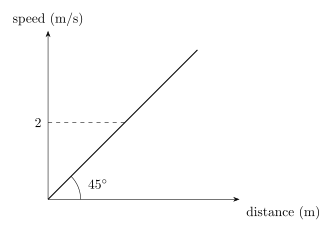
- TG EAPCET 2021Set ap-2021-08-09-FN1 markMCQQ.The speed distance graph is shown below. At what instant of time (in sec) the speed becomes 4 m/s? [FIGURE] (A) t=ln(2) (B) t=ln(4) (C) t=ln(8) (D) t=ln(6)
›Reveal solutionSolution
The speed–distance graph is a straight line of slope 1, so dxdv=1. Using the chain rule dtdv=dxdv⋅v=v and integrating gives v=4 m/s at t=ln2, option (A).
Reading the graph
The graph plots speed v against distance x as a straight line: the speed starts at v=2 m/s at x=0 and rises with slope 1, so
v=2+x,dxdv=1.
The chain-rule connection
Speed, distance and time are linked by
dtdv=dxdv⋅dtdx=dxdv⋅v,
since dtdx=v.
Step-by-step solution
- From the graph dxdv=1, so
dtdv=1⋅v=v.
- Separate variables and integrate from the initial state (t=0, v=2) to when v=4:
∫24vdv=∫0tdt⇒ln24=t.
- Therefore
t=ln2 s.
✓Final answerThe correct option is (A).
ANSWER: A
- TG EAPCET 2021Set ap-2021-08-10-AN1 markMCQQ.The length of minute hand in a clock is 4.5 cm. If the tip of the minute hand moves from 6 AM to 6.30 AM, the average velocity of the tip is. (A) 5×10⁻³ cm/s (B) 50×10−3 cm/s (C) 0.5×10⁻³ cm/s (D) 0.005×10⁻³ cm/s
›Reveal solutionSolution
Average velocity is displacement divided by time. The tip’s displacement is the straight‑line distance from start to end (the chord of a 180° arc), not the path length. With radius 4.5 cm and time 30 min = 1800 s, the average velocity is 18002×4.5=0.005 cm/s = 5×10⁻³ cm/s. The correct option is (A).
Concept & Intuition
Many students mistakenly compute average speed (total path length / time) instead of average velocity (displacement / time). Velocity is a vector; its magnitude depends only on the straight‑line distance between the initial and final positions, not on how far the tip actually travelled along the arc. From 6:00 to 6:30, the minute hand rotates exactly 180°, so the tip’s start and end points are opposite ends of a diameter. The displacement is therefore the diameter of the circle: 2×radius.
Step‑by‑step solution
- Identify the time interval From 6:00 AM to 6:30 AM is exactly 30 minutes. Convert to seconds:
Δt=30×60=1800 s.
- Determine the displacement At 6:00, the minute hand points straight up (12 o’clock). At 6:30, it points straight down (6 o’clock). These two positions are diametrically opposite. The displacement is the straight‑line distance between them, which is the diameter of the circle traced by the tip:
displacement=2×radius=2×4.5=9 cm.
- Compute average velocity Average velocity is a vector quantity:
average velocity=timedisplacement.
Its magnitude is:
∣vavg∣=1800 s9 cm=0.005 cm/s.
- Express in scientific notation
0.005=5×10⁻³.
So the magnitude of the average velocity is 5×10⁻³ cm/s.
Watch outA common mistake is to use the arc length (half the circumference = πr≈14.14 cm) instead of the diameter. That gives average speed ≈ 0.00785 cm/s, which is not among the options — but if you mis‑compute, you might land on a wrong choice. Always ask: “Am I finding velocity (displacement) or speed (distance)?”
TipWhenever the motion covers exactly half a circle (180°), the displacement is simply twice the radius. No need to calculate chords or angles — just double the radius.
✓Final answerThe correct option is (A).
ANSWER: A
- TG EAPCET 2021Set ap-2021-08-10-AN1 markMCQQ.A body moves along the sides of an equilateral triangle of side 20 cm and comes back to the initial point after one round. Then the distance and displacement of the body respectively are (A) 60 cm and 20 cm (B) 60 cm and 0 cm (C) 0 cm and 60 cm (D) 60 cm and 60 cm
›Reveal solutionSolution
Distance is the total path length traveled (60 cm), while displacement is the net change in position from start to finish (0 cm because the body returns to its starting point). The correct option is (B).
The key idea here is the difference between distance (a scalar quantity that measures the total ground covered) and displacement (a vector quantity that measures the straight-line change in position from start to end). When an object returns to its starting point, the displacement is zero regardless of the path taken.
-
Understand the motion: The body moves along the sides of an equilateral triangle with each side = 20 cm. It starts at one vertex, goes along one side, then the next, then the third, and returns exactly to the starting vertex after one full round.
-
Calculate the distance: Distance is the sum of the lengths of all sides traveled. Since the body goes around all three sides:
Distance=20 cm+20 cm+20 cm=60 cm.
- Calculate the displacement: Displacement depends only on the initial and final positions. The body starts at a point and ends at the same point after one round. Therefore, the net change in position is zero:
Displacement=0 cm.
- Match with the options: The pair (60 cm, 0 cm) corresponds exactly to option (B).
Watch outA common mistake is to think displacement is the side length (20 cm) because the body “moved” that far. But displacement is about net change — if you end where you started, it’s always zero, no matter how long the path.
TipFor any closed path (triangle, square, circle, etc.), the displacement after one complete round is always zero. Distance, however, is the perimeter.
✓Final answerThe correct option is (B).
ANSWER: B
-
- TG EAPCET 2021Set ap-2021-08-10-FN1 markMCQQ.The length of minute hand in a clock is 4.5 cm. If the tip of the minute hand moves from 6 AM to 6.30 AM, the average velocity of the tip is, (A) 5×10⁻³ cm/s (B) 50×10−3 cm/s (C) 0.5×10⁻³ cm/s (D) 0.005×10⁻³ cm/s
›Reveal solutionSolution
Average velocity is displacement divided by time, not distance. The minute hand tip moves in a circular arc from 6 AM to 6:30 AM, so its displacement is the straight-line distance between the two positions — the diameter of the circle. With radius 4.5 cm, displacement = 9 cm, time = 1800 s, so average velocity = 0.005 cm/s = 5×10⁻³ cm/s. The correct option is (A).
Concept & Intuition
The classic pitfall here is confusing average speed with average velocity.
- Average speed = total path length / time. The tip traces a semicircle of radius 4.5 cm, so path length = πr≈14.14 cm.
- Average velocity = displacement / time. Displacement is the straight-line vector from start to finish — here, from the 6 AM position (pointing straight down) to the 6:30 AM position (pointing straight up). That’s exactly the diameter of the clock face: 2r=9 cm.
Since the question asks for average velocity, we must use displacement, not distance.
Step-by-step solution
-
Identify the positions
At 6:00 AM, the minute hand points directly at the 6 (straight down). At 6:30 AM, it points directly at the 12 (straight up). These two positions are opposite ends of a vertical line through the center.
-
Find the displacement
Displacement is the straight-line distance between start and end points. Since they are diametrically opposite,
displacement=2×radius=2×4.5 cm=9 cm.
- Find the time interval From 6:00 AM to 6:30 AM is exactly 30 minutes. Convert to seconds:
Δt=30×60=1800 s.
- Compute average velocity
vavg=Δtdisplacement=1800 s9 cm=0.005 cm/s.
- Match with the options 0.005 cm/s can be written as 5×10⁻³ cm/s. That corresponds to option (A).
Watch outIf you mistakenly used the semicircular path length (πr≈14.14 cm) instead of the straight-line displacement, you’d get about 0.00785 cm/s, which is not among the options — but it’s a common trap. Always check: velocity = displacement, not distance.
TipFor any half-revolution of a clock hand, the displacement is always the diameter. So you can jump straight to 2r without drawing anything.
✓Final answerThe correct option is (A).
ANSWER: A
- TG EAPCET 2021Set ap-2021-08-10-FN1 markMCQQ.A body moves along the sides of an equilateral triangle of side 20 cm and comes back to the initial point after one round. Then the distance and displacement of the body respectively are (A) 60 cm and 20 cm (B) 60 cm and 0 cm (C) 0 cm and 60 cm (D) 60 cm and 60 cm
›Reveal solutionSolution
Distance is the total path length traveled (60 cm), displacement is the net change in position from start to finish (0 cm because the body returns to its starting point). The correct option is (B).
Concept and Intuition
The key distinction here is between distance (a scalar: how much ground was covered, regardless of direction) and displacement (a vector: the straight‑line separation between the starting point and the ending point, with direction).
When a body moves along a closed path and returns exactly to where it began, the displacement is always zero — no matter how long or twisty the path. The distance, however, is simply the sum of the lengths of all the sides traversed.
Step‑by‑Step Reasoning
-
Identify the path
The body moves along the sides of an equilateral triangle. Each side is given as 20 cm. It goes around once and comes back to the initial point.
-
Compute the distance
Distance is the total length of the path traveled. The body covers all three sides:
Distance=20 cm+20 cm+20 cm=60 cm.
- Compute the displacement Displacement is the vector from the starting point to the ending point. Since the body returns to the exact same point after one round, the start and end coincide. Therefore the displacement vector has zero magnitude:
Displacement=0 cm.
- Match with the options The pair (60 cm, 0 cm) corresponds to option (B).
Watch outA common mistake is to think displacement is the side length (20 cm) because the triangle is “closed.” But displacement cares only about where you end relative to where you started — if you finish at the start, displacement is zero regardless of the shape.
TipFor any closed loop (triangle, square, circle, etc.), the displacement after one complete round is always zero. Distance, however, is the perimeter of the loop.
✓Final answerThe correct option is (B).
ANSWER: B
-
- TG EAPCET 2021Set eng-2021-08-06-FN1 markMCQQ.Consider a series of measurements of the length of a box in an experiment. The readings are 2.4 m, 2.5 m, 2.6 m, 2.8 m, 3.0 m. What would be the relative error? (A) 0.110 (B) 0.089 (C) 0.079 (D) 0.072
›Reveal solutionSolution
Mean =2.66 m; mean absolute error =0.192 m; relative error =2.660.192≈0.072.
Mean reading.
xˉ=52.4+2.5+2.6+2.8+3.0=513.3=2.66 m.
Absolute deviations from the mean.
0.26, 0.16, 0.06, 0.14, 0.34.
Mean absolute error:
Δxˉ=50.26+0.16+0.06+0.14+0.34=50.96=0.192 m.
Relative error.
xˉΔxˉ=2.660.192≈0.072.
✓Final answerRelative error ≈0.072 — option (D).
🎓Unlock everything free for 14 days
- ✓Full step-by-step solutions
- ✓Concept-first explanations
- ✓Methods, shortcuts & mistakes
- ✓PYQ mapping + timed mock tests
Full access for 14 days. No credit card required.