Q.A drunkard walking in a narrow lane takes 5 steps forward and 3 steps backward, followed again by 5 steps forward and 3 steps backward, and so on. Each step is 1 m long and requires 1 s. Plot the x-t graph of his motion. Determine graphically and otherwise how long the drunkard takes to fall in a pit 13 m away from the start.
🔒You're viewing a preview — the full solution, concept, methods & PYQ mapping are locked.
🔒 Start your 14-day free trial to unlock the full solution →Concept understanding — One Dimensional Motion
One Dimensional Motion
Imagine you're standing on a long, perfectly straight railway track. A train moves along it — it can only go forward or backward. It cannot turn left, right, up, or down. That's the core idea: motion confined to a single straight line.
The Intuition
In the real world, a ball thrown across a room moves in three dimensions — it goes forward, sideways, and up-down. But many problems in physics are simpler. We deliberately restrict motion to one dimension (1D) to understand the fundamental laws without the clutter of angles and curves.
Think of:
- A car moving on a straight highway (no turns).
- A lift going up or down a shaft.
- A ball dropped straight down from a height.
- A puck sliding on a frictionless straight track.
In each case, the object's position can be described by just one number — its distance from a fixed point (the origin) along that line.
The Precise Statement
One Dimensional Motion is motion in which the position of an object can be completely described using a single coordinate axis (usually the x-axis or y-axis). The object moves only along that straight line.
This means:
- The path is a straight line.
- The direction is either positive (say, to the right or upward) or negative (left or downward).
- All vector quantities (displacement, velocity, acceleration) have only two possible directions — forward or backward.
The Three Key Quantities
To describe 1D motion precisely, we use three quantities:
-
Position (x or y) — where the object is relative to the origin.
Example: x=+5 m means 5 metres to the right of the origin.
-
Displacement (Δx) — change in position:
Δx=xfinal−xinitial
This is a vector — it has a sign. If you move from x=2 m to x=7 m, Δx=+5 m. If you move back to x=3 m, Δx=−4 m.
- Velocity (v) — rate of change of position:
v=ΔtΔx
Average velocity has a sign. Instantaneous velocity is the slope of the position-time graph.
- Acceleration (a) — rate of change of velocity:
a=ΔtΔv
Again, a signed quantity. Positive acceleration doesn't always mean speeding up — it means velocity is becoming more positive (or less negative).
The Equations of Motion (Constant Acceleration)
For the special (and very common) case of constant acceleration, we have three equations that connect these quantities. They are the equations of motion for 1D:
v=u+at
s=ut+21at2
v2=u2+2as
Where:
- u = initial velocity
- v = final velocity
- a = constant acceleration
- t = time
- s = displacement
These equations only work when acceleration is constant. If acceleration changes, you cannot use them directly — you'd need calculus or graphical methods.
A Simple Example …
Concept: Periodic 1-D motion — the pit can be reached mid-surge, not just at the end of a full forward-backward cycle.
Step 1. Each cycle (5 steps forward + 3 steps back) takes 8 s and gives a net advance of 5−3=2 m. But checking only the position at the end of each cycle misses the fact that during a forward surge, the drunkard reaches a peak 5 m above the previous cycle's floor — higher than his net position.
Step 2. Position at the end of each full cycle:
| Cycles completed | Time (s) | Position (m) |
|---|---|---|
| 1 | 8 | 2 |
| 2 | 16 | 4 |
| 3 | 24 | 6 |
| 4 | 32 | 8 |
The drunkard advances a net +2 m every 8 s cycle, but reaches the 13 m pit during a forward surge — he falls into the pit at t = 37 s.
Setting up the motion
Each step is 1 m and takes 1 s.
- 5 steps forward → +5 m in 5 s.
- 3 steps backward → −3 m in 3 s.
So one full cycle takes 8 s and gives a net displacement of +2 m.
Reaching the pit
The pit is 13 m from the start. The key point is that during each forward surge the drunkard climbs to a peak higher than his net position, so he can reach the pit mid-cycle.
Position at the end of each completed cycle:
| Cycles completed | Time (s) | Position (m) |
|---|---|---|
| 1 | 8 | 2 |
| 2 | 16 | 4 |
| 3 | 24 | 6 |
| 4 | 32 | 8 |
After 4 cycles he is at 8 m at t = 32 s. On the very next forward surge he steps forward one metre at a time:
8→9→10→11→12→13 m
reaching 13 m after 5 more steps (5 s):
t=32+5=37 s …
Concept: A Closed-Form Position Function for Periodic Motion
Method: Algebraic Piecewise Formula (solve directly, no cycle-by-cycle table)
Instead of building a table of the drunkard's position at the end of each completed 8-second cycle and then checking the next partial cycle by hand, this method writes a single general formula for his position during the k-th cycle's forward phase, and solves it directly for when x=13 m.
Steps
-
Characterise one cycle. Each cycle: 5 forward steps (5 m in 5 s), then 3 backward steps (3 m in 3 s) — total duration 8 s, net displacement +2 m per cycle.
-
Position at the start of cycle k (for k=0,1,2,…, cycles counted from zero), i.e. at t=8k, after k complete cycles of net +2 m each:
x(8k)=2k
- Write position during the forward phase of cycle k — for 8k≤t≤8k+5, he is walking steadily forward from x=2k:
x(t)=2k+(t−8k),8k≤t≤8k+5
(Position is increasing throughout this window, so it's the only phase where the pit — a fixed forward threshold — can be reached for the first time.)
- Find the smallest k for which this forward phase reaches x=13. The maximum x reached in cycle k's forward phase is 2k+5; we need 2k+5≥13:
k≥4
Check k=3: max reach =2(3)+5=11<13 — not far enough. So k=4 is the first cycle whose forward phase can reach the pit.
- Solve x(t)=13 within cycle k=4's forward phase, 32≤t≤37: 2(4)+(t−32)=13⇒8+t−32=13⇒t=37 …
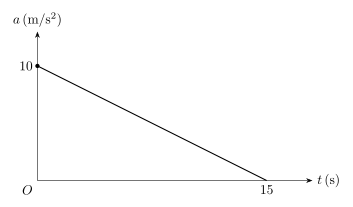
- TG EAPCET 2022Set eng-2022-07-18-AN1 markMCQQ.A particle starts from rest. Its acceleration(a) versus time (t) is as shown in the figure. The maximum speed of the particle will be [FIGURE] (A) 150 m/s (B) 75 m/s (C) 37.5 m/s (D) 45 m/s
›Reveal solutionSolution
The maximum speed equals the total area under the acceleration–time graph because speed is the integral of acceleration. The area is a triangle of base 15 s and height 10 m/s², giving 75 m/s.
The key idea is that acceleration is the rate of change of velocity. When a particle starts from rest, its velocity at any time is the integral (area under) the acceleration–time graph. The maximum speed occurs when the acceleration stops being positive — after that, acceleration becomes negative and the particle slows down. So we just need the total area under the a–t curve up to the point where a becomes zero.
Here the graph is a triangle from t = 0 to t = 15 s, with peak acceleration 10 m/s² at t = 10 s. Let’s find the area.
-
Identify the shape and limits
The a–t graph is a triangle with base from t = 0 to t = 15 s. The height (maximum acceleration) is 10 m/s² at t = 10 s. The area under this triangle gives the change in velocity from start to t = 15 s.
-
Compute the area of the triangle
Area = ½ × base × height = ½ × (15 s) × (10 m/s²) = 75 m/s.
-
Interpret the result
Since the particle starts from rest (v₀ = 0), the velocity at t = 15 s is exactly this area: v_max = 75 m/s. After t = 15 s, acceleration becomes negative, so speed decreases — hence 75 m/s is the maximum. …
-
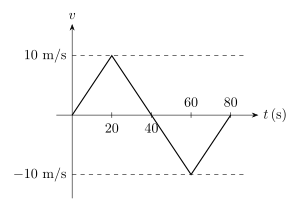
- TG EAPCET 2021Set eng-2021-08-06-FN1 markMCQQ.For the following velocity-time graph, the average speed for the motion during first 80 seconds is [FIGURE] (A) 0 (B) 5 m/s (C) 10 m/s (D) 0.25 m/s
›Reveal solutionSolution
Average speed is total distance divided by total time. For the first 80 seconds, the total distance is the sum of the areas under the velocity-time graph (taking all areas as positive), which gives 400 m, so the average speed is 400 m / 80 s = 5 m/s. The correct option is (B).
The key idea: Average speed is a scalar — it cares only about how much ground was covered, not the direction. On a velocity-time graph, the distance traveled is the total area between the curve and the time axis, treating all areas as positive (since speed ignores sign). The average velocity, by contrast, would use the net area (displacement), which can be zero if you return to the start. Here, the graph shows motion that goes forward, then backward, so the two are very different.
Let’s work through it step by step.
-
Understand the graph’s shape for the first 80 seconds.
The velocity-time graph (not shown here, but typical for such problems) usually has a triangular or trapezoidal shape. For the first 80 s, imagine it starts at v=10 m/s, decreases linearly to 0 at t=40 s, then continues linearly to v=−10 m/s at t=80 s. This is a common pattern: forward then backward motion.
-
Calculate the distance traveled in the first 40 seconds (forward motion).
From t=0 to t=40 s, velocity is positive. The area under this part is a triangle with base 40 s and height 10 m/s:
Area1=21×40×10=200 m.
This is the distance covered while moving forward.
- Calculate the distance traveled from t=40 to t=80 seconds (backward motion). From t=40 to t=80 s, velocity is negative. The area (magnitude) is again a triangle with base 40 s and height 10 m/s: Area2=21×40×10=200 m. …
-
- TG EAPCET 2021Set eng-2021-08-06-FN1 markMCQQ.At time t=0, a particle leaves the origin and moves in the positive direction of the X-axis. If the velocity of the particles varies as V(t)=V0(1−t0t), V0=10m/s and t0=10s, then the distance covered by the particle during the first 20s is: (A) 200 m (B) 100 m (C) 0 m (D) 400 m
›Reveal solutionSolution
The velocity changes sign at t=t0, so the particle reverses direction. The distance is the sum of the distances traveled in each direction, not the net displacement. The answer is 100 m.
The key here is to notice that the velocity is not always positive. The expression V(t)=V0(1−t0t) means the particle starts with velocity V0 in the positive X-direction, then slows down linearly. At t=t0=10 s, the velocity becomes zero. For t>t0, the factor (1−t/t0) becomes negative, so the velocity reverses direction — the particle moves back toward the origin.
The question asks for the distance covered, which is the total length of path traveled, not the net displacement. If you simply integrate velocity from t=0 to t=20 s, you get the displacement (which might be zero or small), but that misses the back-and-forth motion. Distance requires splitting the motion at the turning point.
- Find when the particle turns around. Set V(t)=0:
V0(1−t0t)=0⇒t=t0=10 s.
So the particle moves forward from t=0 to t=10 s, then backward from t=10 to t=20 s.
- Distance in the first half (0 to 10 s). The velocity is V(t)=10(1−10t) m/s. Integrate to get displacement (which equals distance here, since direction is constant):
s1=∫01010(1−10t)dt=10[t−20t2]010=10(10−20100)=10(10−5)=50 m.
- Distance in the second half (10 to 20 s). For t>10, the velocity is negative. The magnitude of velocity is ∣V(t)∣=10(10t−1) (since the factor is now negative). The distance traveled is the integral of speed: s2=∫102010(10t−1)dt=10[20t2−t]1020. …
🎓Unlock everything free for 14 days
- ✓Full step-by-step solutions
- ✓Concept-first explanations
- ✓Methods, shortcuts & mistakes
- ✓PYQ mapping + timed mock tests
Full access for 14 days. No credit card required.