Q.Which range of wavelength (in nm) is called photosynthetically active radiation (PAR)?
Concept understanding — Photosynthetically Active Radiation
Imagine you are standing in a sunlit garden. You feel the warmth of sunlight on your skin, and you can see the bright green of the leaves. But here is the key: the plant does not use all that sunlight for its food-making process. It is picky. It only uses a specific slice of the sunlight — the part that is "photosynthetically active."
That specific slice is called Photosynthetically Active Radiation, or PAR for short.
The Precise Meaning
Sunlight is a mixture of different colours (wavelengths), from violet and blue to green, yellow, orange, and red. Plants have a pigment called chlorophyll that captures light energy. But chlorophyll does not absorb every colour equally. It absorbs light most strongly in the blue and red regions of the spectrum. It reflects green light — that is why leaves look green to us.
Photosynthetically Active Radiation is simply the portion of the light spectrum that plants can actually use for photosynthesis. In scientific terms, it covers the wavelength range from about 400 to 700 nanometres. This range includes blue light, red light, and everything in between — but it excludes ultraviolet (shorter than 400 nm) and far-red/infrared (longer than 700 nm).
PAR is not a measure of how much light there is in total. It is a measure of how much usable light is available for photosynthesis. A dim, red-lit room might have high PAR, while a bright, green-lit room might have low PAR — because plants cannot use green light well.
Why It Matters (Even for a Humanities Student)
You might wonder: why should a commerce or humanities student care about a technical term from plant biology? Here is why.
- Agriculture and food security: Farmers and agronomists measure PAR to know if crops are getting enough usable light. If a crop is shaded by a building or a taller plant, the PAR drops, and yield falls. This directly affects food prices and supply chains — something a commerce student studies.
- Climate and environment: PAR is a key input in models that predict how much carbon dioxide forests and oceans absorb. This links to climate change, which affects everything from insurance premiums to migration patterns — topics a humanities student encounters.
- Urban planning and architecture: When designing green buildings or vertical gardens, architects must ensure enough PAR reaches the plants. A poorly lit indoor garden will fail, no matter how beautiful the design.
PAR is not the same as total sunlight. A cloudy day may still have high PAR if the clouds are thin, while a bright sunny day may have low PAR if the sun is low in the sky (more red/infrared, less blue). Always think: usable light, not visible light.
What the NCERT Textbook Says
The NCERT Class 11 Biology textbook (Chapter 13: Photosynthesis in Higher Plants) states clearly:
"The light energy used in photosynthesis is only a small fraction of the total solar energy reaching the earth. The wavelength range of light that is photosynthetically active is 400–700 nm."
It also explains that chlorophyll absorbs mainly blue and red light, and that green light is mostly reflected. So PAR is the "working range" of sunlight for plants.
A Simple Way to Remember
Think of PAR as the "food-making light" — the part of sunlight that a plant's kitchen (chlorophyll) can actually cook with. The rest of the sunlight is either too weak (ultraviolet) or too "cold" (infrared) for the recipe.
- Blue light (400–500 nm): Helps with leaf growth and opening of stomata.
- Red light (600–700 nm): Drives the main photosynthesis reaction.
- Green light (500–600 nm): Mostly wasted — reflected away.
So when you see a lush green forest, remember: the green you see is the light the plants rejected. The real action happens in the blue and red — the invisible PAR that powers life on Earth.
Photosynthetically active radiation (PAR) is explained in the NCERT Class 12 Biology chapter on Ecosystem, and is often searched as "PAR photosynthetically active radiation class 12 biology" or "gross primary productivity important questions." This concept regularly appears in CBSE board exams and NEET questions on ecosystem productivity.
Photosynthetically active radiation (PAR) is the 400 to 700 nanometre band of the light spectrum.
- This range corresponds to the visible spectrum (the familiar VIBGYOR band) against which the absorption spectrum of chlorophyll a is plotted.
- Chlorophyll a shows its maximum absorption within this band, in the blue and red regions specifically, and the action spectrum of photosynthesis follows the same broad range.
- Wavelengths well outside this window (far ultraviolet or far infra-red) are not usable by the photosynthetic pigments.
The correct option is (C) 400 - 700 nm.
Photosynthetically active radiation spans 400 to 700 nanometres — the visible-light band that the photosynthetic pigments can absorb and use.
Only a portion of the full electromagnetic spectrum of sunlight is actually usable by plants for photosynthesis. The pigments — chlorophyll a, chlorophyll b, the xanthophylls and the carotenoids — absorb light at particular wavelengths, and their combined absorption spans the visible region of the spectrum, the same 400 to 700 nanometre band that is measured against the familiar VIBGYOR colours.
Within this window, chlorophyll a itself shows its highest absorption in the blue and red portions, and the action spectrum of photosynthesis — the plot of photosynthetic rate against wavelength — largely mirrors this, also peaking in the blue and red regions. Because the two spectra broadly overlap across this visible band, the whole 400–700 nanometre range is treated as photosynthetically active. Wavelengths shorter or longer than this range are not effectively absorbed by the pigment system and so contribute little or nothing to driving the light reactions.
The correct option is (C) 400 - 700 nm, the visible-light range absorbed and used by the photosynthetic pigments.
Method 1 — Recall the definition of PAR
- Recall that only part of the solar spectrum is usable for photosynthesis.
- Recall that this usable band coincides with the visible-light (VIBGYOR) range.
- Recall the specific boundaries given in the chapter: 400–700 nm.
- Match to option (c).
Showing the 12 most recent of 13 on this concept.
- TG EAPCET 2026Set ap-2026-05-05-FN1 markMCQQ.Inulin is a polymer of (A) Glucose (B) Fructose (C) Galactose (D) Raffinose
›Reveal solutionSolution
Inulin is a polysaccharide composed primarily of repeating units of fructose. The correct option is (B).
Inulin is a type of natural polysaccharide, which means it is a large molecule made up of many smaller, identical or similar, repeating units called monomers. Understanding what these monomer units are is key to identifying the correct option.
- Identify Inulin's Classification: Inulin belongs to a class of carbohydrates known as fructans. Fructans are polymers where the primary monomer unit is fructose.
- Determine the Monomer: Specifically, inulin is a linear polymer consisting mainly of β−(2→1) linked D-fructose units. It often has a terminal glucose unit, but the bulk of the polymer chain is made of fructose. Therefore, it is considered a polymer of fructose.
- Consider Other Options:
- (A) Glucose: Glucose is the monomer for many other important polysaccharides like starch, glycogen, and cellulose, but not inulin.
- (C) Galactose: Galactose is a monosaccharide, often found as a component of disaccharides (like lactose) or more complex polysaccharides (like agar), but it is not the primary monomer of inulin.
- (D) Raffinose: Raffinose is a trisaccharide (composed of galactose, glucose, and fructose), not a monosaccharide, and it is not the monomer unit of inulin.
ImportantInulin is a fructan, meaning its primary building block (monomer) is fructose. It is often found in plants like chicory, artichokes, and onions, and serves as a storage carbohydrate.
✓Final answerThe correct option is (B) Fructose.
- TG EAPCET 2025Set ap-2025-04-30-FN1 markMCQQ.Consider the following statements Statement-I: Salmon and Hilsa are catadromous fishes. Statement-II: In limnetic zone rate of photosynthesis and rate of respiration are almost equal. The correct answer is (A) Both statements I and II are true (B) Both statements I and II are false (C) Statement I is true, but statement II is false (D) Statement I is false, but statement II is true
›Reveal solutionSolution
Salmon and Hilsa are anadromous, not catadromous, so Statement-I is false; the limnetic zone does reach down to the compensation level where photosynthesis ≈ respiration, so Statement-II is true. Option (D).
Statement-I — the concept: two directions of breeding migration
Many fishes cross the salt/fresh boundary to breed, and the two words for it are easy to mix up. Fix them by their Greek roots:
- Ana- = upward. An anadromous fish spends its adult life in the sea and swims up a river into fresh water to spawn. The textbook examples are the Salmon and the Hilsa (Tenualosa ilisha), which ascends the Ganga and Godavari to breed.
- Cata- = downward. A catadromous fish lives in fresh water and migrates down to the sea to spawn. The textbook example is the freshwater eel, Anguilla, which travels to the Sargasso Sea.
(Fishes that never leave one medium are potamodromous — freshwater only — or oceanodromous — marine only.)
Statement-I labels Salmon and Hilsa catadromous. That is exactly the wrong way round — both are anadromous. ⇒ Statement-I is FALSE.
Statement-II — the concept: the zones of a lake
A lake is divided vertically and horizontally by light penetration, because light sets the rate of photosynthesis while respiration continues everywhere, all the time:
- Littoral zone — the shallow, well-lit water at the margin, where light reaches the bottom; rooted plants grow here and photosynthesis greatly exceeds respiration.
- Limnetic zone — the open water away from the shore, extending down to the depth of effective light penetration. That lower boundary is the compensation depth (compensation level): the depth at which the light is just sufficient for the rate of photosynthesis to equal the rate of respiration, so there is no net production. Phytoplankton and zooplankton dominate this zone.
- Profundal zone — the deep water below the compensation level. Too little light for photosynthesis, so respiration exceeds photosynthesis; it depends on organic matter raining down from above.
Statement-II says that in the limnetic zone the rates of photosynthesis and respiration are almost equal — which is exactly the defining property of the zone's lower limit, the compensation level. ⇒ Statement-II is TRUE.
Step-by-step conclusion
- Statement-I: FALSE (they are anadromous).
- Statement-II: TRUE (the limnetic zone extends to the compensation depth, where P ≈ R).
- Map to the printed options: "Statement I is false, but statement II is true" ⇒ option (D).
✓Final answerStatement I is false and Statement II is true.
ANSWER: D
- TG EAPCET 2025Set ap-2025-04-30-FN1 markMCQQ.In a food chain, primary carnivores occupy (A) First trophic level (B) Second trophic level (C) Third trophic level (D) Fourth trophic level
›Reveal solutionSolution
Primary carnivores eat herbivores, so they sit at the third trophic level — the first level of consumers that feed on plant-eaters.
The key here is understanding how trophic levels are defined in a food chain. A trophic level is a step in the flow of energy from producers upward. The chain always starts with producers (plants) at the first level, then moves to consumers in order of what they eat.
Let’s walk through it:
-
First trophic level — Producers (autotrophs like green plants). They make their own food using sunlight. No one eats anyone else here.
-
Second trophic level — Primary consumers (herbivores). These are animals that eat plants directly. Think of a rabbit eating grass, or a deer eating leaves.
-
Third trophic level — Secondary consumers (primary carnivores). These are animals that eat herbivores. A cat eating a mouse, a snake eating a frog, or a lion eating a zebra — all are primary carnivores. They are the first meat-eaters in the chain.
-
Fourth trophic level — Tertiary consumers (secondary carnivores). These eat primary carnivores. For example, an eagle that eats a snake, or a larger fish that eats a smaller fish.
Watch outA common mistake is to think "carnivore" automatically means top predator. But primary carnivore specifically means the first carnivore in the chain — the one that eats herbivores, not other carnivores. That places it at the third level, not the fourth.
So the logic is clean: producers → herbivores → primary carnivores. That’s three steps from the sun.
✓Final answerThe correct option is (C) Third trophic level.
-
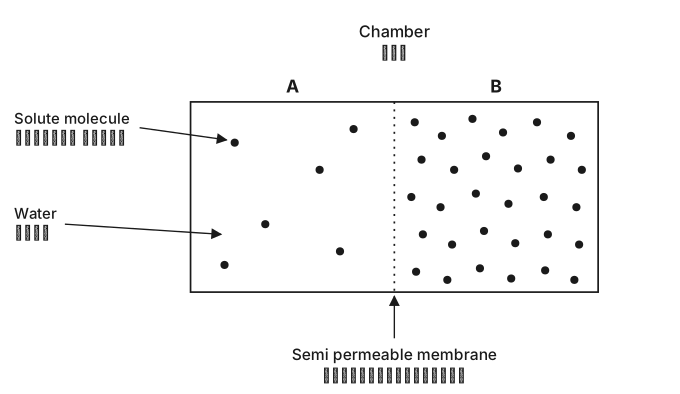
- TG EAPCET 2024Set ap-2024-05-07-AN1 markMCQQ.Based on the figure given below which of the following statements are not correct [FIGURE: A rectangular vessel split by a vertical semi-permeable membrane into chamber A (left) and chamber B (right). Chamber A holds water with only a few solute molecules; chamber B holds many more solute molecules. Labels on the figure: "Chamber", "A", "B", "Solute molecule", "Water", "Semi permeable membrane".] (A) Movement of solvent molecules occur from chamber A to B (B) Movement of solute molecules occur from chamber A to B (C) Semipermeable membrane is prerequisite for the process (D) Rate of osmosis depends on pressure gradient and concentration gradient of solutes
›Reveal solutionSolution
Osmosis involves the movement of solvent (water) from a region of higher water concentration to a region of lower water concentration across a semi-permeable membrane, while solute molecules are restricted. The incorrect statement is that solute molecules move from chamber A to B.
Osmosis is a specific type of diffusion involving the movement of solvent molecules, typically water, across a selectively permeable membrane. This process is driven by differences in solute concentration, which in turn create a difference in water potential. Understanding the roles of the solvent, solute, and the membrane is key to evaluating the given statements.
Here's a breakdown of the concept and an analysis of each statement:
Concept of Osmosis
- Semi-permeable Membrane: This is a crucial component. A semi-permeable membrane allows solvent molecules (like water) to pass through freely but restricts the passage of larger solute molecules.
- Concentration Gradient: Osmosis occurs when there is a difference in the concentration of solutes across the semi-permeable membrane.
- A region with a lower solute concentration has a higher water concentration (or higher water potential).
- A region with a higher solute concentration has a lower water concentration (or lower water potential).
- Movement of Solvent: Solvent molecules move from the region of higher water concentration (lower solute concentration) to the region of lower water concentration (higher solute concentration) through the semi-permeable membrane. This movement continues until equilibrium is reached or until an opposing pressure prevents further net movement.
- Movement of Solute: Due to the nature of the semi-permeable membrane, solute molecules are generally unable to pass through it. Therefore, there is no net movement of solute molecules across the membrane during osmosis.
Analysis of the Figure
The figure shows:
- Chamber A: Contains water with a few solute molecules. This represents a region of higher water concentration (lower solute concentration).
- Chamber B: Contains water with many more solute molecules. This represents a region of lower water concentration (higher solute concentration).
- Semi-permeable membrane: Separates Chamber A and Chamber B.
Evaluating the Statements
-
Statement (A): Movement of solvent molecules occur from chamber A to B
- Chamber A has a higher concentration of water (fewer solute molecules) compared to Chamber B (more solute molecules).
- According to the principle of osmosis, solvent (water) moves from a region of higher water concentration to a region of lower water concentration across a semi-permeable membrane.
- Therefore, water molecules will move from Chamber A to Chamber B.
- This statement is correct.
-
Statement (B): Movement of solute molecules occur from chamber A to B
- A semi-permeable membrane is defined by its property of allowing solvent molecules to pass but restricting solute molecules.
- Therefore, solute molecules cannot pass through the semi-permeable membrane.
- Even if the membrane were fully permeable, solute molecules would move from Chamber B (higher solute concentration) to Chamber A (lower solute concentration) by diffusion, not from A to B.
- This statement is incorrect.
Watch outRemember that osmosis specifically refers to solvent movement across a semi-permeable membrane. Solute movement is generally restricted by such a membrane.
-
Statement (C): Semipermeable membrane is prerequisite for the process
- The definition of osmosis explicitly involves the movement of solvent across a semi-permeable membrane. Without this selective barrier, the process would simply be diffusion of both solvent and solute, not osmosis.
- This statement is correct.
-
Statement (D): Rate of osmosis depends on pressure gradient and concentration gradient of solutes
- The primary driving force for osmosis is the concentration gradient of solutes, which creates a water potential gradient. A larger concentration difference leads to a faster initial rate of osmosis.
- The rate of osmosis is also influenced by the pressure gradient. For example, osmotic pressure is the pressure required to stop the net movement of water. If an external pressure is applied, it can affect the rate and even the direction of osmosis.
- This statement is correct.
Based on the analysis, statement (B) is the only one that is not correct.
✓Final answerThe statement that is not correct is (B) Movement of solute molecules occur from chamber A to B.
- TG EAPCET 2024Set ap-2024-05-07-AN1 markMCQQ.Parazoans exhibit (A) Tissue level organization (B) Organ level organization (C) Cellular level organization (D) Organ system level organization
›Reveal solutionSolution
Parazoans are the simplest multicellular animals that lack true tissues and organs — they function at the cellular level of organization, making option (C) the correct answer.
The key to this question lies in understanding what "parazoans" actually are. The name itself gives it away: para means "beside" or "alongside," and zoa means "animals." These are animals that sit just beside the true tissue-bearing animals (Eumetazoa). The only living examples are the sponges (phylum Porifera).
In sponges, cells are relatively independent. They can change their functions, move around, and even re-aggregate if the sponge is broken apart. There is no coordination through nerve cells or muscle cells, and no real tissues form. Instead, the body is a loose aggregation of cell types — choanocytes, pinacocytes, amoebocytes — each doing its job but without forming the organized layers (like ectoderm, endoderm) that define true tissues. This is why their organization is called cellular level: the cell is the highest functional unit, not the tissue.
Now let's walk through the options one by one.
-
Tissue level organization — This is the hallmark of eumetazoans like cnidarians (jellyfish, hydra). In these animals, cells are grouped into true tissues (e.g., nerve net, muscle fibers) that work together. Parazoans lack this entirely. So (A) is wrong.
-
Organ level organization — Organs are made of multiple tissues working together for a specific function. This appears in flatworms (platyhelminthes) and above. Sponges have no organs — no heart, no gut, no excretory system. So (B) is wrong.
-
Cellular level of organization — This is exactly what parazoans show. Each cell type performs its function independently. For example, choanocytes create water currents and trap food, but they don't form a coordinated digestive tissue. Amoebocytes carry nutrients, but they move freely. There is no germ layer formation, no true tissue differentiation. This is the correct description.
-
Organ system level organization — This is found in higher animals like annelids, arthropods, and chordates, where multiple organs work together in systems (digestive system, circulatory system, etc.). Parazoans are nowhere near this complexity. So (D) is wrong.
Watch outA common mistake is to think that because sponges have different cell types, they must have tissue-level organization. But "different cell types" is not the same as "tissues." Tissues require cells to be structurally and functionally integrated, with cell junctions and coordinated activity — sponges lack this integration.
TipA quick memory trick: Parazoans = Parallel to true animals, but not quite there. They are stuck at the cellular level — the simplest multicellular arrangement. If you remember that sponges can be pushed through a sieve and the cells will re-form a sponge, you'll never forget that they operate at the cellular level.
✓Final answerThe correct option is (C) Cellular level organization.
-
- TG EAPCET 2023Set ap-2023-05-10-FN1 markMCQQ.World Malaria day celebrated on (A) 25th March (B) 25th April (C) 20th August (D) 20th September
›Reveal solutionSolution
World Malaria Day is observed on 25th April each year, as declared by the World Health Organization (WHO) to raise awareness about malaria prevention and control.
The question is a straightforward factual recall from general knowledge, often appearing in competitive exams and current affairs sections. The key is to remember that several global health awareness days are clustered in April — World Health Day (7th April), World Malaria Day (25th April), and World Immunization Week (last week of April). The date was chosen by the WHO in 2007 to mark the global effort against malaria, replacing the earlier Africa Malaria Day.
-
Eliminate unrelated months.
March 25th is not associated with any major WHO health day. August and September have their own awareness days (e.g., World Mosquito Day on 20th August, but that is not Malaria Day). So options (A), (C), and (D) are incorrect.
-
Confirm the correct date.
World Malaria Day is officially 25th April. This date was established at the 60th session of the World Health Assembly in 2007. It serves as a platform to highlight the need for continued investment and political commitment to malaria prevention and control.
Watch outA common confusion is between World Malaria Day (25th April) and World Mosquito Day (20th August). Mosquito Day commemorates Sir Ronald Ross's discovery in 1897 that mosquitoes transmit malaria, but it is not the same as the WHO-declared awareness day.
✓Final answerThe correct option is (B) 25th April.
-
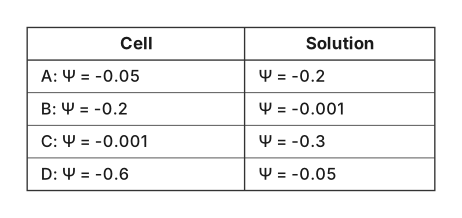
- TG EAPCET 2023Set ap-2023-05-10-AN1 markMCQQ.Four cells A, B, C and D are placed in different water potentials solutions given below. Choose the pair of cells which exhibit same type of osmic flow Cell Solution A: Ψ=−0.05 Ψ=−0.2 B: Ψ=−0.2 Ψ=−0.001 C: Ψ=−0.001 Ψ=−0.3 D: Ψ=−0.6 Ψ=−0.05 (A) A and C : Exosmosis (B) B and C : Endosmosis (C) B and D : Exosmosis (D) A and D : Endosmosis
›Reveal solutionSolution
Water flows down the water-potential gradient, from less negative Ψ to more negative Ψ. Cells A and C are each placed in a solution more negative than themselves, so both lose water: both show exosmosis. The correct option is (A).
The concept first: why the sign trips everyone up
Water potential Ψ measures the free energy of water per unit volume, relative to pure water, which is defined as Ψ=0. Adding solute lowers it, so all real solutions have negative Ψ. That single convention causes most of the errors in this topic, so fix the rule once:
Water moves from HIGHER Ψ (closer to zero) ⟶ LOWER Ψ (more negative)
In other words, water moves towards the more negative value — towards the more concentrated solution — because that is where its free energy is lower. Then:
- Water goes into the cell ⇒ endosmosis (the cell swells, may become turgid).
- Water goes out of the cell ⇒ exosmosis (the cell shrinks, may plasmolyse).
Practical shortcut: if the solution's Ψ is more negative than the cell's Ψ, the cell loses water.
Step-by-step, cell by cell
- Cell A: cell −0.05 vs solution −0.2. Ψsoln(−0.2)<Ψcell(−0.05), so water flows cell → solution. Exosmosis.
- Cell B: cell −0.2 vs solution −0.001. Ψsoln(−0.001)>Ψcell(−0.2), so water flows solution → cell. Endosmosis.
- Cell C: cell −0.001 vs solution −0.3. Ψsoln(−0.3)<Ψcell(−0.001) — a big drop — so water rushes out. Exosmosis.
- Cell D: cell −0.6 vs solution −0.05. Ψsoln(−0.05)>Ψcell(−0.6), so water flows in. Endosmosis.
- Group them:
- Exosmosis: A, C
- Endosmosis: B, D
- Test the options. "A and C : Exosmosis" ✓ matches step 5 exactly. "B and C : Endosmosis" ✗ (C is exosmosis). "B and D : Exosmosis" ✗ (both are endosmosis — right pair, wrong label). "A and D : Endosmosis" ✗ (A is exosmosis, D is endosmosis — they are opposites).
Notice how option (C) is the trap: it picks the right pair (B and D do behave alike) but labels the flow backwards.
✓Final answerCells A and C both lose water to their more negative surrounding solutions, so both exhibit exosmosis. The correct option is (A).
ANSWER: A
- TG EAPCET 2023Set ap-2023-05-10-AN1 markMCQQ.Study the following and pick up the correct statements: I. Oriented locomotor movement of an organism towards or away from light is called photokinesis. II. Influence of light on non directional movement of organism is known as phototaxis. III. The orientation to light of a non-motile organism (such as plant or plant part) is known as phototropism. IV. The response of organisms for the photoperiod is known as photoperiodism. (A) I, II (B) III, IV (C) I, III (D) II, IV
›Reveal solutionSolution
This question tests understanding of biological responses to light. Statements III and IV correctly define phototropism and photoperiodism, respectively, while statements I and II incorrectly define photokinesis and phototaxis. The correct option is (B).
The natural world is full of organisms responding to their environment, and light is one of the most fundamental stimuli. Organisms have evolved diverse ways to react to light, from moving towards it to timing their life cycles based on day length. Understanding these specific terms — taxis, kinesis, tropism, and photoperiodism — is key to distinguishing between different types of responses.
Let's break down each statement to determine its correctness:
-
Analyze Statement I: "Oriented locomotor movement of an organism towards or away from light is called photokinesis."
- Locomotor movement refers to movement from one place to another.
- Oriented movement means the movement has a specific direction relative to the stimulus (towards or away).
- This description, "oriented locomotor movement... towards or away from light," accurately defines phototaxis. Phototaxis is a directional movement of a motile organism in response to light.
- Photokinesis, on the other hand, refers to a non-directional change in the rate or frequency of movement of an organism in response to light intensity. For example, an organism might move faster in brighter light but without a specific direction.
- Since the statement describes phototaxis but labels it photokinesis, Statement I is incorrect.
-
Analyze Statement II: "Influence of light on non directional movement of organism is known as phototaxis."
- As established above, phototaxis is a directional movement.
- Non-directional movement influenced by light is characteristic of photokinesis.
- Since the statement incorrectly associates non-directional movement with phototaxis, Statement II is incorrect.
-
Analyze Statement III: "The orientation to light of a non-motile organism (such as plant or plant part) is known as phototropism."
- Non-motile organisms are those that cannot move from place to place, like plants.
- Orientation to light for a plant typically involves growth or bending.
- Phototropism is indeed the growth or turning movement of a sessile (non-motile) organism, or part of it, in response to light. For example, plant shoots grow towards light (positive phototropism), and roots often grow away from it (negative phototropism).
- This statement accurately defines phototropism. Therefore, Statement III is correct.
-
Analyze Statement IV: "The response of organisms for the photoperiod is known as photoperiodism."
- Photoperiod refers to the relative length of day and night in a 24-hour cycle.
- Photoperiodism is the physiological response of an organism to the length of day or night. This is a crucial regulatory mechanism for many biological processes, such as flowering in plants, dormancy, migration, and reproduction in animals.
- This statement accurately defines photoperiodism. Therefore, Statement IV is correct.
Based on our analysis, statements III and IV are correct.
✓Final answerThe correct statements are III and IV, so the correct option is (B).
-
- TG EAPCET 2023Set ap-2023-05-10-AN1 markMCQQ.Hensen’s disc in a myofibril is less darker than the edges of the A-band due to (A) Presence of thick filaments only (B) Presence of thin filaments only (C) Presence of both thick and thin filaments (D) Presence of Krause’s membrane
›Reveal solutionSolution
Hensen's disc (H-zone) appears lighter than the edges of the A-band because it contains only thick (myosin) filaments, while the A-band edges have overlapping thick and thin filaments that increase optical density. The answer is (A).
The key to this question lies in understanding the molecular architecture of a sarcomere and how different regions appear under a microscope based on protein density.
A sarcomere is the functional unit of a myofibril, bounded by two Z-lines. Within it, thick filaments (myosin) and thin filaments (actin) are arranged in a precise, overlapping pattern. When you examine a sarcomere under polarized light or electron microscopy, different regions show different optical densities—darker regions have more protein overlap, lighter regions have less.
The A-band represents the entire length of the thick filaments. It appears dark because thick filaments are present throughout. However, the A-band is not uniformly dark:
-
At the edges of the A-band, thin filaments from adjacent sarcomeres slide in and overlap with the thick filaments. This double layer of proteins (both thick and thin) creates maximum optical density—the darkest appearance.
-
In the center of the A-band lies the H-zone (Hensen's disc). During muscle relaxation, this is the region where thick filaments exist alone, without any overlapping thin filaments. With only one type of filament present, the protein density is lower than at the edges.
This difference in overlap explains the optical appearance: fewer proteins per unit volume means less light absorption and a lighter appearance.
-
The A-band contains thick filaments throughout its length. This gives it an overall dark appearance compared to the I-band (which has only thin filaments).
-
At the periphery of the A-band, thin filaments interdigitate with thick filaments, creating a zone of overlap where both filament types coexist. This double occupancy maximizes protein density.
-
In the H-zone (Hensen's disc), only the central portions of thick filaments are present—the thin filaments have not yet slid into this region (in the relaxed state). The absence of thin filaments reduces the total protein content per unit area.
-
Optical density correlates with protein mass. More protein means more light scattering and absorption, hence a darker appearance. The H-zone, with only thick filaments, is less dense than the overlap zones and therefore appears lighter.
Watch outDon't confuse the H-zone with the I-band. The I-band (containing only thin filaments) is even lighter than the H-zone and lies outside the A-band entirely. The H-zone is specifically the lighter central region within the dark A-band.
✓Final answerThe correct option is (A) — Hensen's disc contains only thick filaments, making it less dark than the A-band edges where both filament types overlap.
-
- TG EAPCET 2023Set ap-2023-05-11-FN1 markMCQQ.The following is extracted from Laminaria (A) Algin (B) Agar (C) Iodine (D) Carrageen
›Reveal solutionSolution
The question asks which substance is extracted from the brown alga Laminaria. The correct answer is Iodine, as Laminaria is a major commercial source of iodine, though it also yields algin. The correct option is (C).
Concept & Intuition
Laminaria is a genus of brown algae (Phaeophyceae). These seaweeds are known for producing two economically important products: algin (a polysaccharide used as a thickener) and iodine (a trace element concentrated from seawater). While agar comes from red algae (e.g., Gelidium) and carrageen comes from red algae (e.g., Chondrus), iodine is historically extracted from brown kelps like Laminaria. The key is to match the organism to its characteristic extract.
Step-by-Step Reasoning
-
Identify the organism – Laminaria is a brown alga (kelp), common in cold coastal waters. It is not a red or green alga.
-
Recall the major products of brown algae – Brown algae produce algin (alginic acid) as a cell-wall component and are also known to accumulate iodine from seawater, sometimes up to 1% of dry weight. Red algae produce agar and carrageen.
-
Evaluate each option:
- (A) Algin – Yes, Laminaria is a source of algin, but this is not the only or most distinctive extract; many brown algae yield algin.
- (B) Agar – Agar is derived from red algae (e.g., Gracilaria, Gelidium), not from Laminaria.
- (C) Iodine – Historically, Laminaria was a primary source for iodine extraction (especially in 19th-century Europe). This is a classic fact in phycology.
- (D) Carrageen – Carrageen (carrageenan) comes from red algae like Chondrus crispus (Irish moss), not from brown algae.
-
Select the most specific answer – While Laminaria yields algin, the question likely targets the well-known association between Laminaria and iodine. In many biology textbooks, Laminaria is cited as a source of iodine. Thus, the correct choice is Iodine.
Watch outA common mistake is to pick "Algin" because Laminaria does contain it. However, the question asks for the substance extracted from Laminaria in a distinctive sense; iodine is the classic answer in such multiple-choice contexts.
✓Final answerThe correct option is (C).
ANSWER: C
-
- TG EAPCET 2023Set ap-2023-05-11-FN1 markMCQQ.The mineral elements required for carbohydrate translocation, photolysis of water and for chlorophyll synthesis are respectively (A) Boron, Manganese, Zinc (B) Boron, Chlorine, Iron (C) Molybdenum, Copper, Magnesium (D) Molybdenum, Copper, Iron
›Reveal solutionSolution
Boron → translocation of carbohydrates; Chlorine (with Mn) → photolysis of water; Iron → chlorophyll formation. In that order the answer is Boron, Chlorine, Iron — option (B).
The concept first
Mineral nutrition questions are pure recall, but the recall becomes easy if you attach one signature role to each micronutrient:
Element Signature role Boron (B) Uptake and utilisation of Ca2+, translocation of carbohydrates, pollen germination, cell elongation Manganese (Mn) Activates photosynthetic enzymes; splitting of water to liberate O2 Chlorine (Cl) With Mn and Ca, essential in the water-splitting reaction of PS II; also maintains solute balance Iron (Fe) Required in largest amount of all micronutrients; component of ferredoxin/cytochromes; activates catalase; essential for chlorophyll formation Zinc (Zn) Activates carboxylases; needed for auxin (IAA) synthesis Copper (Cu) Component of redox enzymes (plastocyanin, cytochrome oxidase) Molybdenum (Mo) Component of nitrogenase and nitrate reductase — nitrogen metabolism Note the distinction that trips people up: magnesium is a constituent of the chlorophyll molecule (it sits in the centre of the porphyrin ring), whereas iron is required for chlorophyll's synthesis (it is needed to build the ring). The question asks about synthesis.
Step-by-step
Step 1 — Role 1: carbohydrate translocation. Sucrose loading and movement in the phloem require Boron. None of Molybdenum, Copper or Zinc has this role. This alone eliminates options (C) and (D), which both begin with Molybdenum.
Step 2 — Role 2: photolysis of water. The oxygen-evolving complex of PS II needs Mn2+, Cl− and Ca2+. Both Manganese and Chlorine are therefore legitimate answers to "photolysis of water" — so this step alone cannot separate (A) from (B).
Step 3 — Role 3: chlorophyll synthesis. This is the decisive one. Iron is essential for the formation of chlorophyll (iron deficiency causes interveinal chlorosis in young leaves precisely because chlorophyll cannot be made). Zinc has no such role — its signature is auxin synthesis. So option (A), which ends in Zinc, fails here.
Step 4 — Assemble. Boron (translocation) → Chlorine (photolysis) → Iron (chlorophyll synthesis) = option (B), and every element in it is consistent with its role.
✓Final answerBoron, Chlorine and Iron respectively.
ANSWER: B
- TG EAPCET 2022Set ap-2022-07-30-FN1 markMCQQ.In a pond, there were 20 frogs last year and through reproduction 8 new frogs were added, taking current population to 28. The birth rate is (offspring per frog per year) (A) 0.1 (B) 0.4 (C) 2.5 (D) 10
›Reveal solutionSolution
Birth rate is the number of offspring produced per frog per year. With 8 new frogs from 20 original frogs, the rate is 8/20=0.4 offspring per frog per year. The correct option is (B).
The concept here is per capita birth rate — a fundamental idea in population ecology. It tells us how many new individuals are produced, on average, by each existing individual in a given time period. This is not the same as the total number of births; it normalises the births by the population size so we can compare across populations of different sizes.
The trap many students fall into is dividing the new frogs by the current population (28) instead of the original population (20). But the birth rate is defined relative to the population that did the reproducing — the frogs that were there at the start of the year. The new frogs are the result of that reproduction, not the ones doing it.
Let’s work through it step by step.
-
Identify the relevant quantities.
Last year’s population (the reproducing individuals) = 20 frogs.
Number of new frogs added through reproduction = 8 frogs.
Time period = 1 year.
-
Recall the definition of per capita birth rate.
It is the number of offspring produced per individual per unit time. Mathematically:
Birth rate=Initial population size×TimeNumber of births
Here, time is 1 year, so it simplifies to:
Birth rate=208
- Perform the calculation.
208=0.4
- Interpret the result. This means each frog, on average, produced 0.4 offspring over the year. That is, 2 out of every 5 frogs contributed one new frog to the population (or equivalently, each frog contributed 0.4 of a new frog).
Watch outA common mistake is to use the current population (28) as the denominator: 8/28≈0.286. That would be the per capita birth rate if the 28 frogs had produced the 8 new frogs, but they didn’t — the 20 original frogs did. Always use the population at the start of the reproductive period.
TipIf you ever forget, think: “Birth rate is about the parents, not the children.” The denominator is the number of parents (the initial population), not the total after births.
✓Final answerThe correct option is (B) 0.4.
-
🎓Unlock everything free for 14 days
- ✓Full step-by-step solutions
- ✓Concept-first explanations
- ✓Methods, shortcuts & mistakes
- ✓PYQ mapping + timed mock tests
Full access for 14 days. No credit card required.