Q.Energy required for ATP synthesis in PSII comes from
🔒You're viewing a preview — the full solution, concept, methods & PYQ mapping are locked.
🔒 Start your 14-day free trial to unlock the full solution →Concept understanding — ATP Synthase Complex
The Problem ATP Synthase Solves
Imagine a water wheel. Water flows downhill, and the wheel captures that flow to turn a millstone. The cell faces a similar problem: it has a steep proton gradient across the inner mitochondrial membrane — many protons (H⁺) crowded in the intermembrane space, few in the matrix. That gradient is potential energy, like water behind a dam. The cell needs to use that energy to make ATP, the universal energy currency.
The machine that does this is ATP synthase, also called Complex V or the F₀F₁ complex. It is a rotary molecular motor.
The Two Parts: F₀ and F₁
The complex has two distinct functional halves.
F₀ (the "o" stands for oligomycin-sensitive, a poison that blocks it) is embedded in the inner membrane. It contains a channel through which protons flow down their gradient, from the intermembrane space into the matrix. This is the "water wheel" part — the proton flow provides the mechanical energy.
F₁ sticks out into the matrix. It is the catalytic head where ADP and inorganic phosphate (Pᵢ) are bound and squeezed together to form ATP. This is the "millstone" part — it does the chemical work.
The key insight: F₀ and F₁ are physically connected by a rotating shaft (the central stalk). Proton flow through F₀ turns the shaft, and that rotation drives conformational changes in F₁ that make ATP.
How It Works: The Binding Change Mechanism
The F₁ head has three identical catalytic sites, arranged like the lobes of a clover. At any moment, each site is in one of three states:
- Open (O) — binds ADP and Pᵢ loosely
- Loose (L) — traps the bound substrates
- Tight (T) — squeezes ADP and Pᵢ together, forming ATP
As the central shaft rotates (driven by proton flow through F₀), it forces each site to cycle through these three states. One full rotation (360°) produces three ATP molecules — one from each site.
The rotation is not continuous. Each proton passing through F₀ causes a small angular step. In most organisms, 3–4 protons are needed per ATP made, because the shaft has multiple subunits (usually 8–12 c-subunits in the rotor ring).
The Proton Path Through F₀
Protons enter F₀ from the intermembrane space, bind to specific sites on the rotor ring (the c-ring), and are carried partway around the ring before being released into the matrix. This movement turns the ring, which is attached to the central shaft. The shaft then rotates inside the stationary F₁ head.
Do not confuse the direction of proton flow with the direction of rotation. Protons flow down their gradient (high concentration → low concentration), but the rotation they drive is mechanical — it is the shaft turning, not the protons themselves moving in a circle.
The Final Picture …
The energy for ATP synthesis during the light reaction comes from a proton gradient built up across the thylakoid membrane.
- According to the chemiosmotic hypothesis, ATP synthesis is linked to the development of this proton gradient, just as it is in respiration, except here the protons accumulate inside the thylakoid lumen rather than in a mitochondrial compartment. …
ATP synthesis during the light reaction is powered by the proton gradient that builds up across the thylakoid membrane — the chemiosmotic mechanism.
The chemiosmotic hypothesis explains how the light reaction converts the energy of excited electrons into the chemical bond energy of ATP. As in cellular respiration, ATP synthesis here is linked to a proton gradient across a membrane — in this case, the thylakoid membrane — rather than being a direct product of electron flow itself.
Three processes work together to build this gradient. First, the splitting of water occurs on the inner (lumen) side of the membrane, so the protons produced accumulate inside the lumen. Second, as electrons move through the photosystems, the primary electron acceptor located toward the outer side hands its electron to a carrier that removes a proton from the stroma and releases it into the lumen. Third, NADP reductase, positioned on the stroma side, consumes protons from the stroma when it reduces NADP+ to NADPH. The combined effect is that protons in the stroma decrease while protons in the lumen accumulate, creating a steep proton gradient and a me …
Method 1 — Apply the chemiosmotic hypothesis
- Recall that ATP synthesis in the chloroplast is explained by the chemiosmotic hypothesis, just as in mitochondrial respiration.
- Recall the three processes that build the proton (H+) gradient across the thylakoid membrane: water splitting (lumen side), the H-carrier moving protons into the lumen during electron transport, and NADP reductase removing protons from the stroma.
- Recall that this gradient — protons concentrated in the lumen, depleted in the stroma — drives protons back through CF0 of ATP synthase into the stroma. …
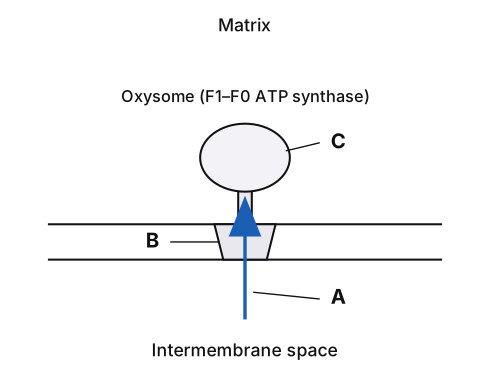
- TG EAPCET 2024Set ap-2024-05-07-AN1 markMCQQ.Observe the diagrammatic representation of ATP synthesis in oxysome of mitochondria. Identify A, B and C respectively. (A) 3H+,F0,F1 (B) 2H+,F1,F0 (C) 3e−,F1,F0 (D) 1H+,F0,F1
›Reveal solutionSolution
Oxysome (F1-F0 ATP synthase) on the inner mitochondrial membrane: F0 base embedded in the ATP synthesis in mitochondria is driven by proton flow through the ATP synthase complex; the diagram shows three protons flowing through the F0 channel (membrane-embedded) to drive rotation of F1 head (matrix-facing), where ADP + Pi → ATP occurs. The answer is (A).
The mitochondrial ATP synthase, also called Complex V or the oxysome, is a molecular turbine. During oxidative phosphorylation, the electron transport chain pumps protons from the mitochondrial matrix into the intermembrane space, creating an electrochemical gradient. This gradient stores potential energy, much like water behind a dam. ATP synthase harvests that energy by allowing protons to flow back down their concentration gradient—and couples that flow to the synthesis of ATP.
The enzyme has two main components:
- F0: the membrane-embedded channel through which protons pass. Think of it as the rotor or turbine base anchored in the inner mitochondrial membrane.
- F1: the catalytic head that projects into the mitochondrial matrix. This is where the actual chemistry happens—ADP and inorganic phosphate are joined to form ATP.
The stoichiometry matters. For each ATP molecule synthesized, approximately three protons must flow through the F0 channel. This proton flow causes the F0 rotor to spin, and that mechanical rotation is transmitted to the F1 head, forcing conformational changes in its catalytic sites that drive ATP formation.
Now let's decode the diagram labels: …
- TG EAPCET 2022Set ap-2022-07-31-FN1 markMCQQ.How several molecules of ATP are generated during photosynthesis? A) Due to conformation changes that occur in F0 particle of ATPase through diffusion of protons. B) By the movement of protons to stroma through the transmembrane channel of F1 of ATPase. C) By breakdown of proton gradient. D) By the organization of ATPase when F0 of ATPase is embedded in the flattened membrane sacs of chloroplast. (A) A, B only (B) B, C only (C) A, D only (D) C, D only
›Reveal solutionSolution
ATP synthase has F0 (channel, embedded in the thylakoid membrane) and F1 (catalytic head, facing the stroma). Protons flow through F0; the collapse of the gradient changes F1's conformation and ATP is made. Only statements C and D say this correctly — option (D).
The concept first
During the light reaction, protons pile up inside the thylakoid lumen for three reasons: water is split on the inner face (releasing H+ into the lumen), plastoquinone ferries H+ from the stroma across the membrane, and NADP reductase consumes H+ on the stroma side. The result is a steep electrochemical proton gradient across the thylakoid membrane.
That gradient is potential energy. The enzyme that cashes it in is ATP synthase (ATPase), built in two parts:
- F0 — embedded in the thylakoid membrane (the flattened membrane sacs), forming a transmembrane channel through which protons diffuse back to the stroma.
- F1 — a knob that protrudes into the stroma. It is the catalytic part: as the gradient breaks down, F1 undergoes a conformational change and synthesises ATP from ADP + Pi.
One sentence to memorise: protons cross through F0; ATP is made by F1.
Step-by-step
Step 1 — Statement A. "Conformation changes that occur in F0 particle of ATPase through diffusion of protons." The conformational change is in F1, not F0. A is INCORRECT. …
- TG EAPCET 2021Set ap-2021-08-10-AN1 markMCQQ.Choose the correct statements. A) In ATPase enzyme F0 part is embedded in the membrane and forms a trans-membrane channel B) The F1 part of ATPase is protrudes on the outer side of membrane and protein gradient is formed across the membrane C) The gradient of proton provides enough energy to cause conformational change in F1 particle D) The change in F1 particle makes the enzyme to synthesize ATP (A) A, B, C (B) A, C, D (C) A, B, D (D) B, C, D
›Reveal solutionSolution
The question tests knowledge of ATP synthase structure and function. The correct statements are A, C, and D, making option (B) the answer.
The key concept here is the chemiosmotic theory and the structure of ATP synthase (also called F₀F₁-ATPase). This enzyme is a molecular turbine that uses the energy of a proton gradient to synthesize ATP. Understanding which part is embedded in the membrane (F₀), which part sticks out (F₁), and how the proton flow causes conformational changes is essential.
Let’s evaluate each statement step by step.
-
Statement A: "In ATPase enzyme F₀ part is embedded in the membrane and forms a trans-membrane channel"
This is correct. The F₀ subunit (the "o" stands for oligomycin-sensitive) is a hydrophobic protein complex that spans the inner mitochondrial membrane (or thylakoid membrane in chloroplasts, or plasma membrane in bacteria). It forms a channel through which protons flow down their electrochemical gradient. Without this channel, protons cannot pass through the membrane to drive ATP synthesis.
-
Statement B: "The F₁ part of ATPase protrudes on the outer side of membrane and protein gradient is formed across the membrane"
This is incorrect for two reasons. First, in mitochondria, the F₁ part protrudes into the matrix (inner side of the inner membrane), not the outer side. In chloroplasts, it protrudes into the stroma. Second, the gradient is a proton gradient (electrochemical gradient of H⁺), not a "protein gradient." The phrase "protein gradient" is biologically meaningless here.
-
Statement C: "The gradient of proton provides enough energy to cause conformational change in F₁ particle" …
-
- TG EAPCET 2021Set ap-2021-08-10-FN1 markMCQQ.Choose the correct statements. A) In ATPase enzyme F0 part is embedded in the membrane and forms a trans-membrane channel B) The F1 part of ATPase protrudes on the outer side of membrane and proton gradient is formed across the membrane C) The gradient of proton provides enough energy to cause conformational change in F1 particle D) The change in F1 particle makes the enzyme to synthesize ATP (A) A, B, C (B) A, C, D (C) A, B, D (D) B, C, D
›Reveal solutionSolution
The question tests the structure and function of ATP synthase (F₀F₁-ATPase). The F₀ part is the membrane-embedded proton channel; the F₁ part protrudes into the mitochondrial matrix (not the outer side); the proton gradient drives conformational changes in F₁ that synthesize ATP. Statements A, C, and D are correct; B is wrong because F₁ faces the matrix, not the outer side. The correct option is (B).
Concept and Intuition
ATP synthase is a molecular turbine. Think of it as a waterwheel: the flow of protons (the "water") through the F₀ channel (the "wheel") turns a central shaft. That rotation forces conformational changes in the F₁ head (the "mill") that squeeze ADP and phosphate together to make ATP. The key is that the proton gradient across the membrane provides the energy, and the F₁ part is on the side where ATP is needed — inside the mitochondrial matrix, not outside.
Step-by-step reasoning
-
Statement A: "In ATPase enzyme F₀ part is embedded in the membrane and forms a trans-membrane channel"
This is correct. The F₀ subunit (the "o" stands for oligomycin-sensitive) is a ring of c-subunits embedded in the inner mitochondrial membrane. It forms a channel through which protons flow from the intermembrane space into the matrix. Without this channel, the gradient cannot be used.
-
Statement B: "The F₁ part of ATPase protrudes on the outer side of membrane and proton gradient is formed across the membrane"
This is incorrect on two counts. First, the F₁ part protrudes into the matrix (the inner side of the inner membrane), not the outer side. Second, the proton gradient is not formed by the ATPase; it is formed by the electron transport chain. The ATPase uses the pre-existing gradient. So B is false.
-
Statement C: "The gradient of proton provides enough energy to cause conformational change in F₁ particle" …
-
🎓Unlock everything free for 14 days
- ✓Full step-by-step solutions
- ✓Concept-first explanations
- ✓Methods, shortcuts & mistakes
- ✓PYQ mapping + timed mock tests
Full access for 14 days. No credit card required.