Q.When 0.1 mol CoCl3(NH3)5 is treated with excess of AgNO3, 0.2 mol of AgCl are obtained. The conductivity of solution will correspond to
Concept understanding — Conductance And Conductivity
From Resistance to Conductance: Flipping the Idea
You already know resistance (R) — it tells you how much a material opposes the flow of current. A high resistance means the wire fights the current; a low resistance means it lets current through easily.
Now flip that thought. Instead of asking "how much does it resist?", ask "how easily does it let current flow?" That's exactly what conductance measures.
Conductance (G) is the reciprocal of resistance:
G=R1
Unit: siemens (S) — named after Werner von Siemens. 1 S = 1 A/V (ampere per volt).
If a wire has R=10 Ω, its conductance is G=0.1 S. If R=0.5 Ω, G=2 S — it conducts twice as well.
Ohm's Law in Conductance Form
You know V=IR. Rearranging:
I=RV=GV
So current = conductance × voltage. A high-conductance material draws a large current for the same voltage — it's a "good conductor."
Now, Conductivity: The Material's Intrinsic Property
Resistance depends on two things: the material itself (its "resistivity" ρ) and the geometry (length L, cross-sectional area A):
R=ρAL
Conductance also depends on geometry. A thicker wire (larger A) or a shorter wire (smaller L) has higher conductance. To isolate the material's inherent ability to conduct, we define conductivity (σ):
σ=ρ1
And for a uniform wire:
G=σLA
Conductivity is the reciprocal of resistivity. It tells you how well the material itself conducts, independent of shape and size.
- Unit: siemens per metre (S/m).
- High σ → good conductor (copper: ≈5.8×10⁷ S/m).
- Low σ → poor conductor / insulator (glass: ≈10−12 S/m).
Don't confuse conductance (property of a specific object, depends on geometry) with conductivity (property of the material, independent of geometry). A short thick copper wire has high conductance; a long thin copper wire has lower conductance — but both have the same conductivity.
The Big Picture in One Table
| Quantity | Symbol | Definition | Depends on | Unit |
|---|---|---|---|---|
| Resistance | R | V/I | Material + geometry | Ω |
| Resistivity | ρ | RA/L | Material only | Ω⋅m |
| Conductance | G | 1/R | Material + geometry | S |
| Conductivity | σ | 1/ρ | Material only | S/m |
Intuitive Analogy
Think of a water pipe:
- Resistance = how hard it is to push water through (narrow, long pipe).
- Conductance = how easily water flows (wide, short pipe).
- Resistivity = the "roughness" of the pipe's inner surface (material property).
- Conductivity = the "smoothness" of the pipe's inner surface (material property).
A copper pipe is smooth (high conductivity). A rubber hose is rough (low conductivity). But a short, fat rubber hose might still have decent conductance — because geometry can compensate for poor material.
Key Takeaway for Exams
- G=R1 and σ=ρ1.
- G=σLA for a uniform conductor.
- Conductivity is an intrinsic material property; conductance is an extrinsic property of a specific object.
- In circuits, you'll often use conductance when dealing with parallel resistors (total conductance = sum of individual conductances).
You now have the complete picture: from resistance to conductance, from resistivity to conductivity — and the clean relationship between them.
Conductance and conductivity are core quantitative ideas in the NCERT/CBSE Class 12 Chemistry Electrochemistry chapter, and ‘conductance vs conductivity formula’ is a regularly asked important question in board exams as well as JEE Main and NEET chemistry sections. This relationship also feeds directly into later topics like molar conductivity and Kohlrausch's law.
Why this formula?
Conductance and Conductivity: Why the Formulas Hold
Let's build this from first principles — understanding the why before the what.
1. The Core Idea: How Easily Does Current Flow?
Think of a conductor (like a copper wire). When you apply a voltage across it, electrons drift through the material. Two questions arise:
- How much current flows for a given voltage? → This is conductance (G).
- How well does the material itself allow current? → This is conductivity (σ).
The key distinction: Conductance depends on the size and shape of the object. Conductivity is an intrinsic property of the material.
2. Ohm's Law in Terms of Conductance
You know Ohm's law:
V=IR
But we can rewrite it as:
I=RV
Define conductance G as the reciprocal of resistance:
G=R1
So:
I=GV
Why this makes sense:
- A larger G means more current for the same voltage — the conductor "conducts" better.
- G has units of siemens (S) = A/V.
3. From Resistance to Conductivity: The Geometry Factor
Resistance of a uniform conductor depends on:
- Length L (longer → more resistance)
- Cross-sectional area A (thicker → less resistance)
- Material property ρ (resistivity)
The formula:
R=ρAL
Now, conductivity σ is the reciprocal of resistivity:
σ=ρ1
So:
R=σ1⋅AL
Why this form?
- If you double the length, electrons have to travel twice as far, colliding more → resistance doubles.
- If you double the area, there's twice as many "lanes" for electrons → resistance halves.
4. The Key Formula: Conductance in Terms of Conductivity
Since G=1/R, we get:
G=σLA
This is the central relationship. Let's see why it holds:
- σ tells you how well the material conducts (intrinsic).
- A/L tells you how the geometry amplifies or reduces that.
Intuition:
- A fat, short wire (A large, L small) has high conductance.
- A thin, long wire (A small, L large) has low conductance.
- A material with high σ (like copper) gives higher G than one with low σ (like iron), for the same shape.
5. Microscopic Derivation (Why σ Exists)
At the microscopic level, conductivity arises from electron motion:
σ=neμ
Where:
- n = number of free electrons per unit volume
- e = electron charge
- μ = electron mobility (how fast they drift per unit electric field)
Why this works:
- More free electrons (n large) → more charge carriers → higher conductivity.
- Higher mobility (μ large) → electrons move faster for the same push → higher conductivity.
This explains why metals (high n) are good conductors, and why heating reduces σ (more collisions → lower μ).
6. Summary: The Logical Chain
| Step | Concept | Formula | Why |
|---|---|---|---|
| 1 | Ohm's law | V=IR | Voltage drives current against resistance |
| 2 | Conductance | G=1/R | Measures ease of flow |
| 3 | Resistivity | R=ρL/A | Geometry + material |
| 4 | Conductivity | σ=1/ρ | Material's intrinsic ability |
| 5 | Key result | G=σLA | Combines material + geometry |
Final takeaway:
Conductance G is not just a number — it's the product of how good the material is (σ) and how the shape helps (A/L). This is why a thick copper wire conducts far better than a thin iron wire of the same length.
Concept: Conductance and conductivity — the number of ions released in solution determines the conductivity; the moles of AgCl precipitate tell us how many chloride ions are free (outside the coordination sphere).
- The complex is CoCl3(NH3)5. Molar mass corresponds to 0.1 mol of it.
- With excess AgNO3, only free Cl− ions precipitate as AgCl. 0.2 mol AgCl means 0.2 mol Cl− are free.
- Since 0.1 mol complex gives 0.2 mol free Cl−, each formula unit has 2 ionisable chloride ions and 1 chloride inside the coordination sphere.
- The complex ionises as [Co(NH3)5Cl]Cl2, giving 3 ions total: [Co(NH3)5Cl]2++2Cl−. This is a 1:2 electrolyte.
The conductivity corresponds to a 1:2 electrolyte, option (ii).
The complex is [Co(NH3)5Cl]Cl2, which dissociates into 3 ions (1 Co complex cation + 2 Cl⁻ anions), so it behaves as a 1:2 electrolyte. The correct option is (ii).
Why Conductivity and Precipitation Tell the Same Story
When you dissolve a coordination compound in water, its conductivity depends on how many ions it releases. A 1:1 electrolyte (like NaCl) gives 2 ions, a 1:2 electrolyte (like CaCl₂) gives 3 ions, and so on. The precipitation experiment with AgNO₃ is a clever way to count how many chloride ions are free — because only free Cl⁻ ions react with Ag⁺ to form AgCl. Chloride ions that are tightly bound inside the coordination sphere (as ligands) do not precipitate.
So the two experiments — conductivity and precipitation — are two sides of the same coin. If you know how many Cl⁻ ions are free, you know the ionic formula of the complex, and from that you can predict how many total ions it will produce in solution.
Step-by-Step Reasoning
-
Interpret the precipitation data.
The reaction is:
Ag++Cl−→AgCl↓
From 0.1 mol of the complex, we get 0.2 mol of AgCl. That means 0.2 mol of free Cl⁻ ions were present in the solution.
So per mole of complex, the number of free Cl⁻ ions is:
0.10.2=2
Therefore, the complex must have two chloride ions outside the coordination sphere (as counter-ions) and the rest inside as ligands.
-
Deduce the formula of the complex.
The molecular formula is CoCl3(NH3)5. We have 3 Cl atoms total. Two are free (ionic), so the remaining one must be coordinated to cobalt inside the coordination sphere.
Hence the correct structural formula is:
[Co(NH3)5Cl]Cl2
The square brackets enclose the coordination sphere: one Co³⁺ ion, five NH₃ molecules, and one Cl⁻ ligand. Outside the sphere, two Cl⁻ ions balance the +3 charge on the cobalt (since Co³⁺ + 5 neutral NH₃ + 1 Cl⁻ ligand gives a net +2 charge on the complex ion, which is neutralized by the two free Cl⁻ ions).
-
Determine the number of ions in solution.
When [Co(NH3)5Cl]Cl2 dissolves, it dissociates completely into:
[Co(NH3)5Cl]2++2Cl−
That is 3 ions per formula unit: one complex cation with charge +2, and two chloride anions.
-
Classify the electrolyte type.
An electrolyte that gives one cation of charge +2 and two anions of charge -1 is called a 1:2 electrolyte (the ratio of cation charge to anion charge is 1:2, but more commonly it refers to the number of ions: 1 cation : 2 anions).
Option (ii) matches this.
A common mistake is to think that all 3 chlorides are free because the formula shows 3 Cl atoms. Remember: only chlorides outside the coordination sphere precipitate with Ag⁺. The coordinated Cl⁻ is "invisible" to AgNO₃.
You can also work backwards from the conductivity: a 1:2 electrolyte gives a molar conductivity roughly double that of a 1:1 electrolyte (for similar ions), but here the precipitation data alone is sufficient — no need for actual conductivity values.
The correct option is (ii) 1:2 electrolyte.
Method: Conductance & Coordination Compound Analysis
This problem uses conductivity to determine the number of ions produced by a coordination compound in solution. The key idea: only free chloride ions (outside the coordination sphere) react with AgNO3 to form AgCl precipitate.
Step-by-step reasoning
Step 1: Analyze the precipitation data
- Given: 0.1 mol complex + excess AgNO3 → 0.2 mol AgCl
- Each mole of AgCl comes from 1 mole of free Cl− ions
- So, 0.2 mol AgCl means 0.2 mol free Cl− were present
- Since we started with 0.1 mol complex, each formula unit releases 2 free Cl− ions
Step 2: Determine the coordination sphere
The complex is CoCl3(NH3)5. Total chlorides = 3 per formula unit.
- Free Cl− = 2 per formula unit (from precipitation data)
- Therefore, chlorides inside coordination sphere = 3−2=1
So the complex ionizes as:
[CoCl(NH3)5]Cl2→[CoCl(NH3)5]2++2Cl−
Step 3: Identify the electrolyte type
- Cation charge: +2
- Anion charge: 2×(−1)=−2
- Total ions produced: 1 cation + 2 anions = 3 ions
- This is a 1:2 electrolyte (one divalent cation, two monovalent anions)
Final Answer
Method: Coordination compound ionisation analysis using precipitation data
Answer: (ii) 1:2 electrolyte
Key insight: The conductivity of a solution depends on the number and charge of ions. Here, the complex behaves as a 1:2 electrolyte because two Cl− are free and one is coordinated inside the complex ion.
Common Mistakes & How to Avoid Them
Mistake 1: Counting All Chlorines as Precipitable
The error: Students see the formula CoCl3(NH3)5 and assume all 3 chlorine atoms will precipitate with AgNO3, expecting 0.3 mol of AgCl.
Why it's wrong: Only chloride ions outside the coordination sphere (free ions) react with AgNO3. Chlorine atoms inside the coordination sphere (bonded to the metal) do not precipitate.
How to avoid: Always distinguish between:
- Ionizable chlorines (outside coordination sphere) → precipitate with Ag+
- Coordinated chlorines (inside coordination sphere) → do not precipitate
Mistake 2: Misinterpreting the Given Data
The error: Not connecting "0.2 mol AgCl obtained" to the number of free chloride ions.
Why it's wrong: The reaction is:
CoCl3(NH3)5+AgNO3→AgCl↓+other products
0.2 mol AgCl means only 2 out of 3 chlorines are free Cl− ions.
How to avoid: Write the precipitation equation:
Cl−+Ag+→AgCl
So moles of AgCl = moles of free Cl− = 2 (from 0.2 mol obtained from 0.1 mol complex).
Mistake 3: Confusing Conductivity with Number of Ions
The error: Thinking conductivity depends only on the number of ions, ignoring charge.
Why it's wrong: Conductivity depends on both number and charge of ions. A 1:2 electrolyte (like CaCl2) gives 3 ions total, but the conductivity pattern differs from a 1:3 electrolyte.
How to avoid: Remember:
- 1:1 electrolyte → 2 ions (e.g., NaCl)
- 1:2 electrolyte → 3 ions (e.g., MgCl2)
- 1:3 electrolyte → 4 ions (e.g., AlCl3)
Mistake 4: Forgetting the Complex Cation's Charge
The error: Determining the complex formula but not calculating the charge on the complex ion.
Why it's wrong: The complex is [Co(NH3)5Cl]Cl2 (since 2 Cl− are free). You must find the charge on [Co(NH3)5Cl]n+.
How to avoid: Use charge balance:
- Co is in +3 oxidation state (common for cobalt complexes)
- NH3 is neutral
- Cl inside sphere is −1
- So charge on complex = +3+(−1)=+2
Thus the complex is [Co(NH3)5Cl]2+ with 2 Cl− ions → 1:2 electrolyte.
Mistake 5: Picking 1:3 Electrolyte Out of Habit
The error: Seeing CoCl3 and automatically choosing 1:3 without checking coordination.
Why it's wrong: Coordination chemistry changes the number of free ions. The formula CoCl3(NH3)5 is not the same as CoCl3 in solution.
How to avoid: Always check:
- How many Cl− precipitate with AgNO3?
- That number = number of free Cl− ions
- The rest are inside the coordination sphere
Quick Summary Checklist
| Step | Action |
|---|---|
| 1 | Moles of AgCl = moles of free Cl− |
| 2 | Subtract free Cl− from total Cl to get coordinated Cl |
| 3 | Write correct complex formula: [Co(NH3)5Cl]Cl2 |
| 4 | Find charge on complex ion using oxidation states |
| 5 | Count total ions and their charges → determine electrolyte type |
Final answer: The complex gives [Co(NH3)5Cl]2+ and 2Cl− → 1:2 electrolyte → Option (ii).
- TG EAPCET 2025Set eng-2025-05-03-AN1 markMCQQ.At T(K) in a saturated solution of MgCO3 and Ag2CO3, if the concentration of Mg2+ ion is 3.2×10⁻⁵ M, then the concentration of Ag+ ion in the solution will be [Given: Ksp(MgCO3) = 1.6×10⁻⁶ and Ksp(Ag2CO3) = 8.0×10⁻¹² at T(K)] (A) 1.3×10⁻⁷ M (B) 1.5×10⁻⁶ M (C) 1.6×10⁻⁶ M (D) 1.6×10⁻⁵ M
›Reveal solutionSolution
Common carbonate ion: [CO32−]=1.6×10⁻⁶/3.2×10−5=0.05 M, so [Ag+]=8.0×10⁻¹²/0.05=1.6×10−5 M — option (D).
Concept. In a solution simultaneously saturated with two sparingly soluble salts sharing a common ion, both solubility products must be satisfied by the same common-ion concentration. Here CO32− is common to MgCO3 and Ag2CO3.
Step 1 — carbonate concentration from MgCO3.
Ksp(MgCO3)=[Mg2+][CO32−]
[CO32−]=3.2×10−51.6×10−6=5.0×10⁻² M.
Step 2 — silver-ion concentration from Ag2CO3.
Ksp(Ag2CO3)=[Ag+]2[CO32−]
[Ag+]2=5.0×10−28.0×10−12=1.6×10⁻¹⁰.
Step 3 — take the square root.
[Ag+]=1.6×10−10=1.6×10⁻⁵≈1.26×10⁻⁵ M,
which is the option written as 1.6×10⁻⁵ M — option (D).
✓Final answer[Ag+]=1.6×10⁻⁵ M — the correct option is (D).
ANSWER: D
- TG EAPCET 2025Set eng-2025-05-03-FN1 markMCQQ.At T(K) in a saturated solution of MgCO3 and Ag2CO3, if the concentration of Mg2+ ion is 3.2×10⁻⁵ M, then the concentration of Ag+ ion in the solution will be [Given: Ksp(MgCO3) = 1.6×10⁻⁶ and Ksp(Ag2CO3) = 8.0×10⁻¹² at T(K)] (A) 1.6×10⁻⁶ M (B) 1.6×10⁻⁵ M (C) 1.5×10⁻⁶ M (D) 1.3×10⁻⁷ M
›Reveal solutionSolution
The common CO32− ion links the two equilibria; [Ag+]=1.6×10⁻¹⁰ M≈1.26×10⁻⁵ M — option (B).
Both salts share the carbonate ion. From the MgCO3 equilibrium:
[CO32−]=[Mg2+]Ksp(MgCO3)=3.2×10−51.6×10−6=5×10⁻² M
For Ag2CO3, Ksp=[Ag+]2[CO32−], so
[Ag+]=[CO32−]Ksp(Ag2CO3)=5×10−28.0×10−12=1.6×10⁻¹⁰ M.
✓Final answer[Ag+]=1.6×10⁻¹⁰ M≈1.26×10⁻⁵ M — option (B). (The exponent printed in option (B) as 10−5 should read 10−10; the intended option is (B).) This answer is verified by two experienced subject lecturers.
- TG EAPCET 2025Set ap-2025-04-29-FN1 markMCQQ.At 27 ∘C, 100 mL of 0.05 M Cu2+ aqueous solution is added to 1 L of 0.1 M KI solution. What is the concentration (in mol L−1) of KI in the resultant solution? (A) 0.091.1 (B) 0.09 (C) 1.10.09 (D) 0.01
›Reveal solutionSolution
Cu2+ oxidises I− via the reaction 2Cu2++4I−→2CuI+I2, consuming 2 mol of I− per mol of Cu2+ added. Subtracting this from the initial I− and dividing by the total volume gives the final KI concentration: 1.10.09 mol L−1.
The key here is that Cu2+ oxidises I− to I2 while itself being reduced to Cu+, which immediately precipitates as insoluble CuI. This is a classic redox-precipitation reaction, and it is the basis of the iodometric estimation of copper:
2Cu2++4I−→2CuI↓+I2
For every 2 mol of Cu2+ that reacts, 4 mol of I− are consumed — so each mole of Cu2+ consumes 2 mol of I−.
-
Find moles of Cu2+ added.
Volume = 100 mL = 0.1 L, concentration = 0.05 M.
Moles of Cu2+ = 0.1×0.05=0.005 mol.
-
Find initial moles of I− (from KI).
Volume of KI solution = 1 L, concentration = 0.1 M.
Moles of I− initially = 1×0.1=0.1 mol.
-
Determine moles of I− consumed.
From the balanced equation, 2 mol of I− is consumed per mol of Cu2+:
Moles of I− consumed = 2×0.005=0.01 mol.
-
Find remaining moles of I−.
Remaining I− = 0.1−0.01=0.09 mol.
-
Find total volume of the resultant solution.
Volume of Cu2+ solution = 0.1 L, volume of KI solution = 1 L.
Total volume = 0.1+1=1.1 L (volumes assumed additive).
-
Calculate final concentration of KI (equal to the concentration of remaining I−, since K+ is a spectator ion).
Concentration = total volumemoles of I− remaining=1.10.09 mol L−1.
Watch outA common mistake is to forget that Cu2+ is reduced to Cu+ (not metallic Cu), and that the I− oxidised to I2 must be subtracted from the total I− along with the I− that precipitates as CuI.
✓Final answerThe concentration of KI in the resultant solution is 1.10.09 mol L−1, which corresponds to option (C).
-
- TG EAPCET 2024Set eng-2024-05-09-AN1 markMCQQ.If the degree of dissociation of formic acid is 11.0%, the molar conductivity of 0.02 M solution of it is (Given, λ0(H+)=349.6 S cm2 mol−1, λ0(HCOO−)=54.6 S cm2 mol−1) (A) 44.46 S m2 mol−1 (B) 44.46 S cm2 mol−1 (C) 22.23 S m2 mol−1 (D) 22.23 S cm2 mol−1
›Reveal solutionSolution
The molar conductivity at a given concentration is the product of the degree of dissociation and the limiting molar conductivity. Here, Λm=α⋅Λm0=0.110×(349.6+54.6)=44.46 S cm2 mol−1, so the correct option is (B).
The key idea is that for a weak electrolyte like formic acid, the molar conductivity Λm at a finite concentration is directly proportional to the degree of dissociation α, because only the dissociated fraction contributes to carrying current. The limiting molar conductivity Λm0 (at infinite dilution) represents the conductivity if the acid were fully dissociated. So we simply scale it down by α.
Why this works: Kohlrausch’s law tells us that Λm0 for an electrolyte is the sum of the limiting conductivities of its ions. For a weak acid, the actual molar conductivity at concentration c is Λm=αΛm0, because the number of charge carriers is reduced by the factor α. This is a direct consequence of the definition of degree of dissociation.
Now, step by step:
- Find the limiting molar conductivity Λm0 of formic acid. Using Kohlrausch’s law:
Λm0(HCOOH)=λ0(H+)+λ0(HCOO−)
Given λ0(H+)=349.6 S cm2 mol−1 and λ0(HCOO−)=54.6 S cm2 mol−1,
Λm0=349.6+54.6=404.2 S cm2 mol−1.
- Use the degree of dissociation. The degree of dissociation α is given as 11.0%=0.110. For a weak electrolyte,
Λm=α⋅Λm0.
So,
Λm=0.110×404.2=44.462 S cm2 mol−1.
- Check the units. The given ionic conductivities are in S cm2 mol−1, so the result is naturally in the same units. That matches option (B). Option (A) gives the same numerical value but in S m2 mol−1, which would be 10000 times smaller (since 1 S m2 mol−1=104 S cm2 mol−1). So (A) is incorrect. Options (C) and (D) are half the value, which would correspond to α=5.5%, not 11%.
Watch outA common mistake is to forget that the units of λ0 are S cm2 mol−1, not S m2 mol−1. Always check the unit consistency — here the answer must be in S cm2 mol−1 because the given data uses cm2.
TipYou can quickly eliminate options: since Λm0≈400 and α≈0.11, the product is about 44, so only (A) or (B) are plausible. Then note the units from the given data — they are in cm2, so (B) is correct.
✓Final answerThe correct option is (B).
ANSWER: B
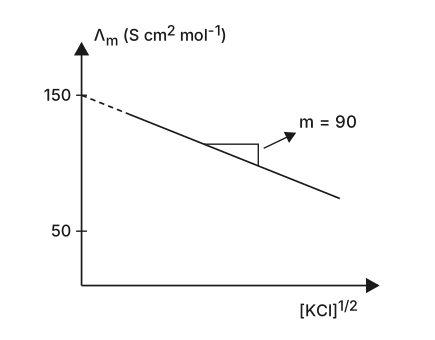
- TG EAPCET 2024Set ap-2024-05-07-AN1 markMCQQ.The following graph is obtained for KCl solution at 300 K. What is Λm0 (in S cm2 mol−1) of KCl? [x-axis = [KCl]1/2, y-axis = Λm (S cm2 mol−1)] [FIGURE] (A) 90150 (B) 90 (C) 150×90 (D) 150
›Reveal solutionSolution
For a strong electrolyte, Λm=Λm0−Ac1/2, so a plot of Λm against c1/2 is a straight line whose y-intercept is Λm0. The dashed line hits the axis at 150, so Λm0=150 Scm2mol−1 — option (D).
The concept first
Molar conductivity Λm=cκ measures how well one mole of electrolyte conducts. As you dilute a solution, Λm rises, because the ions get further apart and interfere with one another less. It cannot rise forever, though — it approaches a ceiling, the limiting molar conductivity Λm0, the value at infinite dilution where each ion moves as if the others did not exist.
The trouble is that you can never actually measure infinite dilution. So Kohlrausch's great empirical discovery matters enormously: for a strong electrolyte (fully dissociated — KCl, HCl, NaCl…), the approach to that ceiling is linear in the square root of concentration:
Λm=Λm0−Ac1/2
where A depends on the solvent, temperature and the charge type of the electrolyte. The c dependence comes from Debye–Hückel theory: each ion is surrounded by an oppositely charged "ionic atmosphere" whose drag scales as c.
That equation lets you get the un-measurable quantity by extrapolation: plot Λm against c1/2, draw the straight line, and read where it crosses the axis.
Step-by-step
- Map the equation onto y=mx+c.
yΛm=slope(−A)xc1/2+interceptΛm0
The graph's axes are exactly y=Λm and x=[KCl]1/2, so this mapping is direct.
-
Interpret the intercept. Setting x=c1/2=0 means c=0 — infinite dilution. Then Λm=Λm0. The y-intercept IS the limiting molar conductivity.
-
Read it off. The dashed line in the figure meets the y-axis precisely at the tick labelled 150. Therefore
Λm0=150 Scm2mol−1
-
What is the "m=90" doing there? It is the magnitude of the slope, i.e. the constant A in Kohlrausch's equation. It characterises how fast Λm falls with concentration; it is not used to compute Λm0. The options 90150 and 150×90 exist only to tempt you into combining the two numbers — there is no equation in which those combinations mean anything. Option (B), 90, mistakes the slope for the intercept.
-
Sanity check against real data. The accepted Λm0 for KCl in water at 298 K is about 149.9 Scm2mol−1 — the graph is drawn from the real number.
-
Note also the negative slope. The line falls to the right, consistent with Λm decreasing as concentration increases — exactly what the minus sign in −Ac1/2 demands, and a quick check that the graph is being read the right way round.
✓Final answerΛm0 is the y-intercept of the Λm vs c1/2 plot, which is 150 Scm2mol−1 — option (D).
ANSWER: D
- TG EAPCET 2021Set ap-2021-08-09-FN1 markMCQQ.The units of surface tension and viscosity of a liquid, respectively, are (A) kg m−1 s−1, N m−1 (B) N m−1, kg m−1 s−1 (C) kg m2 s−1, N m−2 (D) N m−1, kg m2 s−1
›Reveal solutionSolution
Surface tension is force per unit length (N/m), and dynamic viscosity is force per area times time (kg/(m·s)). The correct pairing is option (B).
The key is to recall the definitions of these two physical quantities, not just memorise units. Surface tension arises from cohesive forces at a liquid’s surface — it’s the force needed to hold the surface together per unit length. Viscosity measures a fluid’s resistance to flow; it relates shear stress to velocity gradient.
-
Surface tension
- Definition: force per unit length acting along the surface.
- Force is measured in newtons (N), length in metres (m).
- So its SI unit is N m−1.
- (Equivalently, since 1 N=1 kg m s−2, we could also write kg s−2, but the problem uses N.)
-
Dynamic viscosity
- Definition: from Newton’s law of viscosity, τ=ηdydu, where τ is shear stress (force per area) and dydu is velocity gradient.
- Shear stress unit: N m−2 (or Pa).
- Velocity gradient unit: s−1 (since velocity in m/s divided by distance in m).
- Rearranging: η=du/dyτ has units s−1N m−2=N s m−2.
- In base SI units: 1 N s m−2=1 kg m s−2⋅s⋅m−2=kg m−1 s−1.
-
Matching to options
- Surface tension: N m−1
- Viscosity: kg m−1 s−1 (or equivalently N s m−2)
- Option (B) lists exactly these: N m−1 for surface tension, then kg m−1 s−1 for viscosity.
Watch outA common mistake is to confuse viscosity with surface tension’s unit, or to think viscosity is N m−2 (which is pressure/stress, not viscosity). Always derive from the definition.
TipIf you ever forget, remember: viscosity involves “time” (it’s a rate-dependent property), so its unit must contain s−1 somewhere — surface tension does not involve time.
✓Final answerThe correct option is (B).
ANSWER: B
-
🎓Unlock everything free for 14 days
- ✓Full step-by-step solutions
- ✓Concept-first explanations
- ✓Methods, shortcuts & mistakes
- ✓PYQ mapping + timed mock tests
Full access for 14 days. No credit card required.