Q.Derive an expression for the intensity of the electric field at a point on the equatorial plane of an electric dipole.
You're viewing a preview — the full solution, concept, methods & PYQ mapping are locked.
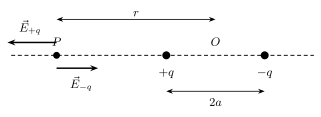
Start your 14-day free trial to unlock the full solution →The equatorial field of a dipole is found by adding the fields of the two charges vectorially; the components perpendicular to the axis cancel and the components along the axis (opposite to ) add, giving for large distances.
Setup: Consider an electric dipole consisting of charges at point A and at point B, separated by distance , with dipole moment directed from to . Let P be a point on the equatorial line (perpendicular bisector of AB), at distance from the centre O of the dipole.
Distance from each charge to P:
Field due to each charge at P (magnitude):
points away from (along BP extended) and points towards (along PA). By symmetry, the components of these two fields perpendicular to the dipole axis are equal and opposite, and cancel. The components parallel to the dipole axis (both pointing in the direction opposite to , i.e. from side towards side) add up.
Each field's component along the axis is where .
Total equatorial field: …
Unlock everything free for 14 days
- Full step-by-step solutions
- Concept-first explanations
- Methods, shortcuts & mistakes
- PYQ mapping + timed mock tests
Full access for 14 days. No credit card required.