Physics · Ch 5 — Electrostatic Potential and Capacitance
Electrostatics of Conductors
Electrostatics of Conductors
Why Conductors Behave Differently in Electrostatics
Conductors (like metals) have free electrons that can move throughout the material. In a static situation (no current), these charges rearrange themselves until they reach equilibrium. This rearrangement leads to six key properties that define the electrostatics of conductors.
1. Inside a Conductor, the Electric Field is Zero
- In equilibrium, free charges experience a force if an electric field exists.
- They drift until they cancel any internal field.
- Result: everywhere inside the conductor.
This is the defining property of a conductor in electrostatics.
2. Electric Field at the Surface is Normal (Perpendicular)
- If the field had a component along the surface, surface charges would move.
- In equilibrium, no such motion occurs.
- Result: The field just outside the surface is perpendicular to the surface at every point.
3. No Excess Charge Inside the Conductor
- Consider any tiny volume inside the conductor. Enclose it with a Gaussian surface.
- Since inside, the electric flux through that surface is zero.
- By Gauss’s law, the net charge enclosed must be zero.
- Result: Any excess charge resides only on the surface.
4. Electrostatic Potential is Constant Throughout
- Since inside, no work is done moving a test charge inside.
- On the surface, has no tangential component, so no work is done moving along the surface either.
- Result: The potential is the same at every point inside and on the surface of a conductor.
For a charged conductor, the potential just outside the surface differs from the potential on the surface (because the normal field exists).
5. Electric Field Just Outside a Charged Conductor
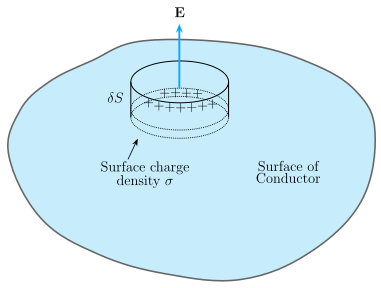
Use a pill-box Gaussian surface (a short cylinder) with one face just inside and one just outside the surface.
- Inside:
- Outside: is normal, magnitude
- Flux only through the outer face:
- Charge enclosed: (where is surface charge density)
By Gauss’s law:
Thus:
In vector form:
- is the outward unit normal to the surface.
- For , field points outward; for , field points inward.
6. Electrostatic Shielding
-
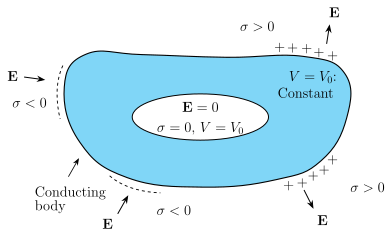
Consider a conductor with a cavity (empty space inside) and no charges placed in the cavity.
-
Result: The electric field inside the cavity is zero, regardless of:
- The shape/size of the cavity
- The charge on the conductor
- Any external electric fields
-
All charges reside only on the outer surface of the conductor.
-
This is called electrostatic shielding — used to protect sensitive instruments from external electric influences.
Real-Life Applications (from Example 2.7) …
Drawn by us to help you understand the concept clearly, and verified to make sure it's accurate. For exams, practice from your textbook's own diagram.
What the Figure Shows
The figure is a schematic diagram used to derive the electric field just outside a charged conductor. It shows a large, pale-blue irregular blob in perspective, representing the conductor. Its top surface is labelled "Surface of Conductor". Straddling this surface is a short flat cylinder (the "pill box"), which is the Gaussian surface. The cylinder is positioned so that half of it lies above the conductor (outside) and half below (inside). The exposed top disc of the cylinder is marked with a row of tiny '+' signs, indicating positive surface charge. A straight arrow labelled E rises vertically out of this top disc, showing the direction of the electric field. A leader labelled ΔS points to the cylinder’s cross-section, and another leader labelled "Surface charge density σ" points to the charged patch where the cylinder meets the conductor’s surface.
Physical Idea Taught
The figure illustrates Gauss’s law applied to the surface of a charged conductor. The key idea is that inside a conductor in electrostatic equilibrium, the electric field is zero. Therefore, the only contribution to the electric flux through the pill box comes from its top face (outside the conductor). The field just outside is normal (perpendicular) to the surface — there is no tangential component, because any such component would cause charges to move. The pill box encloses a small area of surface charge, and by equating the flux through its top face to the enclosed charge divided by , we derive the magnitude of the field.
Key Formula Derived
The textbook uses this figure to derive the electric field at the surface of a charged conductor:
where:
- is the surface charge density (charge per unit area) at the point on the conductor’s surface.
- is the permittivity of free space (a constant).
- is a unit vector normal to the surface, pointing outward (for ) or inward (for ).
The derivation proceeds as follows:
- The pill box has a small cross-sectional area and negligible height.
- Inside the conductor, , so no flux passes through the bottom face or the sides. …
Drawn by us to help you understand the concept clearly, and verified to make sure it's accurate. For exams, practice from your textbook's own diagram.
What the figure shows
The figure depicts a cross-section of an irregularly shaped conductor that contains a smooth, empty cavity inside. The solid conducting material is shaded pale blue, and the cavity is a clean oval void. On the outer surface of the conductor, clusters of + signs indicate regions where the surface charge density is positive (), while other parts of the outer surface are marked with − signs, showing . Short bold arrows labelled E point outward from the positively charged regions and inward near the negatively charged regions — these represent the electric field just outside the conductor, which is always perpendicular to the surface. Inside the cavity, the labels read: E = 0, σ = 0, V = V₀. The surrounding solid region is annotated V = V₀; Constant. A leader points to the solid region and reads Conducting body.
The physical idea
The figure illustrates two fundamental results of electrostatics for conductors with cavities:
-
The electric field inside the cavity is zero — no matter the shape of the cavity or the charge distribution on the outer surface. This is the principle of electrostatic shielding: the cavity is completely shielded from any external electric influence.
-
All excess charge resides only on the outer surface of the conductor. The inner surface of the cavity carries no charge (), and the entire conductor (including the cavity walls) is at a single constant potential .
These results follow from the fact that in electrostatic equilibrium, the electric field inside a conductor is zero. Applying Gauss’s law to a Gaussian surface that lies entirely within the conducting material and encloses the cavity shows that the net charge inside that surface must be zero — hence no charge can exist on the cavity walls. Since the field is zero everywhere inside the conductor, the potential is constant throughout, including on the cavity walls.
Key formula
The electric field just outside a charged conductor is given by:
where:
- is the surface charge density at that point (in ),
- is the permittivity of free space (), …
Drawn by us to help you understand the concept clearly, and verified to make sure it's accurate. For exams, practice from your textbook's own diagram.
What the Figure Shows
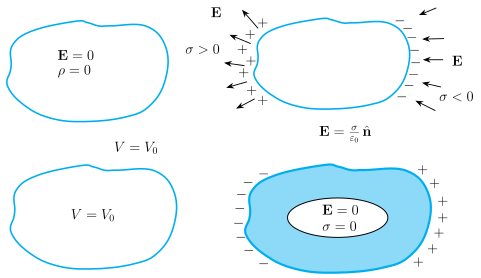
The figure is a 2×2 grid of four conductor shapes, each illustrating one key electrostatic property. No axes or curves are present — each panel is a labelled diagram of a conductor with symbols and annotations.
- Top-left panel: A solid conductor blob with the labels
E = 0,ρ = 0inside, andV = V₀on the surface. This shows that inside a conductor, the electric field is zero, the volume charge density is zero, and the entire conductor is at a constant potential. - Top-right panel: The outer surface of a conductor is marked with
+signs (σ > 0) on one half and−signs (σ < 0) on the other. Short arrows labelledEpoint perpendicularly outward from the+side and inward on the−side. The relationE = (σ/ε₀) n̂is printed nearby. This shows that the electric field just outside a charged conductor is normal to the surface and proportional to the local surface charge density. - Bottom-left panel: An empty conductor shape labelled
V = V₀. This reinforces that the entire conductor, including its surface, is an equipotential region. - Bottom-right panel: A conductor with a cavity. The inner face of the cavity has induced
−charges, the outer edge has+charges, and inside the cavity the labelsE = 0, σ = 0appear. This illustrates electrostatic shielding: the cavity interior is field-free and charge-free regardless of external fields.
Physical Ideas Taught
The figure summarises six core results from the electrostatics of conductors:
- Zero field inside: In static equilibrium, the electric field everywhere inside a conductor is zero. Free charges redistribute until this condition holds.
- Field normal at surface: Any tangential component would cause surface charges to move, so the field just outside must be perpendicular to the surface.
- No excess interior charge: By Gauss's law, if
E = 0inside, the net charge enclosed by any interior Gaussian surface is zero. All excess charge resides on the surface. - Constant potential: Since
E = 0inside, no work is done moving a test charge within the conductor, so potential is uniform throughout —V = V₀everywhere. - Surface field formula: The magnitude of the electric field just outside a charged conductor is given by
E = σ/ε₀, directed along the outward normaln̂. - Electrostatic shielding: A cavity inside a conductor has zero electric field and zero charge density, protecting its interior from external fields.
Key Formula
The central formula associated with the top-right panel is:
where:
- is the electric field just outside the conductor surface, …