Physics · Ch 5 — Electrostatic Potential and Capacitance
Potential Due to an Electric Dipole
Potential Due to an Electric Dipole
Concept: Potential of a Dipole
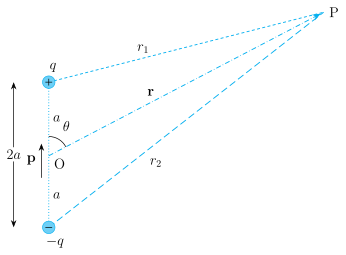
An electric dipole consists of two equal and opposite charges and separated by a small distance . Its total charge is zero, but it has a dipole moment vector with magnitude , pointing from to . Unlike a single point charge, the potential due to a dipole depends not only on the distance from its centre but also on the angle between and .
Derivation of Potential
We place the dipole at the origin, with its centre at . For a point with position vector , the potential is the sum of potentials from each charge (superposition principle):
where and are distances from to and , respectively.
From geometry (using the law of cosines):
For points far away (), we keep only first-order terms in . Using the binomial expansion:
Substituting into the expression for and using :
Since (where is the unit vector along ), the final result is:
This formula is exact for a point dipole at the origin and approximately true for .
Special Cases
- On the dipole axis ( or ): (positive for , negative for ) …
Drawn by us to help you understand the concept clearly, and verified to make sure it's accurate. For exams, practice from your textbook's own diagram.
The figure shows a vertical electric dipole placed at the origin O. The positive charge is at the top, the negative charge at the bottom, and the separation between them is . A vertical double-headed arrow on the left marks this distance, with the upper half labelled (from O to ) and the lower half also labelled (from O to ). At the centre O, a short bold arrow labelled p points upward — this is the dipole moment vector, defined as in the direction from to .
A point P is located at the upper-right, and three lines connect it to the dipole:
- A dashed line from to P, labelled (distance from the positive charge).
- A dashed line from to P, labelled (distance from the negative charge).
- A bold line from O to P, labelled r (the position vector of P from the centre).
At O, the angle between the upward axis (direction of ) and the line OP is marked . This angle is crucial because the potential depends on it.
Physical idea: The total potential at P is the sum of the potentials due to each charge (superposition principle). For a point far away (), the potential simplifies to a form that depends on both and , unlike the potential of a single charge.
Key formula derived from this figure:
where:
- is the magnitude of the dipole moment,
- is the angle between and ,
- is the unit vector along , …