Physics · Ch 5 — Electrostatic Potential and Capacitance
Potential Due to a System of Charges
Potential Due to a System of Charges
Potential Due to a System of Charges
The electric potential at a point due to a collection of point charges is simply the algebraic sum of the potentials due to each individual charge. This follows from the superposition principle, which applies to potential because it is a scalar quantity (unlike electric field, which is a vector).
Derivation for Discrete Charges
Consider point charges located at positions relative to an origin. For a point P with position vector , the potential at P due to alone is:
where is the distance between and P. Similarly, for and :
and so on for all charges. By superposition, the total potential at P is:
This is the key formula for the potential due to a system of point charges. The sum is algebraic — signs of charges matter.
Continuous Charge Distribution
If the charge is distributed continuously (with volume charge density ), we divide the distribution into small volume elements , each carrying charge . The potential due to each element is:
where is the distance from the element to the point P. Summing (integrating) over all elements gives the total potential:
Special Case: Uniformly Charged Spherical Shell
For a spherical shell of radius with total charge :
- Outside the shell (): The potential is the same as if all charge were concentrated at the centre:
- Inside the shell (): The electric field is zero, so no work is done moving a charge inside. Hence the potential is constant and equal to its value at the surface:
Example: Finding Points of Zero Potential …
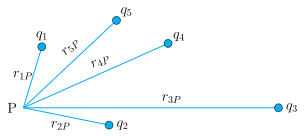
Drawn by us to help you understand the concept clearly, and verified to make sure it's accurate. For exams, practice from your textbook's own diagram.
What the figure shows
The diagram is a schematic sketch of a point P (on the left) and five point charges scattered on the right. From P, five straight line segments fan out, each ending at one of the charges. Each segment is labelled with the corresponding distance: . The charge is farthest to the right, so its segment is the longest and nearly horizontal. The charge is nearest to P, located below and to the right. Charges and cluster together in the upper-right region, while is in the upper-right direction. All five segments share the common vertex at P.
Physical idea
The figure illustrates the superposition principle for electrostatic potential. The total electric potential at a point due to a collection of point charges is simply the algebraic sum of the potentials produced by each charge individually. Unlike electric field (which is a vector and requires vector addition), potential is a scalar — so you just add the numbers, taking care of signs.
Key formula developed with this figure
The textbook uses this figure to derive the general expression for the potential at P due to point charges:
where:
- is the total electric potential at point P (in volts)
- is Coulomb's constant ( = permittivity of free space)
- are the source charges (in coulombs) …