Biology · Ch 4 — Animal Kingdom
Class – Cyclostomata
Class – Cyclostomata
Class Cyclostomata contains the most primitive of the living vertebrates — the jawless fishes. All of its present-day members live as ectoparasites on certain fishes, attaching to the host from the outside.
Body and mouth
Cyclostomes have a long, slender (elongated) body. The most striking feature is the mouth, which is circular and adapted for sucking and, crucially, lacks jaws — this jawless condition places the class in the division Agnatha. The body carries neither scales nor paired fins.
Respiration, skeleton and circulation
- Respiration is carried out through 6 to 15 pairs of gill slits along the body.
- The skeleton is entirely soft: both the cranium (skull) and the vertebral column are made of cartilage.
- The circulatory system is of the closed type, with blood confined to vessels.
Habitat and life cycle …
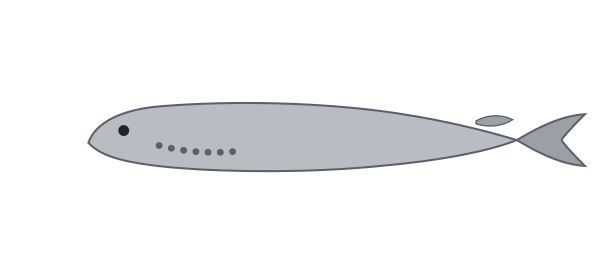
Drawn by us to help you understand the concept clearly, and verified to make sure it's accurate. For exams, practice from your textbook's own diagram.
This is Petromyzon, the lamprey, an example of a jawless vertebrate belonging to the class Cyclostomata. Its most notable feature is a circular, sucking mouth without true jaws, ringed with horny teeth. Using this mouth it clings to the body of a fish and feeds on its blood and flesh, so it lives as an ectoparasite on other fishes. The body is long, slender and eel-like, and the skeleton is made of cartilage rather than bone. Lampreys lack scales and paired fins. As one of the most primitive living verte …