Biology · Ch 4 — Animal Kingdom
Phylum – Porifera
Phylum – Porifera
The members of the phylum Porifera are the animals commonly known as sponges. They are among the most primitive of the multicellular animals, and they stand at the cellular level of organisation, in which the cells act more or less independently and are not organised into tissues. Sponges are generally marine and are mostly asymmetrical in body form.
Water transport (canal) system. The most characteristic feature of a sponge is its water-transport, or canal, system. Water is drawn in through numerous minute pores in the body wall called ostia and passes into a central cavity, the spongocoel. From the spongocoel the water is finally driven out of the body through a large opening called the osculum. This continuous flow of water through the body is not merely mechanical: it serves several vital purposes at once —
- gathering food,
- carrying out respiratory exchange of gases, and
- removing metabolic wastes.
Choanocytes. The spongocoel and the canals are lined by special flagellated cells called choanocytes, or collar cells. These cells help drive the water current and trap food particles. Digestion in sponges is intracellular, taking place within individual cells rather than in a gut cavity.
Skeleton. The soft body of a sponge is held up by a supporting skeleton. This skeleton is made either of spicules or of spongin fibres. …
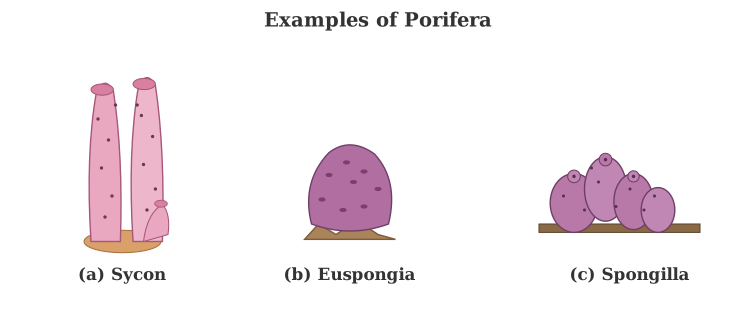
Drawn by us to help you understand the concept clearly, and verified to make sure it's accurate. For exams, practice from your textbook's own diagram.
These are sponges, the simplest multicellular animals, placed in phylum Porifera. The name means pore-bearer, and their bodies are riddled with tiny pores called ostia through which water is drawn in and a larger opening called the osculum through which it leaves. Water flowing through this canal system is driven by special collar cells, and it brings food and oxygen while carrying away wastes, so sponges feed and breathe without organs. They are supported by a skeleton of spicules or spongin fibres. Sycon and Euspongia are marine, while Spongilla lives in fresh water. …