Biology · Ch 4 — Animal Kingdom
Class – Mammalia
Class – Mammalia
Class Mammalia is the most advanced class of vertebrates and occupies an extraordinary range of habitats — polar ice caps, deserts, mountains, forests, grasslands and dark caves. Some mammals are even adapted to fly or to live in water. Mammalia belongs to the super class Tetrapoda.
The defining mammalian features
The single most distinctive mammalian character is the presence of milk-producing glands (mammary glands), through which the mother nourishes her young. Two further features are unique markers of the class:
- The skin possesses hair.
- External ears, or pinnae, are present.
Limbs, teeth, heart and respiration
- Mammals have two pairs of limbs, adapted for a wide variety of activities — walking, running, climbing, burrowing, swimming or flying.
- The jaw carries different types of teeth (that is, the teeth are specialised for different functions).
- The heart is four-chambered.
- They are homoiothermous (warm-blooded), and respiration is by lungs.
Reproduction
Sexes are separate and fertilisation is internal. Mammals are viviparous with a few exceptions, and development is direct.
Examples across the three groups
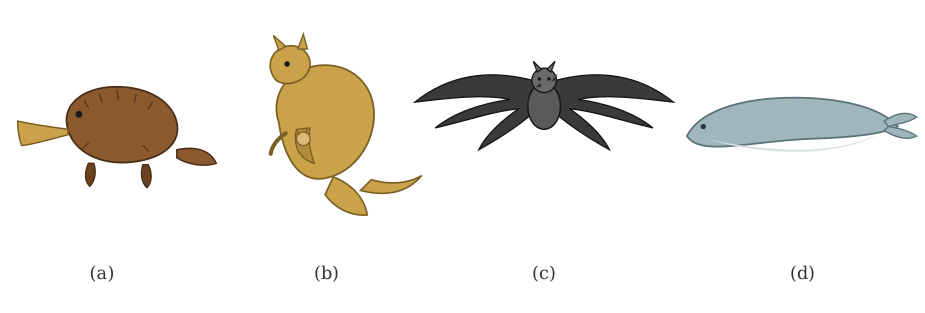
- Egg-laying (oviparous) mammal: Ornithorhynchus (platypus)
- Pouched and live-bearing (viviparous): Macropus (kangaroo) …
Drawn by us to help you understand the concept clearly, and verified to make sure it's accurate. For exams, practice from your textbook's own diagram.
These belong to class Mammalia, the most advanced group of vertebrates. Two features set mammals apart: their bodies bear hair, and the females possess mammary glands that produce milk to nourish the young. They are warm-blooded and mostly give birth to live young. This plate shows the three grades of mammals: Ornithorhynchus, the duck-billed platypus, is an egg-laying mammal; Macropus, the kangaroo, is a pouched mammal whose young complete development in a pouch; and Pteropus, the flying fox bat, and Balaenoptera, the blue whale, are placental ma …
Phylum | Level of Organisation | Symmetry | Coelom | Segmentation | Digestive System | Circulatory System | Respiratory System | Distinctive Feature
Porifera | Cellular | Various | Absent | Absent | Absent | Absent | Absent | Body with pores and canals in the walls.
Coelenterata (Cnidaria) | Tissue | Radial | Absent | Absent | Incomplete | Absent | Absent | Cnidoblasts (stinging cells) present.
Ctenophora | Tissue | Radial | Absent | Absent | Incomplete | Absent | Absent | Comb plates used for locomotion.
Platyhelminthes | Organ and organ-system | Bilateral | Absent | Absent | Incomplete | Absent | Absent | Flat body; suckers and hooks in parasitic forms.
Aschelminthes | Organ-system | Bilateral | Pseudocoelomate | Absent | Complete | Absent | Absent | Often worm-shaped and elongated.
Annelida | Organ-system | Bilateral | Coelomate | Present | Complete | Present | Absent | Body segmented into ring-like metameres.
Arthropoda | Organ-system | Bilateral | Coelomate | Present | Complete | Present | Present | Chitinous exoskeleton with jointed appendages.
Mollusca | Organ-system | Bilateral | Coelomate | Absent | Complete | Present | Present | Usually protected by an external calcareous shell.
Echinodermata | Organ-system | Radial (adult) | Coelomate | Absent | Complete | Present | Present | Water vascular system. …