Biology · Ch 4 — Animal Kingdom
Phylum – Ctenophora
Phylum – Ctenophora
Ctenophores are marine animals commonly called sea walnuts or comb jellies. They live only in the sea and have a radially symmetrical body in which the parts are arranged around a central axis.
Body organisation and layers
- They show a tissue level of organisation, with cells grouped into tissues.
- They are diploblastic, so the body is built from two germ layers.
Locomotion using comb plates
The most recognisable feature is a set of eight external rows of ciliated plates running along the body. These rows, made of fused cilia, are known as comb plates, and their beating drives the animal through the water, providing its means of movement.
Digestion and bioluminescence
Digestion takes place both outside the cells and inside them (extracellular and intracellular). A striking property of ctenophores is bioluminescence, the ability of a living organism to give off its own light, which is strongly developed in this group.
Reproduction
- The sexes are not separate, so a single individual carries both male and female reproductive parts. …
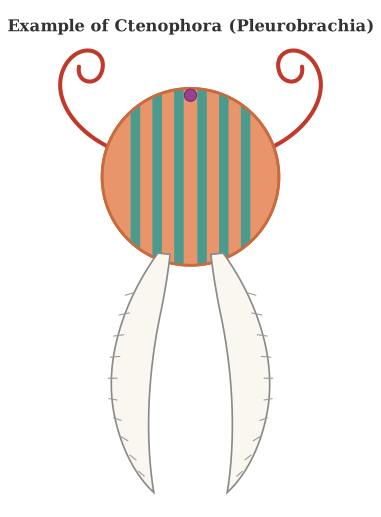
Drawn by us to help you understand the concept clearly, and verified to make sure it's accurate. For exams, practice from your textbook's own diagram.
This shows a comb jelly of phylum Ctenophora, such as Pleurobrachia or Ctenoplana. These are exclusively marine animals that are radially symmetrical and diploblastic, sharing several features with coelenterates. Their most striking feature is eight external rows of comb-like plates made of fused cilia, running along the body; the beating of these ciliary combs is used for swimming, so ctenophores are the largest animals to move by cilia. Many species are bioluminescent, meaning they can produce their own light in the dark water. Digestion is both outside and inside the cel …