Chemistry · Ch 1 — Some Basic Concepts of Chemistry
Mass and Weight
Mass and Weight
Mass and weight are often used interchangeably in daily life, but in science they describe fundamentally different properties. Mass is the amount of matter in an object, a constant that does not change with location, while weight is the force exerted by gravity on that mass, given by . This distinction is crucial because your mass remains the same on Earth and the Moon, but your weight changes with the local gravitational pull. Understanding this difference lays the foundation for accurate measurements in chemical calculations and real-world applications. …
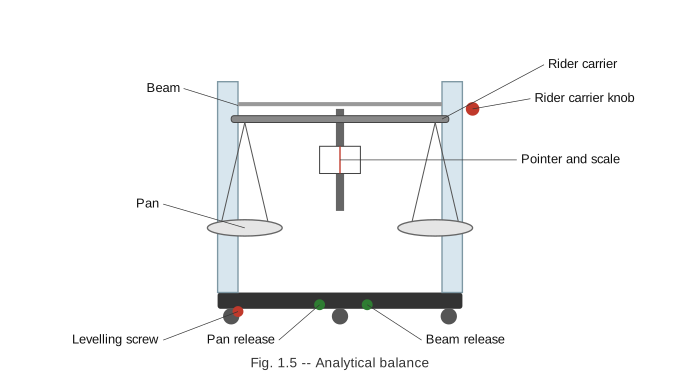
Drawn by us to help you understand the concept clearly, and verified to make sure it's accurate. For exams, practice from your textbook's own diagram.
Fig. 1.5 shows the working parts of an analytical balance, the instrument used to measure mass accurately in a chemistry laboratory. The object to be weighed and a set of reference masses sit on the two pans, suspended from a central beam; the pointer and scale show when the beam is exactly balanced. The rider carrier and its knob let you add very small, precisely known masses without opening the case, and the …