Physics · Ch 9 — Mechanical Properties of Fluids
Capillary Rise
Capillary Rise
Capillary Rise
When a narrow tube (a capillary) is dipped into a liquid, the liquid either rises or falls inside the tube relative to the surrounding liquid surface. This phenomenon is called capillarity or capillary action. The rise of a liquid in a capillary tube is one of the most direct demonstrations of surface tension at work.
The key observation is this: if the liquid wets the tube (like water in glass), it rises up the tube. If the liquid does not wet the tube (like mercury in glass), it is depressed below the surrounding level. The height of rise or depression depends on the tube's radius, the liquid's surface tension, and the contact angle between the liquid and the tube material.
The Mechanism Behind Capillary Rise
Consider a glass capillary tube dipped vertically into water. Water molecules are strongly attracted to the glass — the adhesive force between water and glass is greater than the cohesive force between water molecules. This causes the water surface at the contact line to curve upward, forming a concave meniscus.
The curved meniscus creates a pressure difference across the liquid-air interface. According to the Young-Laplace equation, the pressure just below a concave meniscus is less than the atmospheric pressure above it. This lower pressure pulls the liquid up the tube until the hydrostatic pressure of the raised column balances the pressure deficit.
The same principle explains why a liquid rises in a blotting paper or a wick — the fibres act as many narrow capillaries.
Deriving the Height of Capillary Rise
Let a capillary tube of radius be dipped vertically into a liquid of density and surface tension . The liquid makes a contact angle with the tube wall. The meniscus is approximately spherical, with radius of curvature .
From the geometry of the meniscus, the radius of curvature is related to the tube radius and the contact angle by:
The pressure difference across the curved liquid-air interface is given by the Young-Laplace equation for a spherical surface:
Substituting :
This pressure difference is the driving force. The pressure just below the meniscus is , while the pressure at the same horizontal level outside the tube is . The liquid rises to a height such that the hydrostatic pressure of the column of height exactly balances this pressure difference:
Therefore, the height of capillary rise is:
This is the central result for capillary rise.
Important Consequences and Properties
Property 1: Height is inversely proportional to tube radius.
From the formula, . A narrower tube produces a greater rise. This is why water rises higher in a thin capillary than in a wider one. For a given liquid and tube material, halving the radius doubles the rise height.
Property 2: The rise depends on the contact angle.
For a wetting liquid (), is positive, so is positive — the liquid rises. For a non-wetting liquid (), is negative, so is negative — the liquid is depressed below the surrounding level. For (perfect wetting), and the rise is maximum for that radius:
For , and there is no rise or depression — the liquid surface remains flat.
A common mistake is to forget that can be greater than . For mercury in glass, , so is negative, giving a negative — the mercury is depressed, not raised.
Property 3: The meniscus is approximately spherical.
For a narrow tube, the meniscus is very nearly a spherical surface. The radius of curvature is constant over the entire meniscus. This approximation breaks down for very wide tubes, where the meniscus becomes flatter near the centre.
Property 4: The rise height is independent of the tube's length (as long as it is long enough).
If the tube is shorter than the calculated rise height, the liquid will rise to the top and form a curved surface at the rim — the formula no longer applies. The liquid will not overflow; instead, the meniscus adjusts its curvature until the pressure balance is satisfied at the top.
The Complete Derivation (Step by Step)
›Proof
Full derivation of capillary rise height
Step 1: Geometry of the meniscus
The meniscus is a spherical cap of radius . The tube radius and the contact angle are related by the right triangle formed by the tube wall, the tangent to the meniscus at the contact line, and the radius of curvature:
Hence .
Step 2: Pressure difference across the curved surface
For a spherical liquid-air interface, the Young-Laplace equation gives:
The sign convention: for a concave meniscus (wetting liquid), the centre of curvature lies outside the liquid, so the pressure inside the liquid is less than outside. Taking as the outside pressure:
The pressure deficit is .
Step 3: Hydrostatic balance
At the same horizontal level as the free surface outside the tube, the pressure in the liquid outside is . Inside the tube, at that same level, the pressure is (since we go down a distance from the meniscus). For equilibrium:
Substituting :
Step 4: Substitute for
This completes the derivation.
Numerical Example …
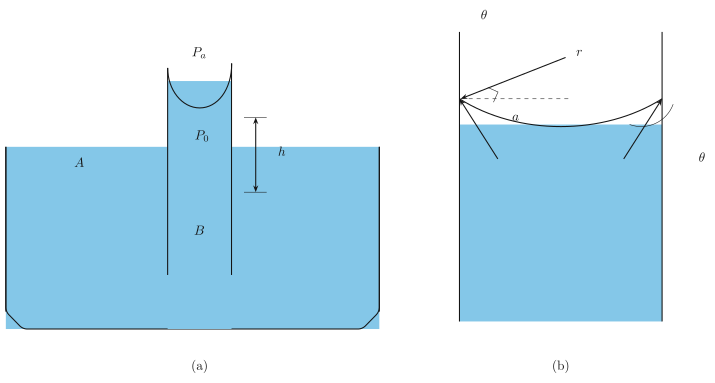
Drawn by us to help you understand the concept clearly, and verified to make sure it's accurate. For exams, practice from your textbook's own diagram.
Figure 9.19 is the textbook’s visual anchor for understanding capillary rise — the phenomenon where a liquid climbs up a narrow tube against gravity. The figure has two parts, (a) and (b), each showing a different scale of the same situation.
Part (a) is the wide view. A narrow glass tube stands vertically in a large vessel of water. The water surface outside the tube is flat and horizontal; a point on that outer surface is labelled A. Inside the tube, the water has risen to a height above the outer level. The top of the water column inside the tube is not flat — it is curved, forming a meniscus. The lowest point of that meniscus is labelled B. The pressure at the top of the tube (above the meniscus) is atmospheric pressure . Just below the concave meniscus, the pressure is , which is less than because the curved surface pulls inward. This pressure difference is what supports the column of height .
Part (b) zooms in on the meniscus region. The tube has internal radius . The meniscus is concave upward (like a bowl), with radius of curvature . At the point where the meniscus meets the tube wall, the liquid surface makes an angle with the wall — this is the contact angle. For water in clean glass, is nearly zero, so the meniscus is almost hemispherical. The figure makes clear that the radius of curvature is related to the tube radius by .
The entire physics of capillary rise hinges on the pressure difference across a curved liquid surface. For a concave meniscus, the pressure just below the surface is lower than the pressure just above it.
The textbook uses this figure to derive the key formula for the height of capillary rise. The pressure difference across the curved meniscus is given by the Young–Laplace equation:
where is the surface tension of the liquid. This pressure difference must balance the hydrostatic pressure of the column of height :
where is the density of the liquid and is the acceleration due to gravity. Equating the two expressions and using gives the capillary rise formula:
Here is the tube radius, is the contact angle, is surface tension, is liquid density, and is gravity. The formula shows that is inversely proportional to the tube radius — narrower tubes give higher rise. For water in glass, , so . …