Physics · Ch 9 — Mechanical Properties of Fluids
Drops and Bubbles
Drops and Bubbles
The Physics Behind Drops and Bubbles
Why does a small drop of water form a perfect sphere, while a larger puddle flattens out? The answer lies in surface tension. A liquid surface behaves like a stretched elastic membrane, always trying to minimise its area. For a given volume, a sphere has the smallest surface area. So, in the absence of other forces (like gravity), a liquid drop naturally pulls itself into a spherical shape.
But there is a price to pay for this minimised area. The surface tension creates a difference in pressure across the curved interface. The pressure inside a drop or bubble is always greater than the pressure outside. This excess pressure is what keeps the bubble inflated and the drop from collapsing. The smaller the drop, the larger this pressure difference becomes — a fact with profound consequences in nature and technology.
Excess Pressure Inside a Liquid Drop
Consider a spherical liquid drop of radius . The liquid surface has a surface tension . Because the surface is curved, the inward pull of surface tension compresses the liquid inside, raising its internal pressure above the external atmospheric pressure . The excess pressure is .
To find , we use the work-energy method. Imagine the drop expands slightly, increasing its radius by a tiny amount . The surface area increases, which requires work against surface tension. This work is supplied by the pressure difference pushing outward.
Step 1: Work done by the excess pressure
The force due to excess pressure on the surface is . As the radius increases by , this force pushes the surface outward through a distance . The work done is:
Step 2: Increase in surface energy
The surface area of the drop increases from to . The change in area is:
(We neglect the term because it is vanishingly small.)
The work required to create this new surface area is the surface tension times the increase in area:
Step 3: Equating the two works
The work done by the excess pressure is entirely converted into the increased surface energy (assuming no other losses). Therefore:
Cancelling from both sides gives:
This is the excess pressure inside a spherical liquid drop. Notice it is inversely proportional to the radius — smaller drops have much higher internal pressure.
This formula gives the excess pressure, not the absolute internal pressure. The absolute pressure inside the drop is .
Excess Pressure Inside a Soap Bubble
A soap bubble is different from a liquid drop because it has two liquid-air interfaces — an inner surface and an outer surface. Each interface contributes its own surface tension. For a thin bubble, both surfaces have essentially the same radius .
Step 1: Work done by excess pressure
The excess pressure acts on the bubble's cross-sectional area. As the bubble expands by , the work done is:
Step 2: Increase in surface energy
The bubble has two surfaces. The total surface area is . When the radius increases by , the change in total area is:
The work required is:
Step 3: Equating
Cancelling :
The excess pressure inside a soap bubble is twice that inside a liquid drop of the same radius. This makes sense — the bubble has two surfaces to stretch.
For a bubble in a liquid (like an air bubble in water), there is only one liquid-air interface. Such a bubble behaves like a liquid drop, and the excess pressure is .
Excess Pressure Inside a Cylindrical Drop
Not all liquid surfaces are spherical. Consider a long cylindrical liquid jet (like a thin stream of water from a tap). Its surface is curved in only one direction — around the circumference — but is flat along its length. …
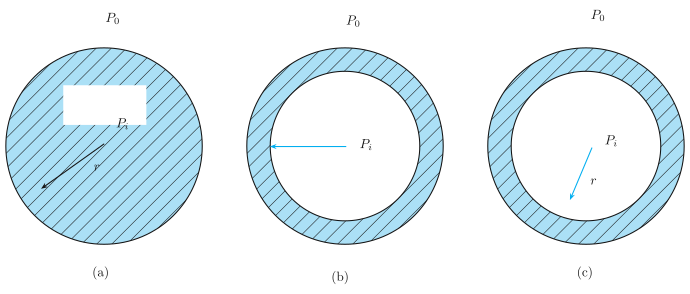
Drawn by us to help you understand the concept clearly, and verified to make sure it's accurate. For exams, practice from your textbook's own diagram.
Fig. 9.18 is a three-panel schematic that lays the foundation for understanding pressure inside curved liquid surfaces. Each panel shows a different configuration of a fluid interface, all drawn with the same radius , so you can compare them directly.
Panel (a) — a liquid drop in air. The drop is a sphere of liquid, radius , with a single interface separating the liquid inside from the surrounding air. The pressure inside the drop is labelled , and the outside atmospheric pressure is . Because the surface is curved and the liquid tries to minimise its area, the inside pressure must be greater than the outside pressure. The excess pressure is what keeps the drop spherical.
Panel (b) — a cavity (a gas bubble) inside a liquid. Here the roles are reversed: the interior is gas (or vapour) at pressure , and the surrounding liquid exerts pressure from outside. The interface is again a single spherical surface, but now the curvature is inward from the liquid’s perspective. The excess pressure is still , but note that for a cavity the inside pressure is less than the outside pressure — the liquid pushes inward, compressing the gas. The magnitude of the pressure difference is the same as for a drop of the same radius, but the sign is opposite.
Panel (c) — a soap bubble. This is drawn as a thin annular shell of liquid (the soap film) with two interfaces: one where the liquid meets the inside air, and one where it meets the outside air. The bubble has an inner radius (approximately the same as the outer radius, since the film is very thin). The pressure inside the bubble is , the pressure in the surrounding air is , and the pressure inside the liquid film itself is somewhere between the two. Because there are two surfaces, each contributing to the net inward pull, the excess pressure inside a soap bubble is twice that for a single-interface drop or cavity of the same radius.
Here is the surface tension of the liquid (or soap solution), and is the radius of the spherical surface. The first formula comes from balancing the force due to surface tension () against the force due to the pressure difference () across a single interface. For the bubble, the same balance applies to each of the two surfaces, so the total force from surface tension is , giving the factor of 4. …