Physics · Ch 9 — Mechanical Properties of Fluids
Surface Energy
Surface Energy
Surface Energy – The Energy Cost of Creating Surface
When you stretch a rubber band, you do work against the elastic forces, and that work gets stored as elastic potential energy. A liquid surface behaves in a strikingly similar way. The molecules at the surface are in a higher-energy state than those in the bulk — they have fewer neighbours to bond with, so they are less stable. To bring a molecule from the interior to the surface, you must pull it against the inward pull of the other molecules. That requires work, and that work becomes stored as surface energy.
The fundamental idea is this: every liquid surface has a certain amount of energy per unit area. This energy is the reason the surface tends to shrink spontaneously — a smaller area means less stored energy, which is a more stable (lower-energy) state. A soap bubble, for instance, has a large surface area and therefore a large surface energy; it will always try to reduce its area, which is why it forms a sphere (the shape with the smallest area for a given volume).
Surface energy is not a separate kind of energy — it is simply the potential energy stored in the intermolecular bonds at the surface. The same forces that give rise to surface tension also give rise to surface energy.
Relating Surface Energy to Surface Tension
Consider a liquid film stretched on a U-shaped wire frame with a movable slider of length , as shown in the textbook. The film has two surfaces (front and back), so the total length of the contact line along which the film pulls on the slider is . The surface tension (or ) is the force per unit length along this line, so the total force exerted by the film on the slider is:
Now suppose you pull the slider outward by a small distance , increasing the area of the film. The work you do against the surface tension force is:
But is exactly the increase in total surface area of the film (both sides). Let . Then:
This work is stored as surface energy. Therefore, the surface energy per unit area is numerically equal to the surface tension .
where is the surface tension of the liquid.
This is a key result: surface tension and surface energy per unit area are the same quantity, just expressed in different units — for tension, for energy.
Properties of Surface Energy (as listed in the textbook)
The textbook then lists several important properties of surface energy. Each one is derived from the definition above.
Property (I): The work done in increasing the surface area of a liquid film by is .
This is exactly what we derived above. It is the direct consequence of the definition of surface tension as force per unit length. The work done is stored as surface energy, so the increase in surface energy equals .
For a single surface (like a liquid drop, not a film), the total length of the contact line is just the perimeter, and the work done to increase the area by is still . The factor of 2 only appears when there are two surfaces (as in a film).
Property (II): The surface energy of a liquid film is , where is the total surface area.
If the film has area , and we assume the energy is zero when the area is zero (a convenient reference), then the total surface energy stored is simply:
This follows directly from Property (I): if you build up the area from 0 to in small increments, the total work done is .
This formula applies to a single surface. For a film with two surfaces of area each, the total surface energy is , not . Always check how many surfaces are present.
Property (III): The surface energy of a liquid drop of radius is .
A spherical drop has only one surface (the outer boundary). Its surface area is . Therefore, using Property (II) for a single surface:
This is the energy stored in the drop's surface. If the drop were to split into smaller drops, the total surface area would increase, and so would the total surface energy — that energy must come from work done on the liquid.
Property (IV): When two identical liquid drops of radius coalesce to form a single drop, the surface energy decreases.
Let's prove this step by step.
›Proof
Given: Two identical drops, each of radius , coalesce to form one larger drop of radius .
Step 1 – Volume conservation: The total volume of liquid is unchanged.
Step 2 – Initial surface energy: Each drop has surface energy , so total initial energy:
Step 3 – Final surface energy: The single large drop has radius , so its surface area is . Thus:
…
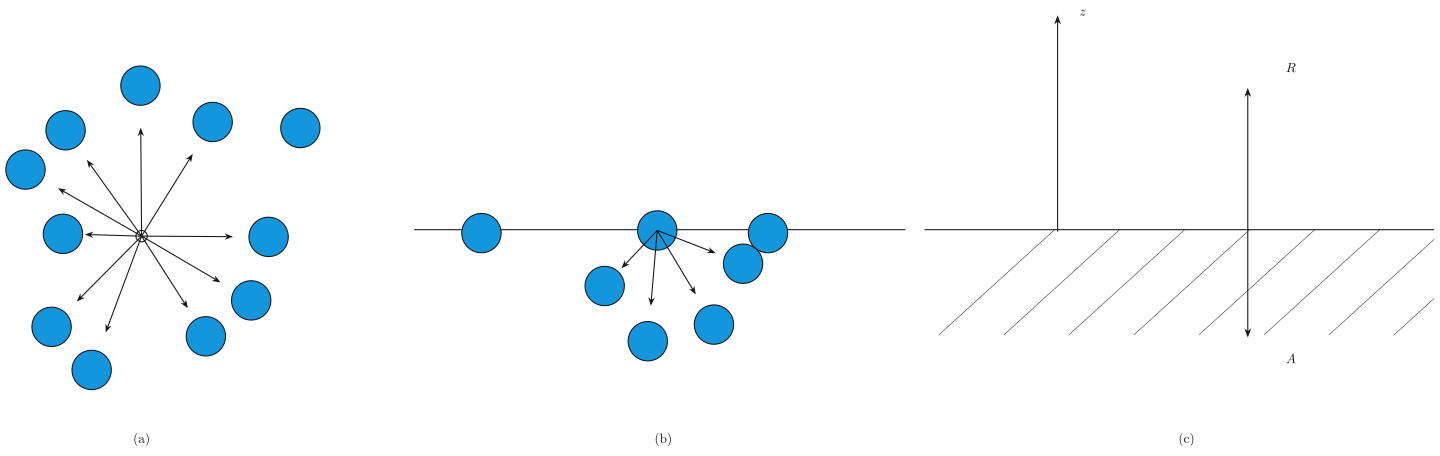
Drawn by us to help you understand the concept clearly, and verified to make sure it's accurate. For exams, practice from your textbook's own diagram.
The figure is built around a single, powerful idea: a molecule deep inside a liquid experiences no net force from its neighbours, but a molecule at the surface feels a net pull inward. That inward pull is the microscopic origin of surface tension.
Panel (a) shows a molecule buried in the bulk. It is surrounded on all sides by other molecules, and the arrows of attraction radiate in every direction. Because the arrangement is symmetric, all these attractive forces cancel out. The molecule is in equilibrium — it feels no net force. This is the normal, quiet life of a molecule in the interior.
Panel (b) shows a molecule at the liquid surface. Above it there is only air (or vapour), with far fewer molecules. The attractive arrows now come only from below and from the sides. The symmetry is broken. The result is a net force pointing straight down, into the liquid. Every surface molecule is being pulled inward. The surface is therefore in a state of tension — it behaves like a stretched elastic membrane trying to shrink.
Panel (c) zooms in on the balance of forces at the surface itself. A vertical -axis is drawn, with the liquid below and the vapour above. Two forces act on a surface molecule: a downward attractive force from the molecules below, and an upward repulsive force from the molecules immediately beneath it (the short-range repulsion that prevents the liquid from collapsing). At equilibrium, these two forces balance: . The hatched region represents the surface layer, typically a few molecular diameters thick.
The net inward pull on surface molecules means that work must be done to bring a molecule from the interior to the surface. That work increases the potential energy of the surface molecules. The surface therefore has extra energy — this is the surface energy, and it is the fundamental quantity behind surface tension.
The textbook uses this picture to define surface tension as the force per unit length acting along the surface, perpendicular to any line drawn on it. But the deeper definition, which follows directly from the figure, is that is the surface energy per unit area:
where is the work required to increase the surface area by . The SI unit is (which is the same as ). For water at , . …