Q.Ball A, of mass 3 kg, moving at 4 m/s, collides elastically, head-on, with ball B, of mass 1 kg, initially at rest. Find the velocity of each ball after the collision, and verify that both total momentum and total kinetic energy are conserved.
Concept understanding — Elastic Collision
Elastic Collision – From Intuition to Precision
Imagine two billiard balls on a table. They smash into each other, bounce apart, and keep moving. Now imagine two lumps of clay that collide and stick together — they stop moving as separate objects. The first case feels like nothing is lost; the second clearly loses motion. That feeling is the seed of the idea.
An elastic collision is the idealised version of that first case: a collision where no kinetic energy is turned into heat, sound, or permanent deformation. All the motion-energy that went in comes out again as motion-energy of the same total amount. The objects bounce perfectly.
The precise statement
For any collision between two bodies (call them A and B), two things are always true if no external force acts:
- Total linear momentum is conserved — this is a law of physics, always.
- Total kinetic energy may or may not be conserved — that depends on the nature of the collision.
An elastic collision is defined by the second condition: both total momentum and total kinetic energy are conserved.
Let the masses be m1, m2 and the velocities before collision be u1, u2; after collision, v1, v2. Then:
m1u1+m2u2=m1v1+m2v2
21m1u12+21m2u22=21m1v12+21m2v22
These two equations together define an elastic collision.
What this means physically
In an elastic collision, the objects do not get dented, heated, or stuck. They exchange energy and momentum purely through reversible deformation — like two perfect springs that compress and then fully recover. Real collisions are never perfectly elastic (some energy always leaks into sound or heat), but many are close enough: billiard balls, steel ball bearings, gas molecules.
A common mistake is to think "elastic" means the objects themselves are elastic (like a rubber band). That's not the point. The collision is elastic — the total kinetic energy is the same before and after. A rubber ball hitting a wall can be nearly elastic; a lump of clay hitting a wall is not.
A useful derived result
From the two conservation equations, you can derive a neat relation for one-dimensional collisions:
u1−u2=−(v1−v2)
That is, the relative speed of approach equals the relative speed of separation. This is often easier to use than the full energy equation in problems.
In a 1D elastic collision, if you know the masses and initial velocities, you can solve for the final velocities using:
v1=m1+m2m1−m2u1+m1+m22m2u2
v2=m1+m22m1u1+m1+m2m2−m1u2
These come directly from the two conservation equations.
The big picture
Elastic collision is the ideal limit — the gold standard of "nothing wasted." Inelastic collisions (where kinetic energy is lost) are the real world. But understanding the elastic case first gives you a clean, solvable model from which you can later add complications like heat loss or deformation.
Key takeaway: In an elastic collision, both momentum and kinetic energy are conserved. The objects bounce perfectly, and the relative speed of approach equals the relative speed of separation.
Elastic collisions are one of the most numerically tested topics in the NCERT Class 11 Physics chapter on Work, Energy and Power, and are searched as "elastic collision formula and derivation class 11 physics" or "elastic collision important questions for JEE Main and NEET".
Apply the standard elastic-collision formulas with u2=0, then verify momentum and kinetic energy are both unchanged.
After collision: ball A moves at 2 m/s, ball B moves at 6 m/s (both forward).
Given: m1=3 kg (ball A), u1=4 m/s; m2=1 kg (ball B), u2=0; elastic, head-on.
v1′=m1+m2(m1−m2)u1+2m2u2=3+1(3−1)(4)+0=48=2 m/s v2′=m1+m2(m2−m1)u2+2m1u1=40+2(3)(4)=424=6 m/s
Momentum check: before, pi=3×4=12 kgm/s; after, pf=3(2)+1(6)=6+6=12 kgm/s. Equal.
Kinetic-energy check: before, Ki=21(3)(4)2=24 J; after, Kf=21(3)(2)2+21(1)(6)2=6+18=24 J. Equal, confirming the collision is elastic.
After the collision, ball A (3 kg) moves at 2 m/s and ball B (1 kg) moves at 6 m/s, both in the original direction; momentum (12 kgm/s) and kinetic energy (24 J) are both conserved.
Substitute directly into the standard elastic-collision formulas with u2=0, then independently verify momentum and kinetic energy are both conserved.
- Mixing up m1 and m2 between the two formulas, giving inconsistent results.
- Skipping the conservation checks and so not catching a sign or arithmetic error.
- CBSE 2026Set ANNUAL1 markMCQQ.A ball of mass 2 kg moving with a speed of 10 m/s collides elastically with another ball of mass 3 kg at rest. What will be the speed of the 3 kg ball after collision ?(a) 0 m/s(b) 2 m/s(c) − 2 m/s(d) 8 m/s
›Reveal solutionSolution
Elastic collision: v2 = 2 m1 u/(m1 + m2) = 8 m/s. Answer (D).
For a one-dimensional elastic collision where mass m2 is initially at rest, the velocity of the struck body is:
v2 = 2 m1 u /(m1 + m2).
Here m1 = 2 kg, u = 10 m/s, m2 = 3 kg:
v2 = 2 x 2 x 10 /(2 + 3) = 40/5 = 8 m/s.
✓Final answer(D) 8 m/s.
- CBSE 2025Set ANNUAL1 markMCQQ.For perfect elastic collision (A) e = 1 (B) e > 1 (C) e < 1 (D) e = 0
›Reveal solutionSolution
A perfectly elastic collision has coefficient of restitution e = 1.
The coefficient of restitution is defined as:
e=relative velocity of approachrelative velocity of separation
For a perfectly elastic collision, both momentum and kinetic energy are conserved, which mathematically requires the relative speed of separation to exactly equal the relative speed of approach, giving e=1. For an inelastic collision, 0≤e<1 (some KE is lost); for a perfectly inelastic collision (bodies stick together), e=0. The value e>1 is not physically possible for ordinary collisions.
✓Final answer(A) e = 1.
- CBSE 2020Set ANNUAL1 markQ.Two identical solid balls, one of ivory and the other of wet-clay, are dropped from the same height on the floor. Which one will rise to a greater height after striking the floor and why?
›Reveal solutionSolution
Ivory is a hard, elastic material, so its collision with the floor is close to perfectly elastic and it rebounds to nearly the same height it was dropped from; wet clay is soft and deforms permanently on impact (a highly inelastic collision), losing almost all of its kinetic energy, so it barely rises after striking the floor.
When a ball is dropped and strikes the floor, the height h' to which it rebounds depends on how much of its kinetic energy just before impact is retained just after impact (rather than being lost to permanent deformation, heat, and sound during the collision) — this is measured by the coefficient of restitution, e, of the collision (e close to 1 = nearly elastic, e close to 0 = highly inelastic).
Ivory is a hard, relatively rigid and elastic material. When an ivory ball strikes the floor, it undergoes very little permanent deformation — it compresses briefly on impact and then springs back to its original shape, converting most of the kinetic energy back into the ball's motion. So the collision is close to perfectly elastic (e close to 1), and the ball rebounds to nearly the height it was dropped from.
Wet clay, in contrast, is soft and plastic (it deforms permanently and does not spring back). When a wet-clay ball strikes the floor, most of its kinetic energy is used up in permanently deforming the clay (flattening it) and is dissipated as heat, with very little energy left to send the ball back upward. This is close to a perfectly inelastic collision (e close to 0), so the clay ball rises to only a very small height (or may not visibly bounce at all).
✓Final answerThe ivory ball rises to a greater height, because ivory is elastic (its collision with the floor is nearly elastic, retaining most of the kinetic energy), while wet clay undergoes a highly inelastic collision (permanently deforming and losing almost all its kinetic energy, so it barely bounces).
- CBSE 2019Set ANNUAL1 markQ.The bob A of a pendulum released from 30° to the vertical hits another bob B of the same mass at rest on a table as shown in Fig. How high does the bob A rise after the collision? Neglect the size of the bobs and assume the collision to be elastic.
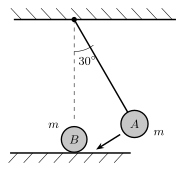
›Reveal solutionSolution
Elastic collision + equal masses + target initially at rest ⇒ velocities are exchanged, so the striking bob (A) stops completely and rises to zero height.
For a head-on elastic collision between two bodies of equal mass m, where the second body (B) is initially at rest, momentum and kinetic-energy conservation together give the standard result that the velocities are exchanged: body A (the one that was moving) ends up at rest, and body B moves off with A's original velocity.
Let A be released from 30° to the vertical. By energy conservation on the way down (before the collision), A arrives at the bottom (table level) with some speed v, having converted its initial gravitational PE fully into KE.
At the collision: since mA=mB=m and it is elastic, the exchange-of-velocity result gives:
- A's velocity after collision =0
- B's velocity after collision =v (A's velocity just before collision)
Since A is left with zero velocity, it has zero kinetic energy immediately after the collision, and therefore cannot rise at all — it simply comes to rest at the point of impact (at the bottom of its swing).
✓Final answerBob A rises to a height of zero after the collision — it stops completely, having transferred all its velocity (and hence energy) to bob B, which now moves off with A's original speed.
- CBSE 2018Set ANNUAL1 markMCQQ.In Elastic Collision:(a) Both momentum and K.E are conserved(b) Both momentum and K.E are not conserved(c) Momentum is conserved and K.E is not conserved(d) Momentum is not conserved and K.E is conserved
›Reveal solutionSolution
Elastic collision = momentum conserved AND kinetic energy conserved; this is what distinguishes it from an inelastic collision.
In any collision (elastic or inelastic), as long as no external force acts on the system, linear momentum is always conserved — this follows directly from Newton's third law (the colliding bodies exert equal and opposite forces on each other for equal times, so their net impulse on the system is zero).
What makes a collision elastic specifically is that kinetic energy is also conserved: none of the mechanical energy is converted into heat, sound, or permanent deformation. In an inelastic collision, momentum is still conserved, but some kinetic energy is lost to these other forms (a perfectly inelastic collision loses the maximum possible KE, with the bodies sticking together).
✓Final answerOption (a): In an elastic collision, both momentum and kinetic energy are conserved.
🎓Unlock everything free for 14 days
- ✓Full step-by-step solutions
- ✓Concept-first explanations
- ✓Methods, shortcuts & mistakes
- ✓PYQ mapping + timed mock tests
Full access for 14 days. No credit card required.