Business Mathematics and Basic Statistics · Ch 5 — Coordinate Geometry (Two Dimensions)
Centroid of a Triangle
Centroid of a Triangle
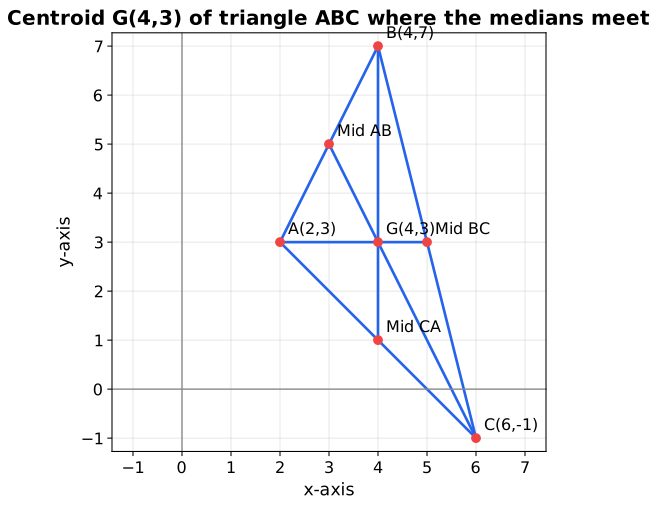
A triangle’s median is the line segment joining one vertex to the mid-point of the opposite side; every triangle has three medians, one from each vertex. A classical geometric fact is that the three medians of any triangle always meet at a single point, called the centroid, and that the centroid divides each median in the ratio , measured from the vertex.
Because the centroid is such a specific point on each median (two-thirds of the way along it from the vertex), its coordinates can be obtained directly from the triangle’s three vertices, without drawing a single median, simply by averaging the corresponding coordinates.
Centroid of a Triangle
If a triangle has vertices , and , its centroid is
This averaging formula can, in fact, be derived from the section formula of the previous section: the centroid is precisely the point that divides a median (from a vertex to the mid-point of the opposite side) in the ratio from that vertex, and substituting the mid-point’s coordinates with this ratio into the section formula reproduces the boxed formula above. There is no need to redo this derivation for every problem — the boxed formula is applied directly.