Business Mathematics and Basic Statistics · Ch 5 — Coordinate Geometry (Two Dimensions)
Distance Between Two Points
Distance Between Two Points
Suppose two branches of a business, or two stops on a delivery route, sit at points and on the coordinate plane. How far apart are they, measured as a straight line — “as the crow flies”? This is answered by the distance formula, and it follows directly from the Pythagorean theorem already familiar from geometry.
Draw the segment . Through draw a horizontal line and through draw a vertical line, and let them meet at a point . Since is horizontal, its length is simply the difference of the x-coordinates, ; since is vertical, its length is the difference of the y-coordinates, . The angle at is a right angle, so triangle is right-angled at , with as its hypotenuse.
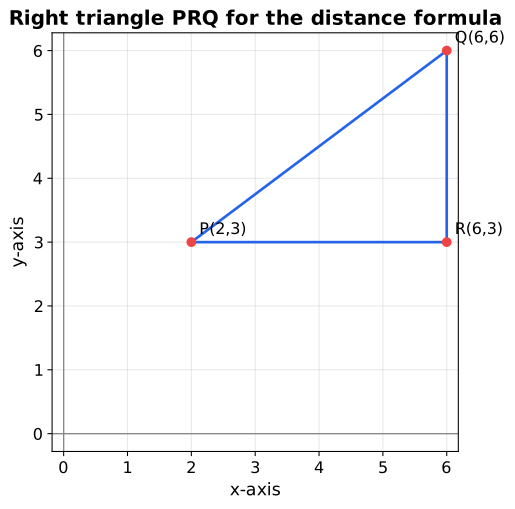
By the Pythagorean theorem,
so, taking the positive square root (a distance is never negative),
Distance Formula
A useful special case follows by putting : the distance of a point from the origin is
…