Business Mathematics and Basic Statistics · Ch 5 — Coordinate Geometry (Two Dimensions)
The Cartesian Coordinate System
The Cartesian Coordinate System
Business problems that involve two related quantities — for example, the price of a share plotted against time, or a firm’s total cost plotted against the number of units produced — are easiest to study with a picture. The Cartesian coordinate system, named after the French mathematician René Descartes, gives us exactly that picture: a way to locate any point in a flat plane using a pair of numbers.
Draw two number lines that cross each other at right angles. The horizontal line is the x-axis, the vertical line is the y-axis, and the point where they cross is the origin, written . Together the two axes divide the plane into four regions called quadrants, numbered I, II, III and IV in the anticlockwise direction starting from the upper-right region.
Every point in this plane corresponds to exactly one ordered pair of real numbers , and every ordered pair corresponds to exactly one point. The first number is called the abscissa — the point’s (signed) distance from the y-axis, measured parallel to the x-axis — and the second number is called the ordinate — the point’s (signed) distance from the x-axis, measured parallel to the y-axis. The pair is written and not ; because the two coordinates play different roles, reversing their order generally gives a completely different point — this is exactly why it is called an ordered pair.
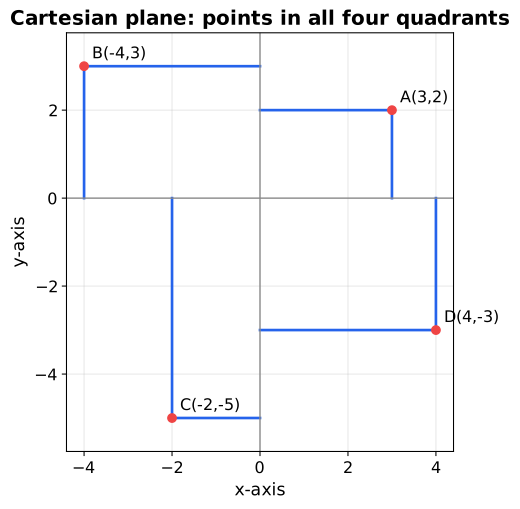
The sign of and tells us at once which quadrant a point lies in, without needing to plot it first:
Quadrant Sign Convention
| Quadrant | Sign of | Sign of | Example |
|---|---|---|---|
| I | |||
| II | |||
| III | |||
| IV |
A point can also lie exactly on an axis rather than inside a quadrant. If , the point lies on the x-axis; if , the point lies on the y-axis. The origin itself, , lies on both axes at once and belongs to none of the four quadrants.
This coordinate picture is what makes the rest of the chapter possible: once every point is just a pair of numbers, questions like “how far apart are two points?”, “what point lies exactly between them in a given ratio?”, and “where is the balance point of a triangle?” all turn into ordinary algebra performed on those numbers — which is exactly the three ideas the rest of this chapter builds, in order: the distance formula, the section formula, and the centroid formula.