Business Mathematics and Basic Statistics · Ch 5 — Coordinate Geometry (Two Dimensions)
Section Formula (Internal Division)
Section Formula (Internal Division)
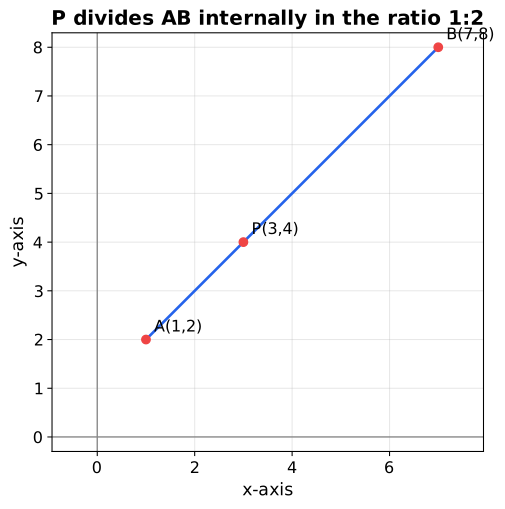
Often what is needed is not the distance between two points but a point that lies between them in a stated proportion — for instance, a warehouse located one-third of the way from a firm’s old depot to its new one. If a point lies on the segment joining and and divides it internally in the ratio (meaning ), the coordinates of are given by the section formula.
Section Formula (Internal Division)
If divides the segment joining and internally in the ratio ,
Notice which endpoint’s coordinates get which weight: ’s coordinates are weighted by (the part of the ratio measured from ), and ’s coordinates are weighted by (the part of the ratio measured from ). It is easy to swap these weights by mistake, so always re-check which end of the segment the dividing point sits closer to before substituting numbers into the formula.
A very common special case is the mid-point of a segment, where divides in the ratio (equally). Putting collapses the section formula to a simple average of the two endpoints: …