Q.What is hypermetropia? What is its cause and how can it be corrected? Explain with a proper diagram. (1+1+1) OR What is normal adjustment? An astronomical telescope, when in normal adjustment has magnifying power 5. If the distance between two lenses is 0.24 m, find the focal length of both the lenses. (1+2)
You're viewing a preview — the full solution, concept, methods & PYQ mapping are locked.
Start your 14-day free trial to unlock the full solution →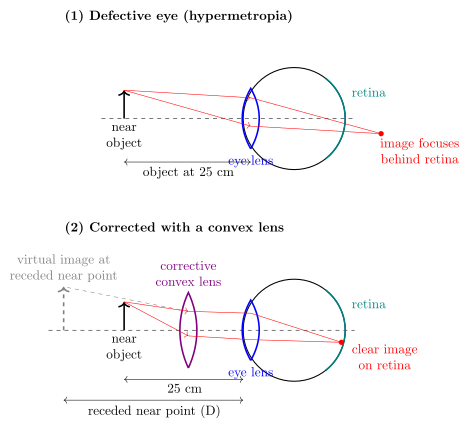
Hypermetropia is the inability to see nearby objects clearly because the image forms behind the retina; a convex lens converges the rays a bit earlier so the image lands exactly on the retina.
What is hypermetropia? Hypermetropia (also called hyperopia, or long-sightedness/far-sightedness) is a defect of vision in which a person can see distant objects clearly but cannot see nearby objects distinctly. The near point of the eye is pushed farther away than the normal near point (25 cm), so objects placed at the normal near point appear blurred.
Cause: This occurs either because (i) the eyeball has become too short, or (ii) the focal length of the eye lens (its converging power) is too large (too weak a lens). As a result, for a nearby object, the eye lens converges the light rays to a point behind the retina, instead of exactly on it, so the retina receives a blurred, unfocused image.
…
Unlock everything free for 14 days
- Full step-by-step solutions
- Concept-first explanations
- Methods, shortcuts & mistakes
- PYQ mapping + timed mock tests
Full access for 14 days. No credit card required.