Q.a) State Huygens' principle for propagation of light wave. b) Show with the help of a ray diagram how the image is formed in an astronomical telescope. c) The magnifying power of a telescope in normal adjustment is 20, and the focal length of the eye-piece is 5×10⁻² m. What is the magnifying power obtained when the system is adjusted so that the final image of a distant object is formed 25×10⁻² m away from the eye-piece? OR
You're viewing a preview — the full solution, concept, methods & PYQ mapping are locked.
Start your 14-day free trial to unlock the full solution →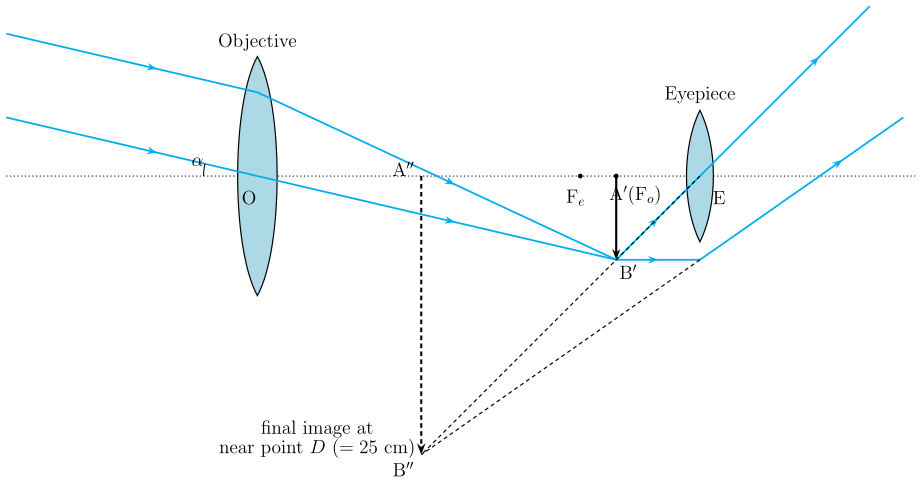
Huygens' principle treats each point of a wavefront as a source of secondary wavelets; in an astronomical telescope the objective forms a real image at its focus which the eyepiece magnifies as a simple magnifier; numerically, adjusting so the final image forms 25 cm from the eyepiece gives magnifying power 24 (up from 20 in normal adjustment).
(a) Huygens' principle: Every point on a wavefront acts as a source of secondary spherical wavelets that spread out with the speed of the wave in that medium; the new (forward) wavefront at any later instant is the surface tangent (envelope) to all these secondary wavelets. This principle is used to derive the laws of reflection and refraction geometrically.
…
Unlock everything free for 14 days
- Full step-by-step solutions
- Concept-first explanations
- Methods, shortcuts & mistakes
- PYQ mapping + timed mock tests
Full access for 14 days. No credit card required.