Question 42 of 60
Q.(a) Draw a ray diagram to show, how an image is formed by a compound microscope.
(b) Write the expression for its magnifying power.
OR
(a) Draw a ray diagram of a reflecting type telescope.
(b) State two advantages of this telescope over a refracting telescope.
West Bengal WbchseWest Bengal HS (WBCHSE) Board 2022Subjective· 3mImportance★★★★★
70% · 42/60 Questions
You're viewing a preview — the full solution, concept, methods & PYQ mapping are locked.
Start your 14-day free trial to unlock the full solution →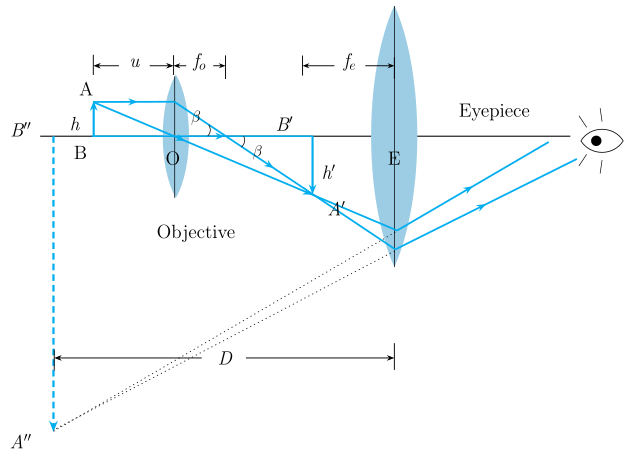
The objective forms a real, inverted, magnified image just inside the eyepiece's focal length, which the eyepiece further magnifies as a simple magnifier; total .
- Ray diagram (described): The object is placed just beyond the focus of the objective lens. The objective forms a real, inverted, highly magnified image a little inside the focal length of the eyepiece. This intermediate image acts as the object for the eyepiece, which — since lies within — acts as a simple magnifier and produces a virtual, further magnified, final image , inverted with respect to the original object, seen at or beyond the near point.
- Magnifying power: Overall magnification is the product of the objective's linear magnification and the eyepiece's angular magnification: …
Unlock everything free for 14 days
- Full step-by-step solutions
- Concept-first explanations
- Methods, shortcuts & mistakes
- PYQ mapping + timed mock tests
Full access for 14 days. No credit card required.