History · Ch 5 — Changing Cultural Traditions
Architecture
Architecture
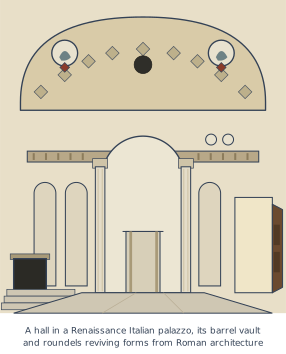
The fifteenth century saw Rome rise again, and this revival was written most visibly in stone. The popes, who had regained political strength after the schism of 1378 ended in 1417, actively encouraged the study of Rome's ancient past. Ruins were carefully excavated by archaeologists — a skill that was itself new — and what emerged from the earth inspired a style that was actually a rebirth of imperial Roman architecture. This style came to be called 'classical'.
The patrons of this new architecture were the popes, wealthy merchants, and aristocrats. They employed architects who knew classical forms well, and also brought in artists and sculptors to decorate the buildings with paintings, sculptures, and reliefs. What is striking is that some individuals were equally skilled in all three arts — painting, sculpture, and architecture.
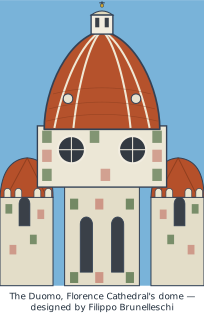
The most impressive example of this versatility was Michelangelo Buonarroti (1475–1564). He is remembered for three great works, all in Rome: the ceiling he painted for the Pope in the Sistine Chapel, the sculpture called 'The Pieta', and his design of the dome of St Peter's Church. Another such figure was Filippo Brunelleschi (1337–1446), the architect of the spectacular Duomo of Florence, who had begun his career as a sculptor.
…
Drawn by us to help you understand the concept clearly, and verified to make sure it's accurate. For exams, practice from your NCERT textbook's own diagram.
The figure shows the Duomo of Florence — the cathedral’s great dome, built of red tiles, rising above the marble-patterned walls of the lower building. The dome dominates the skyline, and the contrast between the warm terracotta of its roof and the patterned marble of the cathedral’s exterior is what makes the structure instantly recognisable. The image is a view of the building as a whole, not a diagram or plan, so there are no arrows, panels, or labels marking parts of the architecture. What you see is simply the finished monument, the way a sixteenth-century viewer would have seen it.
The point of the figure is not the building itself but the man behind it. Filippo Brunelleschi, who designed the Duomo, began his career as a sculptor. That single fact matters because it shows how fluid the boundary between art and architecture was in this period. The same hands that carved marble could also engineer a dome that had defeated earlier builders. The chapter uses Brunelleschi to illustrate a broader shift: the revival of imperial Roman forms, now called ‘classical’ architecture, and the rise of the individual artist who is known by name rather than as an anonymous member of a guild. …
Drawn by us to help you understand the concept clearly, and verified to make sure it's accurate. For exams, practice from your NCERT textbook's own diagram.
The photograph shows the most famous landmark of Florence: the cathedral’s great dome, known simply as the Duomo. What strikes the eye first is the dome itself — a massive, red-tiled structure that dominates the skyline. Beneath it, the cathedral’s lower walls are visible, patterned in marble, their geometric bands of colour contrasting sharply with the plain terracotta of the dome above. The image captures the building whole, so you can see how the dome seems to sit on the cathedral like a crown, its proportions deliberately designed to rise above the city.
The figure is included to make a specific point about the chapter’s argument: that the Renaissance in Italy was not a sudden invention but a deliberate revival of the classical past. Brunelleschi, the designer, began his career as a sculptor, not an architect — the chapter names him precisely to show how fluid artistic roles were in this period. A man trained to carve stone could turn his hand to engineering a dome that no one had attempted on this scale since antiquity. The Duomo’s design draws on the engineering and aesthetic principles of imperial Roman buildings, and its success helped launch the ‘classical’ revival in Italian architecture that the text describes. …
Leon Batista Alberti (1404-72) wrote on art theory and architecture:
'Him I call an Architect who is able to devise and to compleat all those Works which, by the movement of great Weights, and by the conjunction and amassment of Bodies can, with the greatest Beauty, be adapted to the uses of Mankind.'
— Leon Batista Alberti (1404-72) …