History · Ch 5 — Changing Cultural Traditions
Universities and Humanism
Universities and Humanism
The earliest universities in Europe were not scattered across the continent but concentrated in the commercial towns of Italy. Padua and Bologna, from the eleventh century, became the great centres of legal studies. The reason was practical: commerce was the lifeblood of these cities, and large-scale trade simply could not function without written agreements, clear rules, and people who could interpret them. This created a steady demand for lawyers and notaries — a notary being a combination of a solicitor and a record-keeper, someone who could both draft documents and maintain official records. Law, therefore, became a popular subject of study.
But there was a shift in emphasis. Law was no longer studied merely as a set of practical rules; it came to be studied in the context of earlier Roman culture. The man who best represented this change was Francesco Petrarch (1304–78). To Petrarch, antiquity was not a distant, dead past but a distinctive civilisation in its own right, one that could be truly understood only through the actual words of the ancient Greeks and Romans. He therefore insisted on a close reading of ancient authors — not summaries, not second-hand accounts, but the texts themselves. This educational programme carried a deeper implication: there was much to be learned that religious teaching alone could not provide.
This was the culture that nineteenth-century historians would later label ‘humanism’. By the early fifteenth century, the term ‘humanist’ was already in use, applied to masters who taught grammar, rhetoric, poetry, history and moral philosophy. The word itself has a long pedigree. The Latin humanitas, from which ‘humanities’ is derived, had been used many centuries earlier by the Roman lawyer and essayist Cicero (106–43 BCE), a contemporary of Julius Caesar, to mean culture. What distinguished these subjects was that they were not drawn from or connected with religion. They emphasised skills that individuals developed through discussion and debate — skills of argument, persuasion and critical thought.
The importance of debate was taken up with great enthusiasm by Giovanni Pico della Mirandola (1463–94), a humanist of Florence. In his work On the Dignity of Man (1486), he wrote that for Plato and Aristotle, nothing was better for attaining knowledge of truth than attending the exercise of debate as often as possible.
Giovanni Pico della Mirandola (1463-94), a humanist of Florence, wrote on the importance of debate in On the Dignity of Man (1486).
'For [Plato and Aristotle] it was certain that, for the attainment of the knowledge of truth they were always seeking for themselves, nothing is better than to attend as often as possible the exercise of debate. For just as bodily energy is strengthened by gymnastic exercise, so beyond doubt in this wrestling-place of letters, as it were, energy of mind becomes far stronger and more vigorous.'
— Giovanni Pico della Mirandola, On the Dignity of Man, 1486 …
His analogy was striking: just as bodily energy is strengthened by gymnastic exercise, so in the ‘wrestling-place of letters’ the energy of the mind becomes far stronger and more vigorous. …
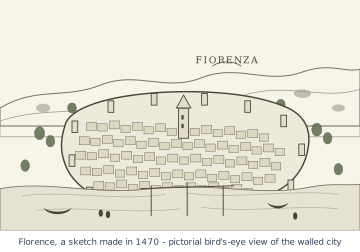
Drawn by us to help you understand the concept clearly, and verified to make sure it's accurate. For exams, practice from your NCERT textbook's own diagram.
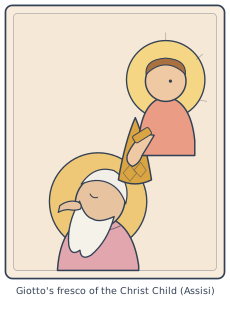
The sketch made in 1470 shows Giotto’s painting of the child Jesus at Assisi, Italy. It is not a map or a diagram but a reproduction of a fresco, and the caption matters because it tells you something important about how Renaissance artists saw their own past. By 1470, Giotto had been dead for over a century, yet his work was still being copied and sketched — that alone signals his reputation.
What the sketch actually reveals is the shift in artistic style that the chapter ties directly to Giotto. The figures are lifelike and individualised, rendered with warmth and naturalism. The child Jesus is not a stiff, formal icon but a believable human infant, and the surrounding figures carry expressions and postures that feel observed from real life. This is precisely the contrast the textbook draws: Giotto painted lifelike portraits, very different from the stiff figures done by earlier artists.
The location, Assisi, is itself significant. Assisi was a major pilgrimage centre, and Giotto’s frescoes there — in the Basilica of San Francesco — were among the most visible religious artworks in Italy. So the sketch connects two things: a religious subject (the child Jesus) and a new artistic method (naturalism). That combination is exactly what made Giotto revolutionary. He did not abandon religious themes; he made them human. The warmth and individuality of the figures made sacred scenes feel immediate and emotionally accessible, which was a departure from the remote, formalised style of medieval painting. …
Drawn by us to help you understand the concept clearly, and verified to make sure it's accurate. For exams, practice from your NCERT textbook's own diagram.
The painting shows the child Jesus, rendered by Giotto in a way that breaks decisively with the tradition before him. Earlier artists painted holy figures as stiff, formal, almost abstract presences — flat, rigid, and remote. Giotto instead gives the child a lifelike, individualised face and body, with warmth and naturalism that make the sacred scene feel human and immediate. The figures around him are drawn with the same attention to real posture and expression, so the whole composition reads as a moment of genuine tenderness rather than a symbolic tableau.
What matters for the chapter is not the religious subject itself but what the style signals. Giotto was a layman, not a monk or a cleric, working in Assisi in the decades around 1300. His naturalism is part of the same cultural shift that the chapter traces through Petrarch and the early humanists: a growing confidence in observing and representing the world as it actually appears, rather than through the fixed conventions of religious art. The painting is placed in the discussion of Florence’s rise precisely because Giotto is named alongside Dante as one of the two great citizens who made the city intellectually famous before its fifteenth-century flowering. …