History · Ch 5 — Changing Cultural Traditions
The Copernican Revolution
The Copernican Revolution
The Christian idea of man as a sinner came under attack from an unexpected direction — science. For centuries, the Church had taught that the earth was a sinful place, and that the very weight of sin made it heavy and immobile. This earth sat motionless at the centre of the universe, with the celestial planets revolving around it. The Copernican revolution shattered that picture.
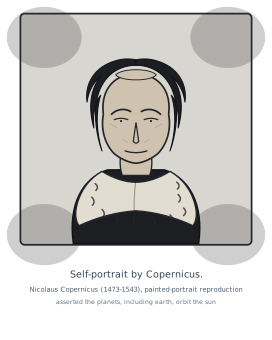
The turning point came with Nicolaus Copernicus (1473–1543), a contemporary of Martin Luther. Copernicus asserted that the planets, including the earth, rotate around the sun.
This was a direct challenge to the geocentric model that Christian tradition had long upheld. Yet Copernicus himself was a devout Christian, and he feared how traditionalist clergymen would react to his theory. So afraid was he that he refused to have his manuscript, De revolutionibus (The Rotation), printed. Only on his deathbed did he hand it over to his follower, Joachim Rheticus.
Acceptance did not come quickly. It took more than half a century before the gap between 'heaven' and 'earth' was finally bridged, and that bridge was built by later astronomers. Johannes Kepler (1571–1630) made the sun-centred system popular through his work Cosmographical Mystery, in which he demonstrated that planets move around the sun not in circles but in ellipses. Galileo Galilei (1564–1642) confirmed the idea of a dynamic world in his work The Motion. The revolution reached its climax with Isaac Newton's theory of gravitation, which gave a physical explanation for why the planets move as they do. …
Drawn by us to help you understand the concept clearly, and verified to make sure it's accurate. For exams, practice from your NCERT textbook's own diagram.
The figure is a self-portrait of Nicolaus Copernicus, the Polish astronomer whose work marks the turning point this section describes. It shows him as a mature man, likely in clerical dress, reflecting his position as a canon in the Church — a reminder that the man who challenged the earth-centred cosmos was himself a devout Christian. The portrait is not a scientific diagram; it is a personal image, and its presence in the chapter signals that the Copernican Revolution was driven by a real individual with fears and convictions, not an abstract force.
What the portrait teaches is tied directly to the text around it. Copernicus lived alongside Martin Luther, and the chapter stresses that he hesitated to publish De revolutionibus because he dreaded the reaction of traditionalist clergymen. The self-portrait humanises that hesitation: here is the man who, on his deathbed, handed his manuscript to Joachim Rheticus rather than see it printed in his lifetime. The image therefore anchors the intellectual shift to a specific person at a specific moment — the late Renaissance, when science began to question religious authority from a new angle. …