History · Ch 5 — Changing Cultural Traditions
Artists and Realism
Artists and Realism
Formal education was not the only channel through which humanists shaped the minds of their age. Art, architecture and books carried humanist ideas with remarkable effectiveness, reaching people who never sat in a classroom. The German artist Albrecht Dürer (1471–1528) captured this spirit when he wrote that art is embedded in nature, that whoever can extract it has it, and that the more closely a work abides by life in its form, the better it will appear. He insisted that no one could make a beautiful figure from imagination alone unless the mind had been well stored by much copying from life.
Dürer's own brush drawing Praying Hands (1508) tells us something important about sixteenth-century Italian culture.
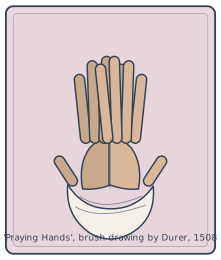
' "Art" is embedded in nature; he who can extract it, has it… Moreover, you may demonstrate much of your work by geometry. The more closely your work abides by life in its form, so much the better will it appear…No man shall ever be able to make a beautiful figure out of his own imagination unless he has well stored his mind by much copying from life.'
— Albrecht Durer (1471-1528)
This sketch by Durer ('Praying Hands', a brush drawing, 1508) gives us a sense of Italian culture in the sixteenth century, when people were deeply religious, but also had a sense of confidence in man's ability to achieve near-perfection and to unravel the mysteries of the world and the universe. …
People of that age were deeply religious, yet they also carried a new confidence in man's ability to achieve near-perfection and to unravel the mysteries of the world and the universe. That combination — faith and human capability — lay at the heart of the Renaissance outlook.
The pull of the past
Artists were inspired by studying the works of earlier ages. The material remains of Roman culture were sought with as much excitement as ancient texts. A thousand years after the fall of Rome, fragments of art were discovered in the ruins of Rome and other deserted cities. What struck the Italians most was the sight of 'perfectly' proportioned men and women sculpted so many centuries earlier. Their admiration for these figures made Italian sculptors want to continue that tradition.
In 1416, Donatello (1386–1466) broke new ground with his lifelike statues. This was a turning point — sculpture moved from stylised convention towards a convincing imitation of the human form.
Science serves art
The artists' concern for accuracy was greatly helped by the work of scientists. To understand bone structures, artists went to the laboratories of medical schools. Andreas Vesalius (1514–64), a Belgian who was professor of medicine at the University of Padua, was the first to dissect the human body. This marked the beginning of modern physiology. Anatomy, in other words, became a working tool for the artist, not merely a subject for the physician.
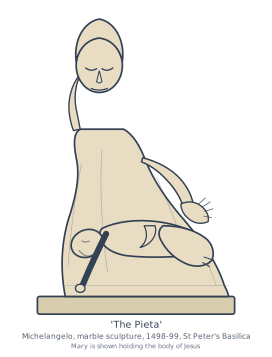
Michelangelo's The Pieta, showing Mary holding the body of Jesus, belongs to this same world of religious feeling combined with technical mastery.
Leonardo da Vinci: disciple of experiment
Leonardo da Vinci (1452–1519) had an astonishing range of interests — botany, anatomy, mathematics and art. He painted the Mona Lisa and The Last Supper. One of his dreams was to fly. He spent years observing birds in flight and designed a flying machine. He signed his name 'Leonardo da Vinci, disciple of experiment'
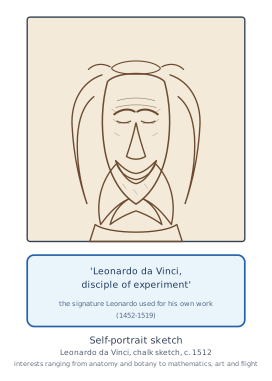
This self-portrait is by Leonardo da Vinci (1452-1519) who had an amazing range of interests from botany and anatomy to mathematics and art. He painted the Mona Lisa and The Last Supper.
One of his dreams was to be able to fly. He spent years observing birds in flight, and designed a flying machine.
He signed his name 'Leonardo da Vinci, disciple of experiment'. …
— a phrase that sums up the Renaissance ideal of learning through direct observation and testing.
The painter's path to realism
Painters did not have older works to use as models, as sculptors did. But they, like sculptors, painted as realistically as possible. Three things helped them:
- Geometry gave them an understanding of perspective — the technique of representing three-dimensional space on a flat surface. …
Drawn by us to help you understand the concept clearly, and verified to make sure it's accurate. For exams, practice from your NCERT textbook's own diagram.
Michelangelo’s Pieta is a marble sculpture, not a painting, and it shows a single, intensely emotional moment rather than a scene with many figures. Mary is seated, and across her lap lies the body of her son Jesus after his crucifixion. The composition is compact: Mary’s body forms a broad, stable base, while Jesus’s limp form stretches horizontally across her knees. Her head is bowed toward him, and her robes cascade in deep, heavy folds that both conceal and reveal the body beneath.
What makes the work remarkable — and what the chapter wants you to see — is the way Michelangelo handled the human form. Jesus’s body is rendered with careful anatomical accuracy: the slack muscles, the drooping head, the natural weight of a dead man’s limbs. Mary’s face is youthful and serene, not aged by grief, and her drapery is carved with a softness that makes marble look like cloth. The figures are idealized, balanced, and proportioned in a way that consciously echoes the sculpture of ancient Rome and Greece.
That connection to antiquity is the real lesson. The chapter places the Pieta in the context of Italian artists who, a thousand years after Rome’s fall, were digging up fragments of ancient sculpture and studying them with excitement. Those rediscovered works showed ‘perfectly’ proportioned men and women, and sculptors like Donatello and Michelangelo wanted to continue that tradition. But they did not merely copy the past — they combined it with new scientific knowledge. Artists went to medical schools to study bone structure, and Vesalius’s dissections of the human body were beginning to establish modern physiology. So the Pieta is not just a religious image; it is a demonstration of how anatomy, geometry, and a sense of beauty came together to produce what the chapter calls ‘realism’. …