History · Ch 5 — Changing Cultural Traditions
The Aspirations of Women
The Aspirations of Women
The Renaissance ideal of the individual and the citizen was built on the exclusion of women. Public life belonged to men, and the new humanist values, for all their talk of freedom and dignity, were framed around male experience. Women were expected to remain in the household, their roles defined by marriage, family and religious duty rather than by learning or public achievement.
In aristocratic families, men were the sole decision-makers. They ran family businesses, entered public life, and educated their sons to inherit these positions. Younger sons were often sent to join the Church as an alternative career. Women, by contrast, had little say in how their husbands managed the family business, even though their dowries were invested in it. Marriages were frequently arranged to strengthen business alliances between families. If a family could not raise an adequate dowry, daughters were sent to convents to live as nuns. The public role of women was thus severely limited, and they were regarded primarily as keepers of the household.
The position of women in merchant families was somewhat different. Shopkeepers were often assisted by their wives in running the shop. In merchant and banking families, wives looked after the business when the men were away on work. If a merchant died early, his widow was compelled to take on a larger public role than was usual in aristocratic families. So while aristocratic women were confined to domesticity, merchant women could exercise real economic responsibility out of practical necessity.
A few women were intellectually creative and deeply aware of the importance of a humanist education. The Venetian Cassandra Fedele (1465–1558) wrote that even though the study of letters offered no reward or dignity for women, every woman ought to seek and embrace these studies. She was among a handful of women who questioned the idea that women were incapable of achieving the qualities of a humanist scholar. Fedele was known for her proficiency in Greek and Latin and was invited to give orations at the University of Padua. Her writings also bring into focus the general regard for education in that age. She was one of many Venetian women writers who criticised the republic for creating a highly limited definition of freedom that favoured the desires of men over those of women.
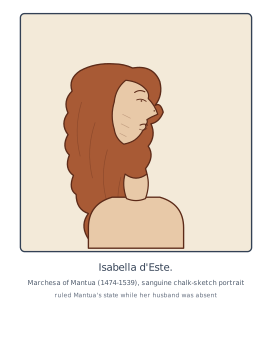
Another remarkable woman was Isabella d’Este (1474–1539), the Marchesa of Mantua. She ruled the state while her husband was absent, and her court in the small state of Mantua became famed for its intellectual brilliance.
Women’s writings of this period reveal their conviction that they should have economic power, property and education to achieve an identity in a world dominated by men.
Not all voices, however, argued for equality. Balthasar Castiglione, author and diplomat, wrote in his book The Courtier (1528)
Balthasar Castiglione, author and diplomat, wrote in his book The Courtier (1528):
'I hold that a woman should in no way resemble a man as regards her ways, manners, words, gestures and bearing. Thus just as it is very fitting that a man should display a certain robust and sturdy manliness, so it is well for a woman to have a certain soft and delicate tenderness, with an air of feminine sweetness in her every movement, which, in her going and staying and whatsoever she does, always makes her appear a woman, without any resemblance to a man. If this precept be added to the rules that these gentlemen have taught the courtier, then I think that she ought to be able to make use of many of them, and adorn herself with the finest accomplishments... For I consider that many virtues of the mind are as necessary to a woman as to a man; as it is to be of good family; to shun affectation: to be naturally graceful; to be well mannered, clever and prudent; to be neither proud, envious or evil-tongued, nor vain... to perform well and gracefully the sports suitable for women.'
— Balthasar Castiglione, The Courtier, 1528 …
that a woman should in no way resemble a man in her ways, manners, words, gestures or bearing. Just as a man should display a robust and sturdy manliness, a woman should have a soft and delicate tenderness, with an air of feminine sweetness in every movement, always appearing a woman without any resemblance to a man. He did allow that many virtues of the mind were as necessary to a woman as to a man — being of good family, shunning affectation, being naturally graceful, well mannered, clever and prudent, neither proud, envious, evil-tongued nor vain, and performing well and gracefully the sports suitable for women. But the ideal he set was one of feminine charm and accomplishment, not of intellectual or public equality. …
Drawn by us to help you understand the concept clearly, and verified to make sure it's accurate. For exams, practice from your NCERT textbook's own diagram.
The portrait shows Isabella d’Este in profile, the standard format for aristocratic portraiture of the period. She is the Marchesa of Mantua, and the image captures her as a woman of rank and intellect rather than merely as a wife or mother. The profile view itself is telling: it echoes the style of ancient Roman coins and medallions, a deliberate visual link to classical antiquity that Renaissance patrons prized. In that sense, the portrait is not just a likeness but a statement of humanist values — the sitter is presented as a figure worthy of commemoration, like a ruler or a scholar.
What makes this figure significant for the chapter is that Isabella d’Este was one of the few Renaissance women who carved out a public role in a world dominated by men. The chapter tells us she ruled Mantua while her husband was absent, and that her court became famous for its intellectual brilliance. The portrait therefore illustrates the exception to the rule: while aristocratic women were generally confined to the household, Isabella exercised political power and cultivated an environment where learning and the arts flourished. Her image stands as visual evidence that a woman could achieve the public standing and cultural influence that the text says was usually reserved for men. …