History · Ch 5 — Changing Cultural Traditions
The Revival of Italian Cities
The Revival of Italian Cities
Towns, Print and a New Sense of History
From the fourteenth century to the end of the seventeenth, towns across many parts of Europe were growing, and a distinct ‘urban culture’ took shape within them. Townspeople increasingly thought of themselves as more ‘civilised’ than people who lived in the countryside, and certain towns — Florence, Venice and Rome above all — became genuine centres of art and learning, where the wealthy and the aristocratic patronised painters, sculptors and writers. The invention of printing in this same period meant that books and prints could now reach far more people, including those living in distant towns or even other countries.
This was also the period in which a distinct sense of history developed in Europe: people began to think of their own age as ‘modern’, and to contrast it deliberately with the ‘ancient’ world of the Greeks and Romans. Religion, too, came to be seen increasingly as something an individual could choose for themselves, as the Church’s earth-centred view of the universe was overturned by astronomers working out the true structure of the solar system, and as new geographical knowledge dismantled the old idea that the Mediterranean Sea sat at the centre of the world.
Because so much material survives from this period — documents, printed books, paintings, sculptures, buildings, even textiles, carefully preserved in archives, art galleries and museums across Europe and America — historians have been able to study it in unusual depth. It was historians writing from the nineteenth century onward who coined the term ‘Renaissance’ (literally, ‘rebirth’) to describe the cultural changes of this age. The scholar most closely associated with the idea was the Swiss historian Jacob Burckhardt (1818–97) of the University of Basle, a student of the German historian Leopold von Ranke. Ranke had taught that a historian’s central task was to write about states and politics using government papers and official files, but Burckhardt found this far too narrow — to him, history was as much about culture as about politics. In 1860 he published The Civilisation of the Renaissance in Italy, in which he drew on literature, architecture and painting to tell the story of how a new ‘humanist’ culture had flowered in the towns of Italy between the fourteenth and seventeenth centuries. This culture, he argued, rested on a new belief: that the individual was capable of making his own decisions and developing his own abilities — a ‘modern’ outlook, in contrast to ‘medieval’ habits of mind that the Church had tightly controlled.
After the fall of the western Roman Empire, the towns that had once been political and cultural centres in Italy fell into ruin. There was no unified government in the peninsula. The Pope in Rome was sovereign only in his own state and was not a strong political figure. While western Europe was being reshaped by feudal bonds and unified under the Latin Church, eastern Europe was under the Byzantine Empire, and Islam was creating a common civilisation further west, Italy remained weak and fragmented.
Yet it was precisely these developments that helped in the revival of Italian culture. With the expansion of trade between the Byzantine Empire and the Islamic countries, the ports on the Italian coast revived. From the twelfth century, as the Mongols opened up trade with China via the Silk Route, and as trade with western European countries also increased, Italian towns played a central role
Key milestones of Italian humanist culture across the fourteenth and fifteenth centuries:
| Date | Development |
|---|---|
| 1300 | Humanism taught at Padua University in Italy |
| 1341 | Petrarch given title of 'Poet Laureate' in Rome |
| 1349 | University established in Florence |
| 1390 | Geoffrey Chaucer's Canterbury Tales published |
| 1436 | Brunelleschi designs the Duomo in Florence |
| 1453 | Ottoman Turks defeat the Byzantine ruler of Constantinople |
| 1454 | Gutenberg prints the Bible with movable type |
| 1484 | Portuguese mathematicians calculate latitude by observing the sun |
| 1492 | Columbus reaches America |
| 1495 | Leonardo da Vinci paints The Last Supper |
| 1512 | Michelangelo paints the Sistine Chapel ceiling |
(All dates are approximate landmarks the book uses to mark the spread of humanist culture from Padua and Florence outward, ending with two of the period's most famous works of art.)
. They no longer saw themselves as part of a powerful empire, but as independent city-states.
Two of these city-states — Florence and Venice — were republics, and many others were court-cities, ruled by princes. One of the most vibrant cities was Venice; another was Genoa.
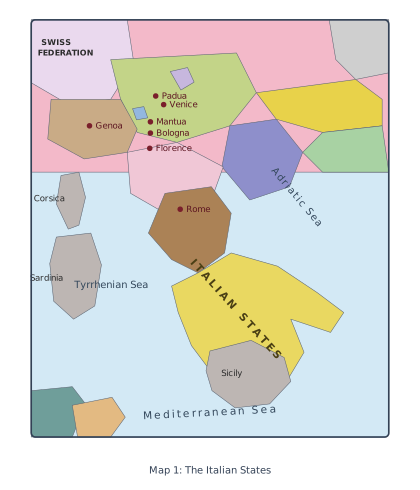
The map is a political sketch of the Italian peninsula around 1500, drawn to show how fragmented the region was at the time. There is no single Italian state; instead, the peninsula is divided into a patchwork of independent territories, each with its own ruler or government. To the north, the Swiss Federation is marked as a separate political entity, reinforcing the idea that Italy’s neighbours were consolidating while Italy itself remained divided.
The cities shown are the ones that matter for the chapter’s argument. Genoa and Venice sit on the coast, facing the Tyrrhenian and Adriatic Seas respectively — these were the great maritime republics whose ports revived with trade between the Byzantine Empire, the Islamic world, and western Europe. Inland, Padua, Mantua, Bologna, Florence, and Rome are marked. Padua is significant because it was home to a university where humanism was taught from 1300. Florence, a republic, was the heart of the Renaissance. Rome, the seat of the Pope, was sovereign in its own state but not a strong political figure, as the text makes clear. Mantua and Bologna were court-cities, ruled by princes, showing the variety of political forms — republics, despotisms, and papal territory — that coexisted in this small space.
The surrounding geography is not incidental. The Adriatic Sea to the east, the Tyrrhenian Sea to the west, and the Mediterranean Sea to the south frame the peninsula, reminding us that Italy’s revival was fundamentally maritime. The islands of Corsica, Sardinia, and Sicily are shown offshore, part of the same Mediterranean trading world. The map’s message is that Italy’s weakness — its lack of unification — was also its strength: the competition among these city-states, and their access to the sea, is precisely what allowed trade, citizenship, and eventually Renaissance culture to flourish.
These cities were different from other parts of Europe: the clergy were not politically dominant here, nor were there powerful feudal lords. Rich merchants and bankers actively participated in governing the city, and this helped the idea of citizenship to strike root. Even when these towns were ruled by military despots, the pride felt by the townspeople in being citizens did not weaken.
The key contrast: elsewhere in Europe, feudal lords and the clergy dominated politics. In the Italian city-states, merchants and bankers governed, and citizenship — not feudal allegiance — became the basis of political identity.
The book includes a passage from Cardinal Gasparo Contarini (1483–1542), writing about the democratic government of his city-state in The Commonwealth and Government of Venice (1534)
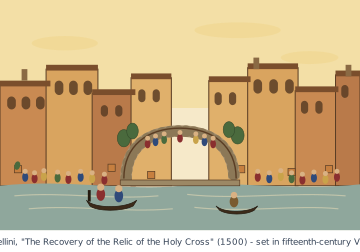
Cardinal Gasparo Contarini (1483-1542) writes about the democratic government of his city-state in The Commonwealth and Government of Venice (1534).
'…to come to the institution of our Venetian commonwealth, the whole authority of the city…is in that council, into which all the gentlemen of the City being once past the age of 25 years are admitted…
Now first I am to yield you a reckoning how and with what wisdom it was ordained by our ancestors, that the common people should not be admitted into this company of citizens, in whose authority [lies] the whole power of the commonwealth... Because many troubles and popular tumults arise in those cities, whose government is swayed by the common people… many were of contrary opinion, deeming that it would do well, if this manner of governing the commonwealth should rather be defined by ability and abundance of riches. Contrariwise the honest citizens, and those that are liberally brought up, oftentimes fall to poverty… Therefore our wise and prudent ancestors… ordered that this definition of the public rule should go rather by the nobility of lineage, than by the estimation of wealth: yet with that temperature [proviso], that men of chief and supreme nobility should not have this rule alone (for that would rather have been the power of a few than a commonwealth) but also every other citizen whosoever not ignobly born: so that all which were noble by birth, or ennobled by virtue, did...obtain this right of government.'
— Cardinal Gasparo Contarini, The Commonwealth and Government of Venice, 1534
The book pairs this excerpt with G. Bellini's painting 'The Recovery of the Relic of the Holy Cross' (painted 1500, recalling an event of 1370, set in fifteenth-century Venice) — a crowded canal-side procession of the very citizens Contarini is describing.
What it shows: Contarini, himself a Venetian nobleman, defends Venice's own restricted republic — citizenship open only to males over 25 of the "right" lineage, common people deliberately excluded — as a wise middle path between rule by wealth and rule by birth alone. Bellini's painting, alongside it, puts faces and a real civic occasion to that same citizenry, showing how central public ceremony and shared civic pride were to a city-state's sense of itself.
. He explains that the whole authority of the city lay in a council into which all gentlemen of the city, once past the age of 25, were admitted. He then gives an account of how the ancestors ordained that the common people should not be admitted into this company of citizens, in whose authority lay the whole power of the commonwealth. The reason given: many troubles and popular tumults arise in those cities whose government is swayed by the common people. Some were of the contrary opinion, deeming that the government should be defined by ability and abundance of riches. But the honest citizens, and those liberally brought up, often fall to poverty. Therefore the wise and prudent ancestors ordered that the definition of public rule should go by the nobility of lineage rather than by the estimation of wealth — yet with the proviso that men of chief and supreme nobility should not have this rule alone, for that would have been the power of a few rather than a commonwealth. Every other citizen, whosoever not ignobly born, was also included, so that all who were noble by birth, or ennobled by virtue, obtained this right of government.
Contarini's account shows that Venetian "democracy" was restricted: it excluded the common people and was based on noble birth or virtue, not on wealth alone — and not on universal citizenship.
The section also mentions a painting by G. Bellini, The Recovery of the Relic of the Holy Cross, painted in 1500 to recall an event of 1370, and set in fifteenth-century Venice.