Political Science · Ch 6 — Judiciary
Judiciary and Rights
Judiciary and Rights
The judiciary is entrusted with protecting the rights of individuals, and the Constitution gives the Supreme Court two distinct ways of doing this. First, it can restore a violated fundamental right by issuing writs such as Habeas Corpus or Mandamus, under Article 32 — and High Courts hold the same writ power under Article 226. Second, the Supreme Court can declare the law responsible for the violation unconstitutional and therefore inoperative, under Article 13. Together, these two provisions make the Supreme Court both the protector of citizens' fundamental rights and the interpreter of the Constitution.
The second of these two powers — striking down an unconstitutional law — is what is known as judicial review, arguably the most important power the Supreme Court holds. Judicial review is the power of the Supreme Court, or a High Court, to examine whether a law is consistent with the Constitution; if the Court concludes it is not, the law is declared unconstitutional and inapplicable. Strikingly, the term "judicial review" appears nowhere in the text of the Constitution — it exists only implicitly, as a natural consequence of India having a written constitution and a Supreme Court empowered to strike down any law that violates Fundamental Rights.
Judicial review is not confined to rights cases. It also applies to India's federal distribution of powers: if the central government makes a law that some States believe actually concerns a subject on the State List, those States can approach the Supreme Court, and if the Court agrees, it can declare that law unconstitutional. This review power extends equally to laws passed by State legislatures. Taken together with the writ power, judicial review is what makes the judiciary genuinely powerful — it gives the Court the authority to interpret both the Constitution and the laws Parliament passes, which is why many see this feature as what allows the judiciary to protect the Constitution effectively and to protect citizens' rights in practice. The growing practice of entertaining PILs has only strengthened this protective role further.
India is not alone in valuing this kind of citizen access to the courts. In South Africa, the constitution has gone a step further and made public interest litigation itself a fundamental right written into its bill of rights, so that any citizen there has a constitutional right to bring cases of rights violations before the Constitutional Court — a comparison worth keeping in mind alongside India's own, judicially-evolved version of PIL. …
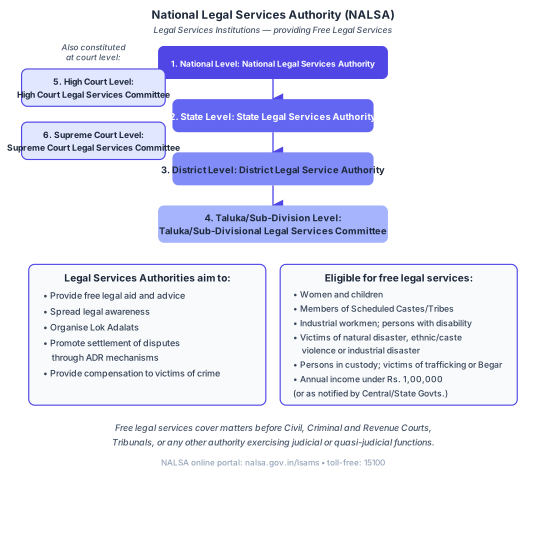
Drawn by us to help you understand the concept clearly, and verified to make sure it's accurate. For exams, practice from your NCERT textbook's own diagram.
Hierarchy diagram of the National Legal Services Authority (NALSA): National, State, District and Taluka/Sub-Division level Legal Services Authorities and Committees, plus the High Court and Supreme Court Legal Services Committees, alongside NALSA's stated aims and the categories of persons eligible for free legal services. Own-illustrated for this platform from the real NCERT page's own facts (composition, labels, and content are recreated; the specific artistic r …