Political Science · Ch 6 — Judiciary
Jurisdiction of Supreme Court
Jurisdiction of Supreme Court
The Supreme Court of India is one of the most powerful courts anywhere in the world, but its power is not unlimited — it functions strictly within the boundaries the Constitution has drawn for it. Those boundaries define the Court's jurisdiction: the specific categories of cases it is entitled to hear and the specific kinds of power it can exercise.
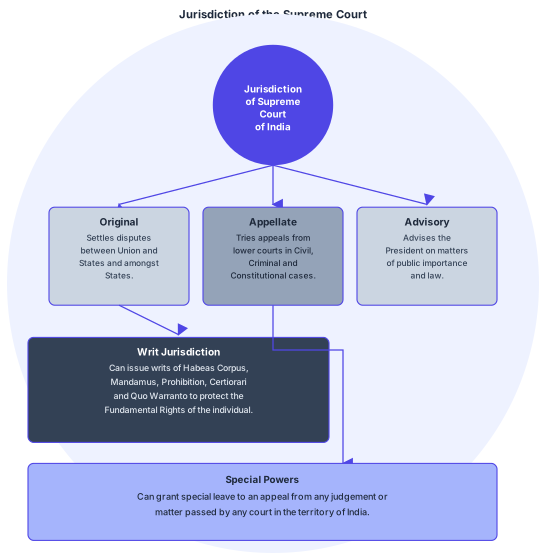
Drawn by us to help you understand the concept clearly, and verified to make sure it's accurate. For exams, practice from your NCERT textbook's own diagram.
Radial diagram of the Jurisdiction of the Supreme Court of India, branching into Original, Appellate and Advisory jurisdiction, with the Writ jurisdiction (Habeas Corpus, Mandamus, Prohibition, Certiorari and Quo Warranto) and the Court's Special Powers to grant special leave to appeal. Own-illustrated for this platform from the real NCERT page's own facts (composition, labels, and content are recreated; the specific artistic render …
Broadly, the Supreme Court's jurisdiction falls into three main categories, plus one closely related power that touches all of them:
- Original Jurisdiction — cases the Supreme Court alone can hear directly, chiefly disputes between the Union and a State, or between two or more States.
- Appellate Jurisdiction — the power to hear appeals against decisions of lower courts in civil, criminal, and constitutional cases.
- Advisory Jurisdiction — the power to advise the President on matters of public importance or constitutional interpretation, when the President chooses to seek that advice.
- Writ Jurisdiction — a closely connected power, under which the Court can issue writs of Habeas Corpus, Mandamus, Prohibition, Certiorari, and Quo Warranto to protect an individual's Fundamental Rights. …