Sociology · Ch 3 — Understanding Social Institutions
Education
Education
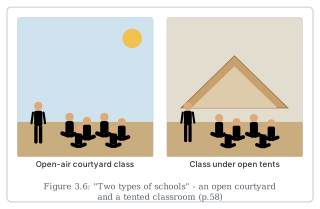
Drawn by us to help you understand the concept clearly, and verified to make sure it's accurate. For exams, practice from your NCERT textbook's own diagram.
Children taught by a teacher on an open courtyard, and children seated under open tents with a teacher, show two very different physical conditions under which formal schooling actually happens in India. The chapter uses this contrast to make the point that access to education -- an institution meant to be universal -- is itself unev …
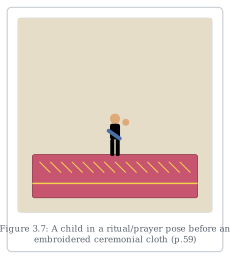
Drawn by us to help you understand the concept clearly, and verified to make sure it's accurate. For exams, practice from your NCERT textbook's own diagram.
A child photographed in a ritual or prayer pose, before an ornately embroidered ceremonial cloth, illustrates how religious and cultural practice is transmitted to children from an early age -- an early, informal form of education that happens al …
Education is a lifelong process that runs through both formal institutions, such as schools, and informal ones, such as the family or community. This chapter, however, narrows its focus to formal school education specifically. Nearly everyone recognises how much getting into a school matters -- for many, school is a step towards higher education and eventually employment; for others, it is valued chiefly as a way of acquiring social skills. What is common across these different motivations is simply a felt need for education, in some form, in every society.
Sociologically, this need for education is understood as a process by which each generation transmits the group's cultural heritage to the next. This requirement, however, is met very differently depending on how complex a society is. In simple societies, there was generally no need for formal schooling at all: children learned the customs and the broader way of life of their community simply by participating in the activities of the adults around them, picking up skills and values through everyday involvement rather than in a separate, dedicated institution. Complex, modern societies cannot rely on this informal method in the same way, because they involve an elaborate economic division of labour, a separation of paid work from the home, a need for specialised knowledge and skills that go well beyond what any one household can teach, the rise of large states and nations, and complex systems of shared symbols and ideas that a child cannot simply absorb by watching a few adults at close hand. Education in such societies therefore has to become formal and explicit -- organised through dedicated institutions with a deliberate curriculum, rather than left to informal imitation.
A related distinction concerns the kind of values modern schooling instils. Modern, complex societies rest on abstract, universalistic values -- ones that are meant to apply to everyone, in principle, regardless of their particular background -- in contrast to simple societies, which rely more on particularistic values rooted in family, kin, tribe, caste or religion, where what applies to a person depends heavily on which particular group they belong to. Schools in modern societies are deliberately designed to promote uniformity and standardised expectations consistent with these universalistic values -- a school uniform is one obvious example, but standardised timetables, curricula, examinations and codes of discipline serve the same purpose, treating every enrolled student, at least formally, according to the same set of rules regardless of their background.
Emile Durkheim argued that no society can hold together without a shared foundation -- a certain number of ideas, sentiments and practices that education is responsible for instilling in every child, whatever social group they come from. On this functionalist view, education does several things at once: it maintains and renews the wider social structure, it transmits and develops the society's culture across generations, and it prepares each child for a future occupation by helping them internalise the core values of their society. Education is also treated, functionally, as a mechanism for selecting and allocating individuals to their eventual roles in society -- in principle, a testing ground where ability, rather than birth, determines a person's future position.
Sociologists working from a conflict or stratification perspective read this same institution rather differently: for them, education functions as a major agent of social stratification in its own right, while at the same time, unequal access to educational opportunity is itself a product of existing social stratification. In practice, this means that the kind of school a child attends is shaped by their family's socio-economic background, and the kind of school they attend in turn shapes the privileges and future opportunities available to them -- some have argued that this dynamic actually widens the gap between an educated elite and the wider mass of the population, since children who attend well-resourced, privileged schools tend to grow up with a confidence that children in poorly resourced schools often do not get the same chance to develop. …