Sociology · Ch 3 — Understanding Social Institutions
Modern Forms of Work and Division of Labour
Modern Forms of Work and Division of Labour
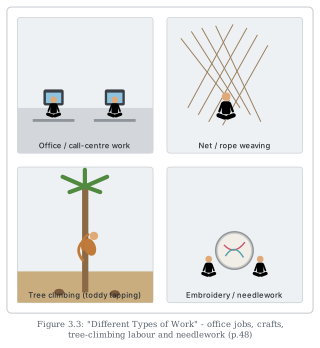
Drawn by us to help you understand the concept clearly, and verified to make sure it's accurate. For exams, practice from your NCERT textbook's own diagram.
Office/call-centre work, net or rope weaving, coconut-tree climbing, and embroidery are placed together to show the real range covered by the single word 'work' -- from modern service employment to traditional craft and agricultural skill. The chapter uses this range to challenge a narrow, factory-only …
In pre-modern societies, most people's work revolved around cultivating land or tending livestock. This picture has been transformed by industrialisation: in industrially developed societies, only a small proportion of the population now works directly in agriculture, and even farming itself has become industrialised, carried out increasingly through machinery rather than human or animal labour. India shows a more layered picture: a large share of its population is still engaged in rural, agriculture-based occupations, even as the service sector -- finance, retail, information technology and a wide range of other services -- has been expanding rapidly.
One of the most distinctive features of a modern economic system is how far the division of labour has developed: work is broken down into an enormous number of separate, specialised occupations rather than being performed in an undivided way by each worker. This marks a sharp change from earlier forms of work. In traditional societies, non-agricultural work generally meant mastering a craft -- something learned over a long period of apprenticeship under an experienced craftsperson, after which the worker would typically carry out every stage of production, from beginning to end, more or less alone. Modern factory work replaced this model with narrow specialisation: workers were trained to perform one specific, limited task within a much larger production process, and were paid a wage for that task alone, while managers took on the separate role of supervising the work, aiming to raise both productivity and workplace discipline.
This growing specialisation has gone hand in hand with an enormous expansion of economic interdependence. Where earlier generations, and people in simpler economies, produced much of what they consumed themselves, most people in modern societies do not grow the food they eat, build the houses they live in, or manufacture the goods they use. Instead, they depend on an immense, often invisible, network of other workers -- frequently spread across the entire world -- for nearly everything that sustains their daily lives. …