Sociology · Ch 3 — Understanding Social Institutions
Transformation of Work
Transformation of Work
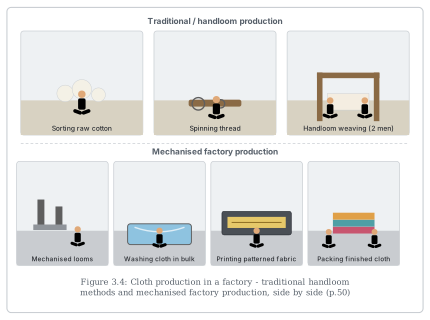
Drawn by us to help you understand the concept clearly, and verified to make sure it's accurate. For exams, practice from your NCERT textbook's own diagram.
Sorting raw cotton, spinning thread by hand, and two-person handloom weaving represent traditional cloth production; power looms, bulk washing, patterned-fabric printing and packing represent the mechanised factory alternative. Set side by side, the two rows are the chapter's worked example of how industrialisation transforms work -- the same end product, cloth, produced through radically differ …
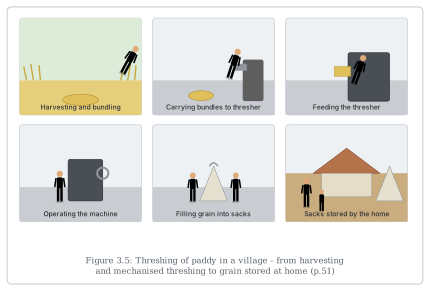
Drawn by us to help you understand the concept clearly, and verified to make sure it's accurate. For exams, practice from your NCERT textbook's own diagram.
Harvesting and bundling paddy, carrying it to a thresher, feeding and operating the machine, and finally filling and storing sacks of grain trace one complete agricultural work process in a village setting. The sequence illustrates the mix of manual labour, simple mechanisation, and household involvement (including children, as shown near t …
Industrialisation did not stop at moving work out of the home; it also transformed the internal organisation of the work process itself. Complex production tasks were broken down into a series of simple, narrowly defined operations, each of which could be precisely timed, organised and closely monitored. This reorganisation was driven by the demands of mass production, which in turn required mass markets large enough to absorb the vastly greater quantities of goods that could now be produced. One of the most significant innovations to emerge from this logic was the moving assembly line, which coordinated many workers, each performing one small, repeated operation, into a single continuous production process. Because the equipment involved was now expensive and central to output, modern industrial production also came to require continuous monitoring of employees -- through direct supervision and, increasingly, formal systems of monitoring or surveillance -- to ensure the pace and quality of work was maintained.
In more recent decades, a further shift has taken place, often described as a move towards 'flexible production' and the 'decentralisation of work'. In an era of intensified global competition between firms and between countries, it has become important for firms to be able to reorganise their production quickly to suit changing market conditions, rather than being locked into one rigid factory-based process. A study of the garment export industry in Bangalore illustrates what this newer system can mean for workers. The industry sits within a very long global supply chain, stretching from an international fashion designer at one end to the final consumer at the other, with well over a hundred distinct operations involved along the way -- of which the local manufacturer directly controls only a small fraction, roughly fifteen. This leaves individual manufacturers with very limited freedom of their own: if workers press seriously for higher wages, manufacturers can respond by shifting production to another location altogether, beyond the reach of local trade unions, since the whole point of a flexible, decentralised supply chain is that production can be moved wherever it is cheapest. Because of this, labour organisers in such industries have had to look beyond simply pressuring the local manufacturer or government; part of the strategy that has emerged is to build international pressure by enlisting the support of the retailers at the consumer end of the chain -- who have reputational reasons to care abo …