Sociology · Ch 3 — Understanding Social Institutions
Families are Linked to other Social Spheres and Families Change
Families are Linked to other Social Spheres and Families Change
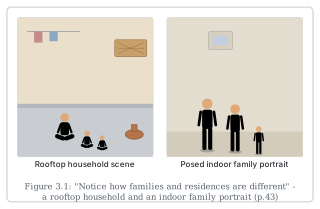
Drawn by us to help you understand the concept clearly, and verified to make sure it's accurate. For exams, practice from your NCERT textbook's own diagram.
A woman on a rooftop surrounded by household items and children, alongside a posed indoor family portrait, show two different material settings for family life. The chapter's point in pairing such images is that a family is never a sealed private unit -- its shape, size and daily rhythms are linked to the wider economic and social circumstances a household is …
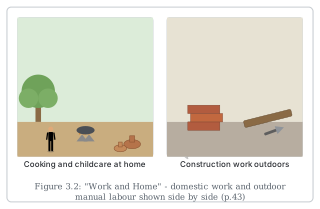
Drawn by us to help you understand the concept clearly, and verified to make sure it's accurate. For exams, practice from your NCERT textbook's own diagram.
A woman engaged in cooking and childcare outdoors, alongside a man doing outdoor construction work, illustrate how work and domestic life are not cleanly separated for many households -- and how the division of labour within the family is commonly, though not universally, organised along gender lines. This grounds the chapter's discussion of gende …
It is easy, in everyday life, to think of the family as a private world set apart from public arenas such as the economy or politics. Sociological evidence suggests the opposite: the family, the household and the norms that organise them are woven tightly into the rest of society, and they change as that wider society changes.
A striking illustration comes from Germany's reunification in the 1990s. Once the two German states merged, the new unified state withdrew many of the protections and welfare provisions that had previously supported families. As people's economic security grew shakier, marriage rates fell sharply -- not because attitudes to marriage as such had changed, but because a change in state policy had made the institution economically riskier to enter. This is a good example of what an earlier chapter called an unintended consequence: a policy aimed at economic reorganisation ended up reshaping an intimate institution like marriage almost as a side effect. …