Computer Science · Ch 3 — Emerging Trends
Characteristics of Big Data
Characteristics of Big Data
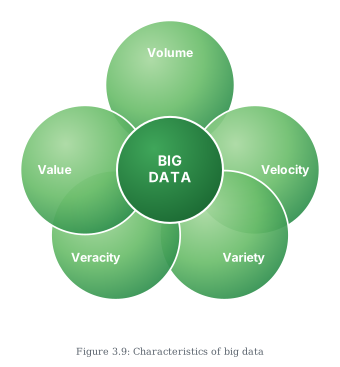
What makes a data set "big data" rather than just a large database? Big data exhibits five characteristics — often remembered as the five V's — that distinguish it from traditional data (Figure 3.9). A data set showing these traits needs big-data tools; a data set that lacks them can be handled conventionally.
(A) Volume
The most prominent characteristic is sheer size. If a data set is so large that it is difficult to process with traditional DBMS tools, it can be termed big data. Volume is the first test: conventional database systems simply cannot cope with data at this scale.
(B) Velocity
Velocity is the rate at which the data is being generated and stored. Big data is produced at an exponentially higher rate than traditional data sets — think of the continuous streams flowing from social media, sensors and smartphones, rather than a batch of records entered once a day.
(C) Variety
Variety means the data set contains varied kinds of data:
- structured data (neat rows and columns),
- semi-structured data, and
- unstructured data.
Examples include text, images, videos and web pages — formats that a traditional table-based system cannot store or query naturally.
(D) Veracity
Veracity refers to the trustworthiness of the data. Big data can be:
- inconsistent,
- biased,
- noisy, or
- contain abnormalities, or suffer from issues in how it was collected.
Veracity matters because processing incorrect data gives wrong results and misleads interpretations — garbage in, garbage out, at massive scale.
(E) Value
Big data is not merely a big pile of data — it may hold hidden patterns and useful knowledge of high business value. But extracting that value costs resources, so before investing in processing, one should make a preliminary enquiry into the data's potential for value discovery. If the data has little to offer, the effort of processing it would be in vain.
Quick recap table
| Characteristic | Asks | Big data's answer |
|---|---|---| …
Drawn by us to help you understand the concept clearly, and verified to make sure it's accurate. For exams, practice from your NCERT textbook's own diagram.
This diagram presents the five characteristics of big data as a flower-like arrangement: a central green circle labelled BIG DATA, surrounded by five overlapping green-gradient circles placed like petals around it. Reading around the arrangement — Volume at the top, Velocity at the right, Variety at the bottom right, Veracity at the bottom left and Value at the left.
The layout carries the meaning. Placing BIG DATA at the centre with the five circles overlapping it says that all five characteristics together define big data — no single one is sufficient. A data set qualifies as big data when it shows:
- Volume — enormous size, beyond what traditional DBMS tools can process;
- Velocity — an exponentially higher rate of generation and storage than traditional data;
- Variety — a mix of structured, semi-structured and unstructured data (text, images, videos, web pages);
- Veracity — questions of trustworthiness, since the data may be inconsistent, biased or noisy;
- Value — hidden patterns and useful knowledge that may justify the cost of processing. …