Q.With the help of a schematic diagram only, show in three steps, the formation of recombinant DNA by the action of restriction endonuclease – EcoRI and DNA ligase.
You're viewing a preview — the full solution, concept, methods & PYQ mapping are locked.
Start your 14-day free trial to unlock the full solution →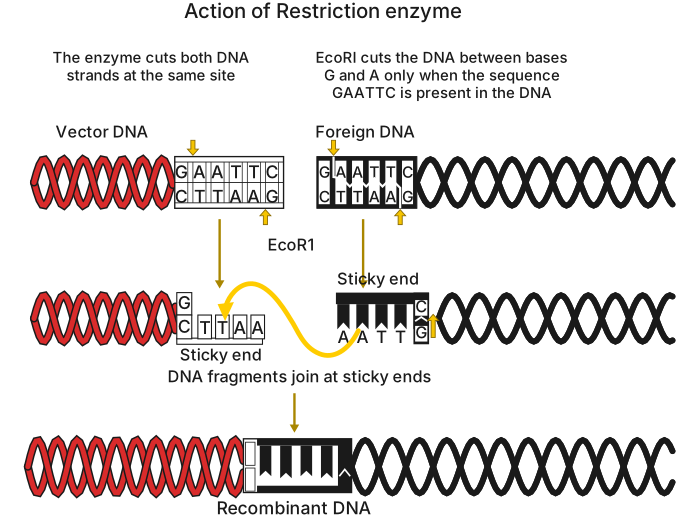
Restriction enzymes like EcoRI cut DNA at specific palindromic sequences, leaving sticky ends that allow a foreign DNA fragment to be joined with a vector using DNA ligase, forming recombinant DNA.
The story of recombinant DNA begins with a pair of molecular scissors and a tube of glue. In nature, bacteria produce restriction endonucleases — enzymes that chop up invading viral DNA at precise recognition sites. EcoRI, one of the most studied of these enzymes, recognises the six-base-pair sequence GAATTC. What makes it special is that it cuts not straight across both strands, but in a staggered fashion, leaving short, single-stranded overhangs. These overhangs are called "sticky ends" because they can base-pair with complementary sequences.
Now imagine you have a circular piece of bacterial DNA called a plasmid — your vector. You also have a gene of interest from another organism, say a human insulin gene, that you want to insert into the plasmid. Both the plasmid and the human DNA are treated separately with EcoRI. Because the recognition site GAATTC occurs in both, each gets cut at those specific points. The plasmid opens up, and the human gene fragment acquires matching sticky ends.
Here is where the schematic diagram comes in — though I describe it in words, you should visualise three clear steps:
Step 1: Cutting with EcoRI
Draw a double-stranded DNA molecule with the sequence GAATTC on one strand and CTTAAG on the other. Show EcoRI cutting between G and A on the top strand, and between A and G on the bottom strand. The result: two fragments, each with a single-stranded overhang — AATT on one end, TTAA on the other.
Step 2: Mixing the cut fragments
Now take the cut plasmid (now linear with sticky ends) and the cut human DNA fragment (also with sticky ends). Because the overhangs are complementary, the human fragment's sticky ends base-pair with the plasmid's sticky ends through hydrogen bonding. This brings the two pieces together, but they are only held by weak forces — not yet covalently joined.
Step 3: Sealing with DNA ligase …
Unlock everything free for 14 days
- Full step-by-step solutions
- Concept-first explanations
- Methods, shortcuts & mistakes
- PYQ mapping + timed mock tests
Full access for 14 days. No credit card required.