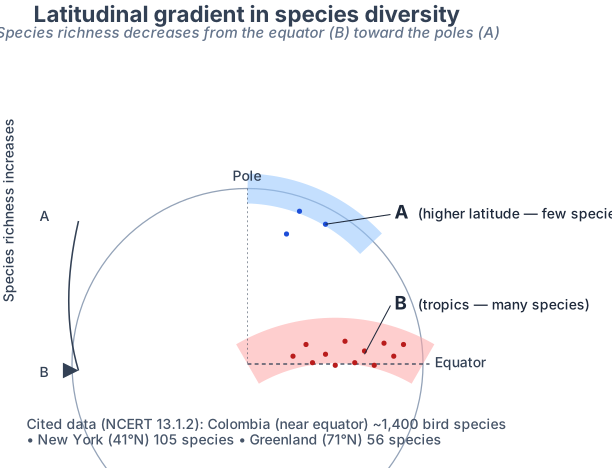
Q.Study the diagrammatic representation given below of the Earth with regions marked 'A' and 'B' respectively. Answer the questions that follow.
🔒You're viewing a preview — the full solution, concept, methods & PYQ mapping are locked.
🔒 Start your 14-day free trial to unlock the full solution →Part (a)Concept understanding — Biodiversity Explanation
Biodiversity: The Web of Life Around You
Imagine walking into a kitchen garden. You see a few tomato plants, some mint, maybe a rose bush. Now imagine walking into a forest — hundreds of tree species, birds calling from every direction, insects crawling under leaves, fungi on the bark, and a stream with tiny fish. That staggering variety of living things — from the tallest tree to the invisible bacteria in the soil — is what we call biodiversity.
The Simple Intuition
Biodiversity is short for biological diversity. Think of it as the "variety of life" on Earth. Just as a library with only one kind of book is boring and limited, an ecosystem with only one kind of plant or animal is fragile and poor. Biodiversity is nature's library — the more species, the richer and more stable the system.
The Precise Meaning
The NCERT textbook defines biodiversity as:
The variety of living organisms present on Earth, including the different plants, animals, fungi, and microorganisms, their genes, and the ecosystems they form.
This definition has three layers, and each matters:
- Genetic diversity — variation within a species. For example, all humans are one species, but we have different eye colours, heights, and resistance to diseases. In crops, genetic diversity means some wheat varieties resist drought while others resist pests.
- Species diversity — the number of different species in a region. A tropical rainforest has thousands of species; a cold desert has very few.
- Ecological diversity — the variety of habitats, ecosystems, and communities. A forest, a grassland, a coral reef, and a pond are all different ecosystems.
Biodiversity is not just about counting species. It includes the genes inside each species and the ecosystems they create together. Lose one layer, and the others suffer.
Why Does Biodiversity Matter?
For a commerce or humanities student, the question is natural: why should I care about how many beetles live in a forest? The answer is that biodiversity is the foundation of everything we use and consume.
Direct economic value — We depend on biodiversity for food (crops, fish, livestock), medicine (many drugs come from plants and fungi), raw materials (timber, cotton, rubber), and tourism (wildlife sanctuaries, national parks).
Indirect value — This is harder to see but more critical. Forests clean the air, wetlands purify water, bees pollinate crops, and soil microbes recycle nutrients. These are called ecosystem services. If biodiversity collapses, these services stop — and no technology can replace them at scale.
Ethical and cultural value — Every species has a right to exist, regardless of its usefulness to humans. Many cultures, especially in India, revere certain trees, animals, and rivers as sacred. Biodiversity is also a source of beauty, inspiration, and knowledge.
The NCERT textbook emphasises that biodiversity is our life insurance. It gives us resilience — when one species fails due to disease or climate change, another can take its place. A system with low biodiversity (like a wheat monoculture) is one disease away from collapse.
A Quick Look at India's Biodiversity
India is one of the world's mega-diverse countries. Though it has only 2.4% of the world's land area, it contains about 8% of all known species. This includes:
- Over 45,000 plant species
- More than 90,000 animal species
- 10 biogeographic zones — from the Himalayas to the Western Ghats to the Andaman Islands
This richness is not accidental. India's varied climate, geography, and ancient landmass have allowed many species to evolve and survive here.
The Threat: Why We Talk About It …
Part (b)Concept understanding — Biodiversity Explanation
Biodiversity: The Web of Life Around You
Imagine walking into a kitchen garden. You see a few tomato plants, some mint, maybe a rose bush. Now imagine walking into a forest — hundreds of tree species, birds calling from every direction, insects crawling under leaves, fungi on the bark, and a stream with tiny fish. That staggering variety of living things — from the tallest tree to the invisible bacteria in the soil — is what we call biodiversity.
The Simple Intuition
Biodiversity is short for biological diversity. Think of it as the "variety of life" on Earth. Just as a library with only one kind of book is boring and limited, an ecosystem with only one kind of plant or animal is fragile and poor. Biodiversity is nature's library — the more species, the richer and more stable the system.
The Precise Meaning
The NCERT textbook defines biodiversity as:
The variety of living organisms present on Earth, including the different plants, animals, fungi, and microorganisms, their genes, and the ecosystems they form.
This definition has three layers, and each matters:
- Genetic diversity — variation within a species. For example, all humans are one species, but we have different eye colours, heights, and resistance to diseases. In crops, genetic diversity means some wheat varieties resist drought while others resist pests.
- Species diversity — the number of different species in a region. A tropical rainforest has thousands of species; a cold desert has very few.
- Ecological diversity — the variety of habitats, ecosystems, and communities. A forest, a grassland, a coral reef, and a pond are all different ecosystems.
Biodiversity is not just about counting species. It includes the genes inside each species and the ecosystems they create together. Lose one layer, and the others suffer.
Why Does Biodiversity Matter?
For a commerce or humanities student, the question is natural: why should I care about how many beetles live in a forest? The answer is that biodiversity is the foundation of everything we use and consume.
Direct economic value — We depend on biodiversity for food (crops, fish, livestock), medicine (many drugs come from plants and fungi), raw materials (timber, cotton, rubber), and tourism (wildlife sanctuaries, national parks).
Indirect value — This is harder to see but more critical. Forests clean the air, wetlands purify water, bees pollinate crops, and soil microbes recycle nutrients. These are called ecosystem services. If biodiversity collapses, these services stop — and no technology can replace them at scale.
Ethical and cultural value — Every species has a right to exist, regardless of its usefulness to humans. Many cultures, especially in India, revere certain trees, animals, and rivers as sacred. Biodiversity is also a source of beauty, inspiration, and knowledge.
The NCERT textbook emphasises that biodiversity is our life insurance. It gives us resilience — when one species fails due to disease or climate change, another can take its place. A system with low biodiversity (like a wheat monoculture) is one disease away from collapse.
A Quick Look at India's Biodiversity
India is one of the world's mega-diverse countries. Though it has only 2.4% of the world's land area, it contains about 8% of all known species. This includes:
- Over 45,000 plant species
- More than 90,000 animal species
- 10 biogeographic zones — from the Himalayas to the Western Ghats to the Andaman Islands
This richness is not accidental. India's varied climate, geography, and ancient landmass have allowed many species to evolve and survive here.
The Threat: Why We Talk About It …
Part (a)
(Regions A and B represent a latitudinal gradient — A at higher latitudes/poles, B towards the equator/tropics.)
(a) Observation and two reasons. Moving from region A to region B, species diversity increases (species richness is greatest in the tropics). Two reasons:
- More constant/undisturbed environment: tropical regions were largely spared the drastic glaciations of temperate zones and have had a long, uninterrupted evolutionary time, allowing more species to accumulate and specialise.
- More solar energy / higher productivity: the tropics receive more sunlight, giving greater productivity that can support more species and more complex food webs. …
Part (a): from region A (poles/temperate) to region B (tropics) species diversity increases — because of a constant, long-undisturbed environment and greater solar energy/productivity; India records about 1,200 bird species due to its varied tropical habitats.
Part (b): the Amazonian tropical rainforest records the greatest biodiversity, thanks to a constant warm-moist climate, high productivity and long evolutionary time.
Part (a)
The diagram shows a latitudinal gradient in diversity: region A lies at higher latitudes (towards the poles / temperate belt) and region B lies at lower latitudes (towards the equator / the tropics).
(a) Observation and reasons. As one moves from region A towards region B, species diversity (species richness) increases markedly — in general, diversity is highest in the tropics and decreases towards the poles. A tropical forest may hold hundreds of species in a small area, while a comparable temperate or boreal area holds far fewer. Two reasons for this pattern are:
-
Constancy of the tropical environment and long evolutionary time. Unlike temperate regions, which faced frequent, severe glaciations, the tropics have remained relatively undisturbed for millions of years. This long, uninterrupted period of favourable conditions has allowed more speciation and greater niche specialisation, so more species have accumulated and persisted.
-
Greater availability of solar energy / higher productivity. The tropics receive more solar energy throughout the year, which drives higher primary productivity. More energy at the base of the food web supports larger populations, more complex food webs and, therefore, a greater number of coexisting species. …
Showing the 12 most recent of 39 on this concept.
- CBSE 2026Set A1 markMCQQ.How many mega-biodiversity countries are there in the world?(a) 25(b) 34(c) 14(d) 17
›Reveal solutionSolution
The world has 17 megadiverse countries that together hold most of the Earth's species; India is one of them.
A small number of countries lying largely within the tropics harbour a very large share of the world's biodiversity. These are termed megadiverse (mega-biodiversity) countries and number 17, including …
- CBSE 2026Set A1 markMCQQ.Which region got comparatively shorter span of time for species evolution and diversification due to frequent glaciation?(a) temperate region(b) tropical region(c) polar region(d) glaciation occurred in all regions
›Reveal solutionSolution
Tropics stayed relatively undisturbed and had more evolutionary time; temperate regions faced frequent glaciations, giving less time for diversification.
One explanation for the greater species richness of the tropics is time: tropical latitudes have remained relatively undisturbed for millions of years, providing a long, stable period for species to evolve and diversify. Temperate regions, in contrast, were subj …
- CBSE 2026Set ANNUAL1 markQ.Fill in the blank: When a species become extinct, the plant and animal species associated with an obligatory way also become extinct. It is called ______.
›Reveal solutionSolution
The linked extinction of dependent species along with the species they rely on is called co-extinction.
Many species are so closely dependent on another species (for food, host or partner) that they cannot survive without it. When such a host or partner species becomes extinct, the plants and animals that were obligately associated with it also die out. This linked loss is called co-extinction, for exa …
- CBSE 2026Set ANNUAL1 markMCQQ.The possible reason for extinction of Steller's sea cow is due to –(a) Alien species invasion(b) Over exploitation(c) Habitat Loss(d) Co-extinction
›Reveal solutionSolution
Steller's sea cow became extinct because humans hunted it excessively — an example of over-exploitation.
Over-exploitation is one of the major causes of biodiversity loss ("The Evil Quartet"): when a resource is harvested by humans faster than it can replenish, the species declines to extinction. Steller's sea cow (Hydrodamalis gigas) was a large, docile marine mammal that was kill …
- CBSE 2025Set F1 markMCQQ.Where are woody lianas / climbers found?(a) Taiga(b) Deciduous forest(c) Tropical rain forest(d) Shrub (chaparral)
›Reveal solutionSolution
Woody lianas (large climbers) are typical of tropical rain forests.
Lianas are thick, woody climbing plants that root in the ground but use tall trees to reach sunlight in the canopy. They flourish in the warm, humid, densely vegetated tropical rain forest, which has the highest biodiversity and vertical stratification of any biome. Taiga (coniferous), temperate deciduous fore …
- CBSE 2025Set F1 markMCQQ.Which of the following terms is used for the population found in a particular area?(a) Natural(b) Endemic(c) Alien(d) Pandemic
›Reveal solutionSolution
Species/populations confined to a particular area are termed endemic.
Endemic refers to a species or population whose natural occurrence is restricted to one particular geographic area and is found nowhere else (for example, many species endemic to the Western Ghats). "Alien" species, by contrast, are introduced from outside a region, and "pandemic" refers …
- CBSE 2025Set ZOOLOGY1 markMCQQ.Which term is used for the conservation of biodiversity outside the natural habitat?(i) In vivo(ii) Ex situ(iii) In situ(iv) In vitro
›Reveal solutionSolution
Ex situ conservation protects biodiversity outside the natural habitat (zoos, botanical gardens, seed/gene banks, etc.).
Conservation strategies are of two main types:
- In situ conservation — protecting species within their natural habitat (national parks, sanctuaries, biosphere reserves).
- Ex situ conservation — protecting species outside their natural habitat, e.g. zoological parks, botanical gardens, wildlife safari parks, seed banks, gene banks, cryopreservation and tissue culture. …
- CBSE 2024Set E1 markMCQQ.Biodiversity of India is what percentage of the total global species diversity?(a) 2.4%(b) 8.1%(c) 5%(d) 9%
›Reveal solutionSolution
India holds 8.1% of global species diversity on just 2.4% of the world's land area — making it a megadiversity country.
Despite occupying only about 2.4% of the world's land area, India accounts for 8.1% of the total global species diversity. This makes India one of the 17 mega-diverse countries of the world. The contrast between th …
- CBSE 2024Set D1 markQ.Answer in one sentence: What is called 'lungs of the earth'?
›Reveal solutionSolution
The Amazon rain forest is popularly termed the 'lungs of the earth' because of its enormous contribution to global oxygen production and carbon dioxide absorption.
The Amazon rain forest of South America is the largest tropical rain forest on Earth, harbouring an extraordinarily rich diversity of plant and animal life — estimated to house more species than anywhere else on the planet.
…
- CBSE 2024Set ANNUAL1 markMCQQ.Which of the following statements is not true?(a) Species diversity decreases as we move from equator towards the poles(b) Species diversity decreases as we move from pole towards equator(c) Tropics harbour more species than temperate or polar areas(d) Colombia located near the equator has nearly 1400 species of birds
›Reveal solutionSolution
The well-established latitudinal gradient in biodiversity is that species richness is highest near the equator and decreases towards the poles - so a statement claiming diversity decreases going FROM the pole TOWARDS the equator has it backwards.
Ecologists have long recognised that species diversity shows a clear latitudinal gradient: it is generally richest in the tropics and declines progressively as one moves from the equator towards the poles. Tropical regions (like the Amazonian rainforest in South America, believed to harbour the largest number of plant and animal species of any biome) support far greater species richness than temperate or polar regions, e.g. Colombia, located near the equator, has about 1,400 bird specie …
- CBSE 2024Set ANNUAL1 markQ.Where is the highest biodiversity found on earth?
›Reveal solutionSolution
Species richness peaks in tropical regions near the equator, and tropical rainforests, especially the Amazon, are considered the single richest reservoir of biodiversity on Earth.
Although tropical regions cover less than 7% of the Earth's land surface, they are estimated to hold over 50% of all species. Among these, tropical rainforests - most famously the Amazon rainforest spanning parts of Brazil, Peru, Colombia and neighbouring countries - are thought to harbour the largest concentration of plant and animal species of any biome, t …
- CBSE 2024Set ANNUAL1 markQ.Biodiversity is the term popularized by the sociobiologist _____ to describe the combined diversity at all the levels of biological organization
›Reveal solutionSolution
'Biodiversity' was popularised as a term by the American sociobiologist Edward Wilson.
The term 'biological diversity' was used first by wildlife scientist and conservationist Raymond F. Dasmann, but it was the sociobiologist Edward Wilson (E. O. Wilson) who popularised the now-familiar contracted term 'biodiversity', to describe the combined diversity at …
🎓Unlock everything free for 14 days
- ✓Full step-by-step solutions
- ✓Concept-first explanations
- ✓Methods, shortcuts & mistakes
- ✓PYQ mapping + timed mock tests
Full access for 14 days. No credit card required.