Q.For the following question, two statements are given — one labelled Assertion (A) and the other labelled Reason (R). Select the correct answer from the codes (A), (B), (C) and (D) given below. Assertion (A) : n-Butyl chloride has higher boiling point than n-Butyl bromide. Reason (R) : C – Cl bond is more polar than C – Br bond. (A) Both Assertion (A) and Reason (R) are true and Reason (R) is the correct explanation of the Assertion (A). (B) Both Assertion (A) and Reason (R) are true, but Reason (R) is not the correct explanation of the Assertion (A). (C) Assertion (A) is true, but Reason (R) is false. (D) Assertion (A) is false, but Reason (R) is true.
🔒You're viewing a preview — the full solution, concept, methods & PYQ mapping are locked.
🔒 Start your 14-day free trial to unlock the full solution →Concept understanding — Boiling Point Trend of Haloalkanes
Boiling Point Trend of Haloalkanes
Think about what boiling actually means. To turn a liquid into a vapour, you have to pull the molecules apart from each other. The stronger the forces holding them together, the more heat you need — and the higher the boiling point.
In haloalkanes, the only forces between molecules are van der Waals forces (also called London dispersion forces). These are temporary, weak attractions that arise because electrons move around and create fleeting positive and negative patches. The bigger the molecule, the more electrons it has, and the stronger these forces become.
So the first rule is simple: larger molecules boil at higher temperatures.
The Three Factors That Control Boiling Point
1. Size of the alkyl chain.
A longer carbon chain means more electrons and a larger surface area for neighbouring molecules to "grip" each other. Compare chloromethane (CH₃Cl, bp –24°C) with chloroethane (CH₃CH₂Cl, bp 12°C) and chloropropane (CH₃CH₂CH₂Cl, bp 47°C). Each extra carbon adds roughly 30–40°C to the boiling point.
2. Mass of the halogen atom.
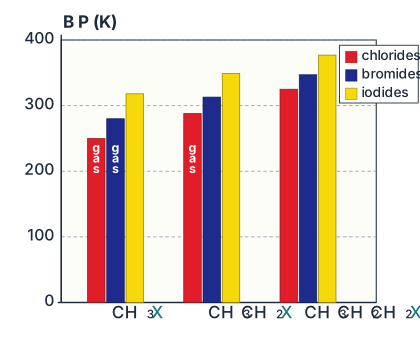
For the same alkyl group, a heavier halogen gives a higher boiling point. Fluorine is tiny and light; iodine is huge and heavy. More electrons in the halogen mean stronger dispersion forces. So the order is:
R–F < R–Cl < R–Br < R–I
For example: CH₃F (–78°C), CH₃Cl (–24°C), CH₃Br (4°C), CH₃I (42°C). The trend is clear and consistent.
Both trends — longer chain and heavier halogen — are visible together in NCERT's own comparison chart:
3. Branching of the carbon chain.
This is where intuition often goes wrong. A branched molecule has the same number of carbons as a straight-chain one — so why does it boil lower?
The answer is surface area. A straight chain is long and thin, offering a large surface for neighbouring molecules to touch. A branched chain is more compact and ball-like, with less surface exposed. Less surface contact means weaker van der Waals forces, and therefore a lower boiling point.
Think of two magnets: a long bar magnet can touch another along its whole length, but a crumpled ball of magnets only touches at a few points. Same mass, less grip.
Compare pentane (straight chain, bp 36°C) with 2-methylbutane (one branch, bp 28°C) and 2,2-dimethylpropane (highly branched, bp 9°C). All have five carbons, but the boiling points drop sharply as branching increases.
The Precise Statement
For haloalkanes, boiling point increases with: …
Concept: Boiling Point Trends in Alkyl Halides
The boiling point of alkyl halides depends primarily on molecular mass and van der Waals forces, not just bond polarity.
Step 1: Check the assertion. n-Butyl chloride (CX4HX9Cl, MW ≈ 92.5 g/mol) boils at ~78 °C, while n-butyl bromide (CX4HX9Br, MW ≈ 137 g/mol) boils at ~101 °C. The assertion claims chloride has a higher boiling point — this is false. Bromide actually boils higher due to greater molecular mass and stronger dispersion forces.
Step 2: Check the reason. Electronegativity: Cl (3.0) > Br (2.8), so the C−Cl bond is indeed more polar than C−Br. The reason is true. …
Boiling points of alkyl halides depend primarily on molecular mass and van der Waals forces, not bond polarity. n-Butyl bromide (heavier) boils higher than n-Butyl chloride, making the assertion false; the C–Cl bond is more polar than C–Br, making the reason true.
The question tests whether you understand what actually governs boiling points in alkyl halides. Many students fall into the trap of thinking "more polar → higher boiling point," but that reasoning breaks down here.
Why boiling point depends on molecular mass, not just polarity
Boiling point measures the energy needed to overcome intermolecular forces. For alkyl halides, the dominant force is van der Waals (London dispersion) forces, which scale with:
- Molecular mass (heavier atoms → more electrons → stronger instantaneous dipole–induced dipole interactions)
- Surface area (larger molecules → more contact)
Dipole–dipole interactions do contribute when molecules are polar, but in the alkyl halide series, the van der Waals contribution from the halogen's mass overwhelms the polarity effect.
Step-by-step analysis
-
Check the Assertion: Does n-butyl chloride boil higher than n-butyl bromide?
The experimental boiling points are:
- n-Butyl chloride (CX4HX9Cl): 78 °C
- n-Butyl bromide (CX4HX9Br): 101 °C
n-Butyl bromide boils higher. The assertion is false.
-
Why does the heavier halide win?
Bromine (atomic mass 80) is much heavier than chlorine (35.5). The larger electron cloud in Br creates stronger London dispersion forces, raising the boiling point despite lower polarity.
-
Check the Reason: Is C–Cl more polar than C–Br?
Electronegativity values:
- Chlorine: 3.0
- Bromine: 2.8
- Carbon: 2.5
The C–Cl bond has a larger electronegativity difference (Δχ=0.5) than C–Br (Δχ=0.3), so C–Cl is indeed more polar. The reason is true.
-
Does the Reason explain the Assertion? …
- CBSE 2026Set ANNUAL1 markQ.Arrange the following set of compounds in order of increasing boiling points: 1-chloropropane, isopropyl chloride, 1-chlorobutane
›Reveal solutionSolution
Boiling point of haloalkanes increases with molecular mass/surface area and decreases with branching among isomers, fixing the order among these three compounds.
- 1-chloropropane, CH3CH2CH2Cl (C3H7Cl): a straight chain, bp≈46.6∘C.
- Isopropyl chloride (2-chloropropane), (CH3)2CHCl (C3H7Cl): the same molecular formula as 1-chloropropane but branched — the more compact, nearly spherical shape has less surface area available for van der Waals (London dispersion) contact with neighbouring molecules, so it boils lower, bp≈35.7∘C. …
- CBSE 2025Set 56/4/11 markMCQQ.For the following question, two statements are given — one labelled Assertion (A) and the other labelled Reason (R). Select the correct answer from the codes (A), (B), (C) and (D) given below. Assertion (A) : n-Butyl chloride has higher boiling point than n-Butyl bromide. Reason (R) : C – Cl bond is more polar than C – Br bond. (A) Both Assertion (A) and Reason (R) are true and Reason (R) is the correct explanation of the Assertion (A). (B) Both Assertion (A) and Reason (R) are true, but Reason (R) is not the correct explanation of the Assertion (A). (C) Assertion (A) is true, but Reason (R) is false. (D) Assertion (A) is false, but Reason (R) is true.
›Reveal solutionSolution
Boiling points of alkyl halides depend primarily on molecular mass and van der Waals forces, not bond polarity. n-Butyl bromide (heavier) boils higher than n-Butyl chloride, making the assertion false; the C–Cl bond is more polar than C–Br, making the reason true.
The question tests whether you understand what actually governs boiling points in alkyl halides. Many students fall into the trap of thinking "more polar → higher boiling point," but that reasoning breaks down here.
Why boiling point depends on molecular mass, not just polarity
Boiling point measures the energy needed to overcome intermolecular forces. For alkyl halides, the dominant force is van der Waals (London dispersion) forces, which scale with:
- Molecular mass (heavier atoms → more electrons → stronger instantaneous dipole–induced dipole interactions)
- Surface area (larger molecules → more contact)
Dipole–dipole interactions do contribute when molecules are polar, but in the alkyl halide series, the van der Waals contribution from the halogen's mass overwhelms the polarity effect.
Step-by-step analysis
-
Check the Assertion: Does n-butyl chloride boil higher than n-butyl bromide?
The experimental boiling points are:
- n-Butyl chloride (CX4HX9Cl): 78 °C
- n-Butyl bromide (CX4HX9Br): 101 °C
n-Butyl bromide boils higher. The assertion is false.
-
Why does the heavier halide win?
Bromine (atomic mass 80) is much heavier than chlorine (35.5). The larger electron cloud in Br creates stronger London dispersion forces, raising the boiling point despite lower polarity.
-
Check the Reason: Is C–Cl more polar than C–Br?
Electronegativity values:
- Chlorine: 3.0
- Bromine: 2.8
- Carbon: 2.5
The C–Cl bond has a larger electronegativity difference (Δχ=0.5) than C–Br (Δχ=0.3), so C–Cl is indeed more polar. The reason is true.
-
Does the Reason explain the Assertion? …
- CBSE 2025Set 56/5/11 markMCQQ.Two statements are given — one labelled as Assertion (A) and the other labelled as Reason (R). Select the correct answer from the codes (A), (B), (C) and (D) as given below. (A) Both Assertion (A) and Reason (R) are true and Reason (R) is the correct explanation of the Assertion (A). (B) Both Assertion (A) and Reason (R) are true, but Reason (R) is not the correct explanation of the Assertion (A). (C) Assertion (A) is true, but Reason (R) is false. (D) Assertion (A) is false, but Reason (R) is true. Assertion (A) : The boiling points of alkyl halides decrease in the order RI > RBr > RCl > RF. Reason (R) : The van der Waals forces of attraction decrease in the order RI > RBr > RCl > RF.
›Reveal solutionSolution
The boiling point trend RI > RBr > RCl > RF is driven by increasing molecular size and polarizability, which strengthen van der Waals forces. The Reason correctly identifies this cause, so both statements are true and the Reason is the correct explanation.
The question tests your understanding of how intermolecular forces — specifically van der Waals (London dispersion) forces — govern boiling points in a homologous series of alkyl halides. Let’s build the reasoning from the ground up.
Why boiling points depend on van der Waals forces
Boiling a liquid means overcoming the attractive forces between molecules so they can escape into the gas phase. For nonpolar or weakly polar molecules like alkyl halides, the dominant attractive force is the London dispersion force — a temporary, induced dipole interaction. The strength of these forces depends on two things: how easily the electron cloud can be distorted (polarizability) and how much surface area the molecule has for contact.
Larger atoms have more electrons and a more diffuse electron cloud, making them more polarizable. A more polarizable molecule develops stronger temporary dipoles, which in turn induce stronger dipoles in neighbours — leading to stronger van der Waals attractions and a higher boiling point.
Step-by-step reasoning
-
Identify the trend in the Assertion.
The given order is RI > RBr > RCl > RF. For a fixed alkyl group (say, methyl or ethyl), the boiling point increases as the halogen gets heavier: fluorine (the lightest) gives the lowest boiling point, iodine (the heaviest) gives the highest. This is a well-established experimental fact.
-
Connect the trend to molecular properties.
As you go down Group 17 (F → Cl → Br → I), the atomic size and number of electrons increase dramatically:
- Fluorine: 9 electrons, very small
- Chlorine: 17 electrons
- Bromine: 35 electrons
- Iodine: 53 electrons, very large
More electrons mean a larger, more polarizable electron cloud. The polarizability increases in the order F < Cl < Br < I.
-
Link polarizability to van der Waals forces.
Stronger polarizability → stronger temporary dipoles → stronger London dispersion forces between molecules. So the van der Waals attraction between alkyl halide molecules follows the same order: RF (weakest) < RCl < RBr < RI (strongest).
-
Check the Reason statement.
The Reason says: “The van der Waals forces of attraction decrease in the order RI > RBr > RCl > RF.” This is exactly the same order as the boiling points. Since stronger van der Waals forces require more energy to overcome, they lead to higher boiling points. So the Reason correctly explains why the boiling points follow that order. …
-
- CBSE 2025Set A1 markQ.Write alkyl halides RI, RF, RBr, RCl in decreasing order of boiling points.
›Reveal solutionSolution
For the same alkyl group R, boiling point of alkyl halides increases as the halogen gets heavier/bigger: RF < RCl < RBr < RI.
Boiling point of a covalent molecular compound depends mainly on the strength of the intermolecular (van der Waals/London dispersion) forces, which in turn depend on molecular mass and polarisability of the atoms. Going down the halogen group F → Cl → Br → I, both atomic size and the number of electrons increase sharply, making the electron cloud more polarisable — this produces much stronger London dispersion forces between molecules, and also increases molecular mass, both of which raise the boiling point …
- CBSE 2024Set ANNUAL1 markMCQQ.Arrange the following compounds in increasing order of their boiling points:(i) (CH3)2CH-CH2-Br (isobutyl bromide)(ii) CH3-CH2-CH2-CH2Br (n-butyl bromide)(iii) (CH3)3C-Br (tert-butyl bromide, i.e. CH3-C(CH3)(CH3)-Br)(a)(ii) <(iii) <(i)(b)(i) <(ii) <(iii)(c)(iii) <(i) <(ii)(d)(iii) <(ii) < (i)
›Reveal solutionSolution
Among isomeric haloalkanes, boiling point decreases as branching increases, because branching reduces the molecular surface area available for van der Waals (London dispersion) contact between molecules.
The three isomers (all C4H9Br):
- isobutyl bromide, (CH3)2CH-CH2-Br - one branch
- n-butyl bromide, CH3-CH2-CH2-CH2-Br - straight chain, no branching
- tert-butyl bromide, (CH3)3C-Br - most branched (three methyl groups on the C-Br carbon) …
- CBSE 2024Set ANNUAL1 markMCQQ.Assertion [A] : The boiling point of alkyl halides decreases in the order RI > RBr > RCl > RF for same alkyl group. Reason [R] : The boiling point of alkyl halide having chloride, bromide and iodides are higher than that of the hydrocarbon of comparable molecular mass.(a) Both [A] and [R] are true and [R] is the correct explanation of [A].(b) Both [A] and [R] are true, but [R] is not the correct explanation of [A].(c) [A] is true, but [R] is false.(d) [A] is false, but [R] is true.
›Reveal solutionSolution
Both statements are individually correct chemistry facts, but [R] compares halides to hydrocarbons, while [A] is about comparing halides to EACH OTHER — so [R] doesn't actually explain the trend stated in [A].
[A] For a given alkyl group, boiling point order RI>RBr>RCl>RF is TRUE — boiling point rises with the size/polarizability of the halogen (van der Waals forces increase down the halogen group despite similar dipole moments), and with increasing molar mass.
[R] Alkyl halides (Cl, Br, I) do have higher boiling points than hydrocarbons of comparable molecular mass — TRUE, because of their greater polarizability and the presence of a permanent C–X dipole (dipole-dipole interactions) in addition to van der Waals forces present in hydrocarbons.
…
- CBSE 2021Set OC1 markQ.Arrange the following compounds in increasing order of their boiling points: Bromomethane, Bromoform, Chloromethane, Dibromomethane
›Reveal solutionSolution
Among alkyl halides, boiling point rises with molecular mass and with the number of heavier halogen atoms present, since both increase the strength of van der Waals (London dispersion) forces between molecules.
Reasoning from structure to boiling point
All four compounds are small, only weakly polar haloalkanes, so intermolecular attraction is dominated by van der Waals (dispersion) forces, which grow stronger as molecular size/mass and the number of polarisable halogen atoms increase:
- Chloromethane, CH3Cl (M ≈ 50.5 g/mol) — smallest, only one Cl atom → weakest van der Waals forces → lowest boiling point (≈ –24 °C).
- Bromomethane, CH3Br (M ≈ 95 g/mol) — one Br atom, heavier and more polarisable than Cl → stronger forces than chloromethane (bp ≈ 3.6 °C). …
- CBSE 2021Set ANNUAL1 markMCQQ.Which of the following compound shows the highest boiling point?(a) CH3Cl(b) CH3Br(c) CH3F(d) CH3I
›Reveal solutionSolution
Boiling point of methyl halides rises with the size/polarizability of the halogen, not with dipole moment.
Although C–F and C–Cl bonds are more polar, boiling point of haloalkanes is governed mainly by the strength of van der Waals (London dispersion) forces, which increase with the size and polarizability of the halogen atom and with the molecular mass. Order of at …
- CBSE 2020Set 56/2/11 markMCQQ.Assertion (A) : Boiling points of alkyl halides decrease in the order R-I > R-Br > R-Cl > R-F. Reason (R) : Van der Waals forces decrease with increase in the size of halogen atom. (A) Both Assertion (A) and Reason (R) are true and Reason (R) is the correct explanation of the Assertion (A). (B) Both Assertion (A) and Reason (R) are true, but Reason (R) is not the correct explanation of the Assertion (A). (C) Assertion (A) is true, but Reason (R) is false. (D) Assertion (A) is false, but Reason (R) is true.
›Reveal solutionSolution
Boiling points of alkyl halides increase with halogen size (R-I > R-Br > R-Cl > R-F) because larger halogens create stronger van der Waals forces, not weaker ones. The assertion is true but the reason contradicts it. The correct option is (C).
Understanding Boiling Points and Intermolecular Forces
Boiling point reflects how much energy you need to separate molecules from one another in the liquid phase. For alkyl halides, which are essentially non-polar or weakly polar molecules, the dominant intermolecular force is the van der Waals force (specifically, London dispersion forces).
The strength of these dispersion forces depends on two factors: molecular size and the ease with which the electron cloud can be distorted—what we call polarizability. A larger electron cloud is more easily distorted, creating temporary dipoles that attract neighboring molecules more strongly.
Step-by-Step Analysis
-
Examine the Assertion
The assertion states that boiling points decrease in the order R-I > R-Br > R-Cl > R-F. This is actually stating that iodoalkanes have the highest boiling points and fluoroalkanes the lowest. Let's verify this with the actual trend.
-
The Real Trend in Alkyl Halides
As we move down the halogen group (F → Cl → Br → I), the halogen atom becomes larger. For example, in the series CH₃F, CH₃Cl, CH₃Br, and CH₃I:
- CH₃F: b.p. ≈ -78°C
- CH₃Cl: b.p. ≈ -24°C
- CH₃Br: b.p. ≈ 4°C
- CH₃I: b.p. ≈ 42°C
The boiling point increases as the halogen gets larger. So the assertion correctly describes this order.
-
Evaluate the Reason
The reason claims that "van der Waals forces decrease with increase in the size of halogen atom." This is where the problem lies. Let's think about what happens as halogen size increases:
- Iodine has 53 electrons in a diffuse cloud
- Fluorine has only 9 electrons in a compact cloud
The larger iodine atom is far more polarizable—its electron cloud can be distorted much more easily, creating stronger instantaneous dipole-induced dipole interactions.
-
The Contradiction
If van der Waals forces actually decreased with halogen size (as the reason states), then R-F would have the highest boiling point and R-I the lowest. But experimental data shows exactly the opposite. The reason is factually incorrect. …
-
- CBSE 2020Set ANNUAL1 markQ.Write the structure of the isomer that will have the lowest boiling point of all the isomers of C4H9Cl.
›Reveal solutionSolution
Among structural isomers, the most branched (most spherical) one has the least surface area for intermolecular contact and hence the lowest boiling point.
C4H9Cl has four structural isomers: 1-chlorobutane (n-butyl chloride, straight chain), 2-chlorobutane (sec-butyl chloride), 1-chloro-2-methylpropane (isobutyl chloride), and 2-chloro-2-methylpropane (tert-butyl chloride, most branched). Boiling point falls as branching increases, because a more branched (more compact/spherical) molecule has less surface area available for van der Waals contact with neighbouring molecules than an elongated stra …
- CBSE 2018Set ANNUAL1 markQ.For isomeric haloalkanes, the boiling point decreases with branching of chain. Why?
›Reveal solutionSolution
Boiling point depends on the strength of van der Waals forces, which in turn depend on the surface area available for intermolecular contact; branching reduces that surface area, so more-branched isomers boil at lower temperatures.
For isomeric haloalkanes (same molecular formula, same molar mass), the dominant intermolecular force is the van der Waals (London dispersion) force, whose strength depends heavily on the total surface area of contact between neighbouring molecules — the larger the contact area, the stronger the net attractive force, and the higher the boiling point.
- A straight-chain (unbranched) haloalkane has an elongated shape that allows extensive, close, side-by-side surface contact between neighbouring molecules — maximising van der Waals attraction.
- As branching increases, the molecule becomes more compact and closer to a spherical shape. A sphere has the minimum possible surface area for a given volume, so branched molecules present much less surface area for intermolecular contact, and can also approach each other less closely due to the bulky branches getting in the way. …
🎓Unlock everything free for 14 days
- ✓Full step-by-step solutions
- ✓Concept-first explanations
- ✓Methods, shortcuts & mistakes
- ✓PYQ mapping + timed mock tests
Full access for 14 days. No credit card required.