Q.Two transparent media of refractive indices and are separated by a spherical transparent surface. The rays of light incident on the surface get refracted into the medium on the other side. The laws of refraction are valid at each point of the spherical surface. A lens is a transparent optical medium bounded by two surfaces, at least one of which should be spherical. The focal length of a lens is determined by the radii of curvature ( and ) of its two surfaces and the refractive index () of the medium of the lens with respect to the surrounding medium. Depending on and , a lens behaves as a diverging or a converging lens. The ability of a lens to diverge or converge a beam of light incident on it defines its power.
You're viewing a preview — the full solution, concept, methods & PYQ mapping are locked.
Start your 14-day free trial to unlock the full solution →(a) The refraction formula at a single spherical surface depends on which medium the object and image lie in; for object in and image in , . (b) Virtual image in air. (c) Real, same size. (d) D. (e) Focal length remains .
(a) Refraction at a Single Spherical Surface
The key is to recognize which medium contains the object and which contains the image. The general refraction formula at a spherical surface separating two media is derived from Snell's law applied at every point on the surface, combined with the paraxial approximation (small angles).
The standard form when light travels from medium of refractive index (object side) to medium of refractive index (image side) is:
where is the object distance (measured from the surface), is the image distance, and is the radius of curvature (positive if the center of curvature is on the image side).
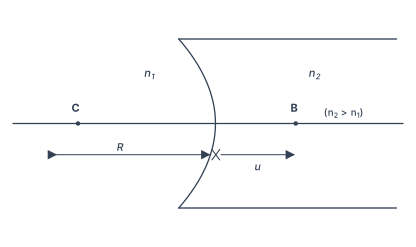
Looking at the figure description: the object is at point B on the right (in medium ), and the spherical surface is concave to the left with center C on the left (in medium ). Light travels from (where the object is) into (where the image will form).
When the object is in medium and the image forms in medium , we swap the roles:
This matches option (iv).
The most common mistake is blindly applying the formula without checking which medium contains the object. Always identify the direction of light propagation first.
The correct answer for (a) is (iv).
(b) Point Object at Distance from Convex Surface
A point object is placed in air () at distance from a convex spherical surface of radius , with glass (, typically ) on the other side.
Using the refraction formula (light going from air into glass):
Substituting , (object distance is negative in the sign convention where distances are measured from the surface, with the object on the left):
For typical glass with :
The negative sign indicates the image is on the same side as the object (in air), making it virtual.
When , the denominator is negative, guaranteeing a virtual image in air for this configuration.
The correct answer for (b) is (iv): virtual and formed in air.
(c) Object at in Front of Equiconvex Lens
An equiconvex lens has equal radii of curvature on both surfaces. When an object is placed at distance (twice the focal length), we use the thin lens equation:
Substituting (negative in the standard sign convention):
The positive value means the image is real (on the opposite side of the lens). The magnification is:
The magnitude means the image is the same size as the object. The negative sign indicates it is inverted.
The correct answer for (c) is (i): real and of the size of the object.
(d) Power of Lens Combination
When two thin lenses are placed in contact, their powers add:
Power is the reciprocal of focal length in meters:
For the converging lens with cm m:
For the diverging lens with cm m (negative for diverging): …
Unlock everything free for 14 days
- Full step-by-step solutions
- Concept-first explanations
- Methods, shortcuts & mistakes
- PYQ mapping + timed mock tests
Full access for 14 days. No credit card required.