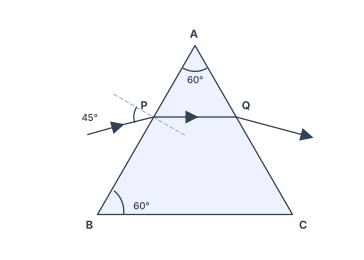
Q.A ray of light is incident on a prism at an angle of and passes symmetrically as shown in the figure. Calculate :
You're viewing a preview — the full solution, concept, methods & PYQ mapping are locked.
Start your 14-day free trial to unlock the full solution →For a prism with symmetric passage, the ray travels parallel to the base inside. Given and , the minimum deviation , refractive index , and the angle of refraction at P is .
The key insight here is that the problem states the ray "passes symmetrically" through the prism. In prism optics, symmetric passage means the ray inside the prism travels parallel to the base. This is the defining condition for minimum deviation — and it's the single most powerful simplification you can use.
When a ray passes symmetrically, two things become true automatically: the angle of incidence equals the angle of emergence (), and the two angles of refraction inside the prism are equal (). The figure shows an equilateral prism, so the apex angle . With given, you have everything you need.
Let's work through each part.
-
Find the angle of minimum deviation
For any prism, the deviation is given by . At minimum deviation, , so:
Substituting and :
The formula is only valid when the ray passes symmetrically (i.e., at minimum deviation). Don't use it for arbitrary incidence angles.
-
Find the refractive index of the prism material
The standard formula for refractive index at minimum deviation is:
This formula comes from applying Snell's law at the first face and using the geometry (which follows from and ).
Plug in and :
Now and , so:
…
Unlock everything free for 14 days
- Full step-by-step solutions
- Concept-first explanations
- Methods, shortcuts & mistakes
- PYQ mapping + timed mock tests
Full access for 14 days. No credit card required.