Q.A particle of mass m and charge q describes a circular path of radius R in a magnetic field. If its mass and charge were 2m and q/2 respectively, the radius of its path would be ______.
(A) R/4
(B) R/2
(C) 2R
(D) 4R
Concept understanding — Cyclotron Motion Radius
Cyclotron Motion Radius – From Intuition to Formula
Imagine you're pushing a charged ball on a frictionless table, and there's a giant magnet underneath. The moment that ball starts moving, the magnet doesn't pull it or push it forward — it turns it. The force from the magnet always acts sideways, perpendicular to the ball's velocity. So the ball never speeds up or slows down; it just keeps changing direction. If the magnetic field is uniform and the ball keeps moving, it will trace out a perfect circle.
That circle is called cyclotron motion, and the radius of that circle is what we're after.
Why does it curve at all?
The magnetic force on a moving charge is given by:
F=q(v×B)
The cross product means the force is always perpendicular to both the velocity v and the magnetic field B. For a charge moving perpendicular to a uniform field, this force acts as a centripetal force — it constantly pulls the charge toward the centre of a circle, without doing any work (since force is perpendicular to displacement).
So the charge moves in uniform circular motion. The magnetic force provides the necessary centripetal acceleration.
Deriving the radius
For circular motion, the centripetal force required is:
Fcentripetal=rmv2
where m is the mass of the particle, v is its speed, and r is the radius of the circle.
The magnetic force (for v⊥B) has magnitude:
FB=∣q∣vB
Set them equal:
∣q∣vB=rmv2
Cancel one factor of v (assuming v=0):
∣q∣B=rmv
Solve for r:
r=∣q∣Bmv
That's the cyclotron motion radius (also called the Larmor radius or gyroradius).
What the formula tells you
- Faster particle → larger radius (it's harder to turn something moving fast).
- Heavier particle → larger radius (more inertia resists the turn).
- Stronger magnetic field → smaller radius (the turning force is stronger).
- Larger charge → smaller radius (more force for the same field).
If the particle's velocity has a component parallel to B, it doesn't feel any magnetic force in that direction. So the particle moves in a helix — circular motion in the plane perpendicular to B, plus constant speed along B. The radius formula above still applies using only the perpendicular component of velocity, v⊥.
A quick example
A proton (m=1.67×10⁻²⁷ kg, q=1.6×10⁻¹⁹ C) moves at 2.0×10⁶ m/s perpendicular to a 0.50 T magnetic field.
r=(1.6×10⁻¹⁹)(0.50)(1.67×10⁻²⁷)(2.0×10⁶)=8.0×10−203.34×10−21=0.042 m
So the proton circles with a radius of about 4.2 cm.
Common mistake to avoid
The formula r=∣q∣Bmv uses the speed v, not velocity. And it assumes the velocity is perpendicular to B. If there's a parallel component, use only v⊥ in the numerator. The parallel component doesn't affect the radius — it just carries the particle along the field line.
Why "cyclotron"?
The name comes from the cyclotron, a particle accelerator that uses this exact principle. Particles spiral outward in a magnetic field, gaining energy from an alternating electric field each half-turn. The radius increases as the particle speeds up — exactly what the formula predicts.
Queries like "cyclotron radius formula derivation" and "moving charges and magnetism class 12 physics" are common, since this result comes straight from the Moving Charges and Magnetism chapter of the NCERT/CBSE Class 12 Physics curriculum. It's also a standard numerical-question type in JEE Main and NEET on charged-particle motion in magnetic fields.
Concept: Cyclotron motion radius — the radius of a charged particle’s circular path in a uniform magnetic field depends on momentum per unit charge.
Reasoning:
- For a particle moving perpendicular to a uniform magnetic field B, the centripetal force is provided by the magnetic force:
Rmv2=qvB
This simplifies to
R=qBmv
-
The problem does not specify whether speed v or kinetic energy is held constant. In standard cyclotron motion, the radius depends on the particle’s momentum p=mv. If only mass and charge change, and the particle is injected with the same speed v, then:
-
Original: R=qBmv
New: m′=2m, q′=q/2
R′=(q/2)B(2m)v=(q/2)B2mv=qB4mv=4R
The radius becomes 4R, so option (D) is correct: 4R.
The radius of cyclotron motion depends on the ratio m/q. When mass doubles and charge halves, the ratio quadruples, so the new radius is 4R.
The key idea here is that a charged particle moving perpendicular to a uniform magnetic field experiences a centripetal force provided by the magnetic Lorentz force. The radius of the circular path is not an independent quantity — it emerges from balancing these two forces.
For any such problem, always start from the force balance equation. The magnetic force is qvB, and the centripetal force required for circular motion is mv2/R. Setting them equal gives the radius directly.
- Write the force balance The magnetic force provides the centripetal force:
qvB=Rmv2
Cancel one factor of v (assuming v=0):
qB=Rmv
- Solve for the radius Rearranging:
R=qBmv
This is the standard formula for the cyclotron radius (also called the gyroradius or Larmor radius). Notice that R depends on the ratio m/q, not on m or q individually.
R=qBmv
-
Identify what changes
The problem states:
- New mass: m′=2m
- New charge: q′=q/2 The magnetic field B and the speed v are not mentioned as changing, so we assume they remain the same. (This is a standard assumption in such problems unless stated otherwise.)
-
Find the new radius
Substitute the new values into the formula:
R′=q′Bm′v=(q/2)B(2m)v=qB/22mv=qB2mv×2=qB4mv
But qBmv=R, so:
R′=4R
A common mistake is to treat mass and charge changes independently and guess R′=(2)/(1/2)R=R or something similar. Always combine them as a ratio: R∝m/q, so the factor is (m′/q′)/(m/q)=(2m)/(q/2)÷(m/q)=4.
You can think of it this way: doubling mass alone would double the radius (more inertia, harder to turn), but halving the charge also doubles the radius (weaker magnetic force). Two doublings multiply to give 4R.
The radius becomes 4R, so the correct option is (D).
Showing the 12 most recent of 13 on this concept.
- CBSE 2026Set DS1 markQ.An electron of energy 10 eV is revolving round a circular path in a uniform magnetic field of 10−5 tesla. Determine the radius of the circular path.
›Reveal solutionSolution
Using r=eB2mE, the radius comes out to about 1.07 m.
Concept. A charged particle moving perpendicular to a magnetic field goes in a circle whose radius is set by balancing the magnetic force against the centripetal requirement: qvB=rmv2, giving r=qBmv=qBp. The momentum is found from the kinetic energy, p=2mE.
Calculation. Kinetic energy E=10 eV=10×1.6×10−19=1.6×10⁻¹⁸ J.
p=2mE=2(9.1×10⁻³¹)(1.6×10⁻¹⁸)=2.912×10−48=1.71×10⁻²⁴ kg⋅m/s.
r=eBp=(1.6×10⁻¹⁹)(10−5)1.71×10−24=1.6×10−241.71×10⁻²⁴≈1.07 m.
✓Final answerr≈1.07 m.
- CBSE 2026Set A1 markMCQQ.If a charged particle of mass m and charge q enters a uniform magnetic field B at an angle θ in the direction of field with velocity v, then the path of the particle is helical. The radius of circular path of the helix will be (A) mv/qB (B) mv cosθ/qB (C) mv sinθ/qB (D) 2πmv/qB
›Reveal solutionSolution
The perpendicular component v sinθ gives circular motion; r = m v sinθ / qB.
When a charge enters a magnetic field at angle θ to B, resolve its velocity:
- Component along B: vcosθ — unaffected by the field, gives uniform motion along the axis (the pitch of the helix).
- Component perpendicular to B: vsinθ — experiences the magnetic force qvBsinθ, producing circular motion.
Setting magnetic force = centripetal force for the perpendicular component:
q(vsinθ)B=rm(vsinθ)2⇒r=qBmvsinθ.
✓Final answer(C) mv sinθ/qB.
- CBSE 2025Set 55/4/11 markMCQQ.A particle having charge +q enters a uniform magnetic field B as shown in the figure. The particle will describe: (A) a circular path in the XZ plane (B) a semicircular path in the XY plane (C) a helical path with its axis parallel to the Y-axis (D) a semicircular path in the YZ plane
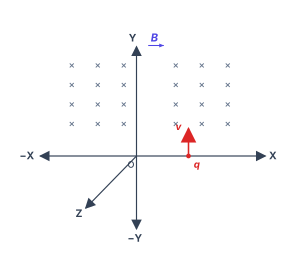
›Reveal solutionSolution
The charge enters with velocity along +Y and the field is into the page (−Z), so the magnetic force keeps it in the XY plane — the path is a semicircle in the XY plane. Option (B).
Reading the figure.
Figure — 55/4/1 Q3 The axes are X (right), Y (up) and Z (out of the page, toward the viewer). The × grid marks a uniform field into the page, i.e. B=−Bk^, filling the upper region. The charge +q sits on the +X axis and enters moving along +Y, so v=vj^.
Force direction.
F=qv×B=q(vj^)×(−Bk^)=−qvB(j^×k^)=−qvBi^
The force is along −X, i.e. it lies in the XY plane, perpendicular to v.
Nature of the path. Since v⊥B, the entire velocity is perpendicular to the field, so the motion is a circle of radius r=qBmv lying in the plane perpendicular to B — that is the XY plane. As the field fills only the upper region, the particle completes half the circle inside the field and exits, tracing a semicircle in the XY plane.
✓Final answer(B) a semicircular path in the XY plane.
- CBSE 2025Set 55/5/11 markMCQQ.A charged particle gains a speed of 106 ms−1 when accelerated from rest through a potential difference of 10 kV. It enters a region of magnetic field 0.4 T such that its velocity is perpendicular to the field. The radius of the circular path described by it is: (A) 2.5 cm (B) 5 cm (C) 8 cm (D) 10 cm
›Reveal solutionSolution
The radius of cyclotron motion is r=qBmv. Using the kinetic energy gained from the potential difference, we find the charge-to-mass ratio, then substitute into the radius formula to get 5 cm.
Why this works — the physics of circular motion in a magnetic field
When a charged particle moves perpendicular to a uniform magnetic field, the magnetic force acts as a centripetal force, bending the path into a circle. The key relation comes from equating:
qvB=rmv2
which simplifies to the cyclotron radius:
r=qBmv
The problem gives us v=106 m/s and B=0.4 T, but we don't directly know m/q — the mass-to-charge ratio of the particle. However, we can find it from the acceleration step: the particle was accelerated from rest through a potential difference of 10 kV=104 V.
Step-by-step solution
1. Find the kinetic energy gained
When a charge q is accelerated through a potential difference V, it gains kinetic energy equal to the work done by the electric field:
21mv2=qV
We know v=106 m/s and V=104 V. This gives us a direct relation between m and q.
2. Extract the charge-to-mass ratio
From 21mv2=qV, rearrange:
mq=2Vv2
Plug in the numbers:
mq=2×10⁴(106)2=2×1041012=2108=5×10⁷ C/kg
TipYou don't need to identify the particle — the ratio q/m is all that matters for the radius. This is a common exam trick: they give you v and V so you can find q/m without needing the particle's identity.
3. Write the radius formula in terms of known quantities
From r=qBmv, we can write:
r=Bv⋅qm=Bv⋅(q/m)1
This is cleaner because we have q/m directly.
4. Substitute and calculate
r=0.4106×5×1071
First, 0.4106=4/10106=106×410=4107=2.5×106
Then:
r=(2.5×106)×5×1071=52.5×10−1=0.5×0.1=0.05 m
Convert to centimetres: 0.05 m=5 cm.
Watch outA common mistake is to forget that V=10 kV means 104 V, not 103. Also, watch the unit conversion from metres to centimetres at the end — the options are in cm.
✓Final answerThe radius of the circular path is 5 cm, which corresponds to option (B).
- CBSE 2025Set 55/6/11 markMCQQ.A proton and an α-particle enter with the same velocity v in a uniform magnetic field B (with v⊥B). The ratio of the radii of their paths (rp:rα) is: (A) 2 (B) 21 (C) 41 (D) 4
›Reveal solutionSolution
When charged particles enter perpendicular to a magnetic field, the radius depends on momentum and charge: r=qBmv. Since the proton and α-particle have the same velocity but different mass-to-charge ratios, we find rp:rα=1:2.
Why the radius depends on mass and charge
When a charged particle moves perpendicular to a magnetic field, the Lorentz force acts as a centripetal force, bending the particle into a circular path. The magnetic force qvB must equal the centripetal force rmv2, which immediately tells us that heavier particles or those with less charge will trace larger circles.
The key insight: the radius is proportional to the particle's momentum-to-charge ratio. Two particles with the same velocity will have radii in the ratio of their qm values.
Step-by-step calculation
- Write the force balance equation The magnetic force provides the centripetal acceleration:
qvB=rmv2
- Solve for the radius Canceling one factor of v from both sides:
r=qBmv
r=qBmv
-
Identify the particle properties
- Proton: mass mp, charge qp=e
- α-particle (helium nucleus): mass mα=4mp, charge qα=2e
-
Write the radius for each particle
For the proton:
rp=eBmpv
For the α-particle:
rα=2eB4mpv=eB2mpv
- Form the ratio
rαrp=eB2mpveBmpv=eBmpv×2mpveB=21
The α-particle, despite being four times heavier, also carries twice the charge. The net effect is that it curves in a circle twice as large as the proton's path.
Watch outA common mistake is to think "heavier means larger radius" without accounting for charge. The α-particle's double charge partially compensates for its quadruple mass, so the radius ratio is not 1:4 but 1:2.
✓Final answerThe correct option is (B) 21.
- CBSE 2025Set IMPROVEMENT1 markMCQQ.If the velocity of a charged particle moving perpendicular to the direction of a uniform magnetic field is doubled and the value of the magnetic field is halved, then the radius of the path of the charged particle will become:(a) 8 times(b) Double(c) 4 times(d) 3 times
›Reveal solutionSolution
The radius of a charged particle's circular path in a magnetic field is r=qBmv; doubling v and halving B makes r four times larger.
For a charged particle moving perpendicular to a uniform magnetic field, the magnetic force provides the centripetal force: qvB=rmv2⟹r=qBmv.
Let the new velocity be v′=2v and new field B′=B/2. Then:
r′=qB′mv′=q(B/2)m(2v)=4(qBmv)=4r
✓Final answer(c) 4 times — the new radius becomes 4 times the original radius.
- CBSE 2024Set 55/5/11 markMCQQ.A particle of mass m and charge q describes a circular path of radius R in a magnetic field. If its mass and charge were 2m and q/2 respectively, the radius of its path would be ______. (A) R/4 (B) R/2 (C) 2R (D) 4R
›Reveal solutionSolution
The radius of cyclotron motion depends on the ratio m/q. When mass doubles and charge halves, the ratio quadruples, so the new radius is 4R.
The key idea here is that a charged particle moving perpendicular to a uniform magnetic field experiences a centripetal force provided by the magnetic Lorentz force. The radius of the circular path is not an independent quantity — it emerges from balancing these two forces.
For any such problem, always start from the force balance equation. The magnetic force is qvB, and the centripetal force required for circular motion is mv2/R. Setting them equal gives the radius directly.
- Write the force balance The magnetic force provides the centripetal force:
qvB=Rmv2
Cancel one factor of v (assuming v=0):
qB=Rmv
- Solve for the radius Rearranging:
R=qBmv
This is the standard formula for the cyclotron radius (also called the gyroradius or Larmor radius). Notice that R depends on the ratio m/q, not on m or q individually.
R=qBmv
-
Identify what changes
The problem states:
- New mass: m′=2m
- New charge: q′=q/2 The magnetic field B and the speed v are not mentioned as changing, so we assume they remain the same. (This is a standard assumption in such problems unless stated otherwise.)
-
Find the new radius
Substitute the new values into the formula:
R′=q′Bm′v=(q/2)B(2m)v=qB/22mv=qB2mv×2=qB4mv
But qBmv=R, so:
R′=4R
Watch outA common mistake is to treat mass and charge changes independently and guess R′=(2)/(1/2)R=R or something similar. Always combine them as a ratio: R∝m/q, so the factor is (m′/q′)/(m/q)=(2m)/(q/2)÷(m/q)=4.
TipYou can think of it this way: doubling mass alone would double the radius (more inertia, harder to turn), but halving the charge also doubles the radius (weaker magnetic force). Two doublings multiply to give 4R.
✓Final answerThe radius becomes 4R, so the correct option is (D).
- CBSE 2024Set 55/2/11 markMCQQ.Assertion (A) : An electron and a proton enter with the same momentum p in a magnetic field B such that p⊥B. Then both describe a circular path of the same radius. Reason (R) : The radius of the circular path described by the charged particle (charge q, mass m) moving in the magnetic field B is given by r=qBmv. (A) Both Assertion (A) and Reason (R) are true and Reason (R) is the correct explanation of the Assertion (A). (B) Both Assertion (A) and Reason (R) are true, but Reason (R) is not the correct explanation of the Assertion (A). (C) Assertion (A) is true, but Reason (R) is false. (D) Assertion (A) is false and Reason (R) is also false.
›Reveal solutionSolution
The radius of circular motion in a perpendicular magnetic field depends on momentum, not mass or velocity separately. Since both particles have the same momentum, they trace the same radius — the assertion is true, and the reason correctly explains it.
Why this works — the core idea
When a charged particle moves perpendicular to a uniform magnetic field, the magnetic force F=q(v×B) acts as a centripetal force. The particle is forced into a circular path whose radius depends on how much "oomph" (momentum) it has versus how strongly the field tries to bend it. The key insight: the radius formula r=qBmv is really r=qBp — it's momentum that matters, not mass or speed alone.
- Start with the force balance. For a particle of charge q, mass m, and speed v moving perpendicular to B, the magnetic force provides the centripetal force:
qvB=rmv2
Cancel one v (valid since v=0):
qB=rmv⇒r=qBmv
- Rewrite in terms of momentum. Linear momentum p=mv, so:
r=qBp
This is the cleaner, more revealing form. The radius depends only on the magnitude of momentum, the charge magnitude, and the field strength — not on mass or velocity individually.
- Apply to the given situation. Both the electron and the proton have the same momentum p (same magnitude and direction), and both have the same magnitude of charge ∣q∣=e (ignoring sign, which only affects direction of rotation, not radius). They enter the same magnetic field B with p⊥B. Therefore:
relectron=eBp=rproton
Both paths have identical radii.
- Check the reason statement. The reason gives r=qBmv, which is correct. It is the standard formula derived from Newton's second law. Since mv=p, this formula directly leads to the conclusion in the assertion. The reason is true and it correctly explains why the assertion holds.
Watch outA common mistake is to think radius depends on mass — "proton is heavier, so it must have a larger radius." But here momentum is fixed, not velocity. The heavier proton moves slower, the lighter electron moves faster, and the product mv stays the same. Radius cares about mv, not m alone.
TipWhenever you see "same momentum" in a magnetic field problem, immediately write r=p/qB. It cuts through the clutter — mass and velocity differences cancel out.
✓Final answerBoth Assertion (A) and Reason (R) are true and Reason (R) is the correct explanation of Assertion (A). The correct option is (A).
- CBSE 2023Set 55/3/11 markMCQQ.A particle of mass m and charge q moving with a uniform velocity v=v0xi^+v0yj^ enters a region with a magnetic field B=B0j^. After some time, an electric field E=E0j^ is also switched on in the region. The resulting path described by the particle will be :(a) a circle in x-z plane(b) a parabola in x-y plane(c) a helix with constant pitch(d) a helix with increasing pitch
›Reveal solutionSolution
The particle initially undergoes circular motion in the x-z plane due to the magnetic field. When the electric field is switched on along y, it adds a constant acceleration in that direction, turning the circle into a helix whose pitch increases quadratically with time — so the correct option is (d).
Concept and Intuition
This problem is about the superposition of two well-known motions: cyclotron motion (from a magnetic field perpendicular to velocity) and uniform acceleration (from an electric field parallel to the magnetic field). The key is to see that the magnetic force depends only on the velocity components perpendicular to B, while the electric force acts along B itself. Once you separate the motion into these independent directions, the path becomes clear.
Let’s break it down.
Step-by-step Reasoning
1. Identify the force directions
The magnetic field is B=B0j^ — it points along the y-axis. The particle enters with velocity v=v0xi^+v0yj^. The magnetic force is
FB=q(v×B)=q[(v0xi^+v0yj^)×(B0j^)].
Since i^×j^=k^ and j^×j^=0, we get
FB=qv0xB0k^.
So the magnetic force acts purely along the z-axis — it has no component along y (the direction of B). This means the y-component of velocity is unaffected by the magnetic field.
2. Motion before the electric field is switched on
Initially, only B is present. The particle has:
- vy=v0y constant (no force along y).
- vx=v0x and vz varying due to the magnetic force.
The magnetic force qvxB0 in the z-direction, together with the perpendicular component of velocity, produces uniform circular motion in the x-z plane. The radius (cyclotron radius) is
r=∣q∣B0mv⊥,
where v⊥=v0x (since the y-component is parallel to B and doesn't contribute to the circular motion). The angular frequency (cyclotron frequency) is
ω=m∣q∣B0.
So the particle moves in a circle in the x-z plane while drifting with constant speed v0y along y. That combination — circular motion in a plane plus uniform motion perpendicular to that plane — is a helix of constant pitch.
Watch outA common mistake is to think the initial motion is a circle. It is actually a helix from the very beginning, because the particle already has a constant vy along the magnetic field. The circle is only the projection onto the x-z plane.
3. What happens when the electric field is switched on?
The electric field E=E0j^ is along the same direction as B. It exerts a force
FE=qE0j^.
This force is parallel to the magnetic field, so it does not affect the circular motion in the x-z plane. It only accelerates the particle along y.
The y-component of motion now becomes uniformly accelerated:
ay=mqE0,vy(t)=v0y+mqE0t,y(t)=v0yt+21mqE0t2.
4. Combine the motions
In the x-z plane, the particle continues its circular motion with constant angular speed ω and radius r — unchanged by the electric field. Along y, it now has a velocity that increases linearly with time (if q and E0 have the same sign) or decreases (if opposite signs).
The pitch of a helix is the distance the particle moves along the axis (y) in one complete revolution. One revolution takes time T=2π/ω. The distance travelled along y in that time is
Δy=vy(t)⋅T,
but since vy is changing, the distance covered in each successive revolution is different. Specifically, during the n-th revolution, the average vy is larger (or smaller) than during the previous one, so the pitch increases (or decreases) with time.
TipIf the electric field were zero, vy would be constant and the pitch would be constant — a regular helix. The electric field adds a linear change to vy, so the pitch changes linearly with time, meaning the y-displacement grows quadratically. That’s the signature of an increasing pitch helix.
5. Eliminate the other options
- (a) A circle in the x-z plane — This would require vy=0 always. But vy is not zero initially, and even if it were, the electric field would accelerate it along y, so the motion is never confined to a plane.
- (b) A parabola in the x-y plane — The magnetic force has a z-component, so the motion is three-dimensional. A parabola would require no force out of the x-y plane, which is false here.
- (c) A helix with constant pitch — This would require vy constant, which is false once the electric field is on.
- (d) A helix with increasing pitch — This matches our analysis exactly.
✓Final answerThe correct option is (d) a helix with increasing pitch.
- CBSE 2023Set 55/4/11 markMCQQ.An electron enters a uniform magnetic field with speed v. It describes a semicircular path and comes out of the field. The final speed of the electron is : (A) Zero (B) v (C) 2v (D) 2v
›Reveal solutionSolution
The magnetic force on a moving charge is always perpendicular to its velocity, so it does no work and cannot change the particle's speed. The electron's final speed remains v.
The key insight here is about the nature of the magnetic force. When a charged particle moves through a uniform magnetic field, the force it experiences is given by F=q(v×B). This cross product means the force is always perpendicular to both the velocity and the magnetic field.
Because the force is perpendicular to the velocity at every instant, it can only change the direction of motion — never the magnitude of the velocity. Work done by a force is W=F⋅d, and since F⊥v at all times, the dot product is zero. No work means no change in kinetic energy, and therefore no change in speed.
Let's walk through the problem step by step.
-
What the magnetic force does
The electron enters the field with speed v. The magnetic force acts as a centripetal force, bending the electron's path into a circle. For a semicircular path, the electron simply traces half of that circle before exiting. The force is always directed toward the centre of the circle, perpendicular to the instantaneous velocity.
-
Why speed stays constant
Since F⊥v, the power delivered by the magnetic force is P=F⋅v=0. No power means no change in kinetic energy: ΔK=0. The electron's kinetic energy 21mv2 remains the same throughout the motion.
-
What the semicircular path tells us
The fact that the path is a semicircle (rather than a full circle or some other arc) only affects the geometry of the exit point and the time spent inside the field. It has no bearing on the speed. Whether the particle goes through a quarter-circle, a semicircle, or a full circle, the speed is unchanged as long as the field is uniform and the particle doesn't lose energy through collisions or radiation.
-
The final speed
The electron enters at speed v and exits at speed v. No option other than v is consistent with the work-energy theorem applied to a purely magnetic force.
Watch outA common mistake is to think that because the path curves, the particle must slow down or that "coming out" implies some loss of energy. But curvature alone does not imply a change in speed — only a change in direction. The magnetic force is a deflecting force, not an accelerating one in the sense of changing speed.
TipIf you ever see a problem where a charged particle moves through a uniform magnetic field and the only force is magnetic, the speed is always conserved. The radius of the path changes with speed, but the speed itself does not change unless an electric field or some other force is present.
✓Final answerThe final speed of the electron is v, so the correct option is (B).
-
- CBSE 2019Set 55/2/11 markQ.A proton is accelerated through a potential difference V, subjected to a uniform magnetic field acting normal to the velocity of the proton. If the potential difference is doubled, how will the radius of the circular path described by the proton in the magnetic field change ?
›Reveal solutionSolution
A charged particle's cyclotron radius depends on its momentum. Doubling the accelerating voltage increases kinetic energy (and hence momentum) by 2, so the radius increases by a factor of 2.
When a charged particle moves through a magnetic field perpendicular to its velocity, the Lorentz force provides the centripetal acceleration needed for circular motion. The radius of this path—called the cyclotron radius—depends on how fast the particle is moving. The key insight is that the accelerating potential difference determines the particle's speed through energy conservation.
The magnetic force qvB acts as the centripetal force, giving us:
qvB=rmv2
Rearranging for the radius:
r=qBmv
This tells us the radius is proportional to the particle's momentum mv. Now we need to connect the velocity to the potential difference.
Step-by-step solution
-
Find the velocity after acceleration through potential V
When the proton (charge q, mass m) is accelerated through potential difference V, it gains kinetic energy equal to the work done by the electric field:
qV=21mv2
Solving for velocity:
v=m2qV
-
Express the initial radius r1
Substituting this velocity into the radius formula:
r1=qBmv=qBmm2qV=B1q2mV
-
Find the new radius r2 when potential is doubled
When the potential difference becomes 2V, the new velocity is:
v′=m2q(2V)=2⋅m2qV=2⋅v
The new radius becomes:
r2=qBmv′=qBm(2⋅v)=2⋅r1
- Calculate the ratio
r1r2=2
r∝V
The cyclotron radius is proportional to the square root of the accelerating potential.
Watch outA common mistake is to assume the radius doubles when the voltage doubles. Remember that kinetic energy is proportional to v2, so doubling the energy only increases velocity—and hence radius—by 2.
✓Final answerThe radius of the circular path increases by a factor of 2 when the potential difference is doubled.
-
- CBSE 2019Set ANNUAL1 markMCQQ.A charged particle of mass m and charge q moves along a circular path with a velocity v perpendicular to a magnetic field B. The radius of the circular path is(a) qBmv(b) qvmB(c) vBmq(d) mBqv
›Reveal solutionSolution
Set the magnetic force equal to the required centripetal force for circular motion and solve for the radius.
Step 1 — Magnetic force (perpendicular v, B)
F=qvB
Step 2 — Centripetal force requirement
qvB=rmv2
Step 3 — Solve for r
r=qBmv
✓Final answerr=qBmv — option (a).
🎓Unlock everything free for 14 days
- ✓Full step-by-step solutions
- ✓Concept-first explanations
- ✓Methods, shortcuts & mistakes
- ✓PYQ mapping + timed mock tests
Full access for 14 days. No credit card required.