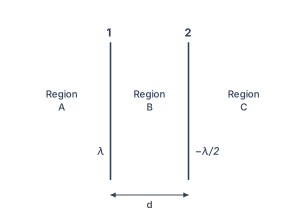
Q.(a) Two small solid metal balls A and B of radii R and 2R having charge densities 2σ and 3σ respectively are kept far apart. Find the charge densities on A and B after they are connected by a conducting wire.
🔒You're viewing a preview — the full solution, concept, methods & PYQ mapping are locked.
🔒 Start your 14-day free trial to unlock the full solution →Part (a)Concept understanding — Electrostatic Induction
Electrostatic Induction: From Intuition to Precision
Imagine you're holding a charged balloon near a wall. The balloon sticks to the wall, even though the wall is uncharged. How does that happen? That's electrostatic induction at work.
The Core Intuition
Every material is made of atoms, which contain equal numbers of positive protons and negative electrons. Normally, these charges are balanced — the material is neutral. But charges can rearrange inside a material without leaving it.
When you bring a charged object near a neutral conductor, the charges inside that conductor feel a force. Like charges repel, opposite charges attract. So the free electrons in the conductor shift slightly: they move toward a positive external charge, or away from a negative one. The conductor as a whole stays neutral, but one side becomes slightly positive and the other slightly negative. This separation of charge is electrostatic induction.
Induction does not involve contact. The charged object never touches the conductor — it only comes near. The effect is purely due to the electric field.
The Precise Statement
Electrostatic induction is the redistribution of electric charge in an object, caused by the influence of a nearby charged body, without direct contact between them.
Key points to remember:
- The inducing charge remains unchanged.
- The induced charges are equal in magnitude but opposite in sign on the two sides of the conductor.
- The total charge on the induced object remains zero (if it was initially neutral).
- The effect is strongest in conductors (where charges move freely), but also occurs in insulators (where molecules polarise slightly).
A Simple Demonstration
Take a metal sphere (uncharged) and bring a positively charged rod near it — not touching.
- Electrons in the metal are attracted toward the rod. The side nearest the rod becomes negatively charged.
- The far side, now lacking electrons, becomes positively charged.
- The sphere is still neutral overall, but charge has been induced.
If you now touch the far side of the sphere with your finger while the rod is still near, electrons flow from your body into the sphere (or out of it, depending on sign). Remove your finger first, then remove the rod — the sphere now has a net charge. This is charging by induction, a direct application. …
Part (b)Concept understanding — Coulomb Force Superposition
Coulomb Force Superposition – From Intuition to Precision
Imagine you're in a room with three friends. Each friend can push or pull you. If two friends push you from the same side, you feel a stronger push — the combined effect. If one pushes from the left and another from the right, you feel the net effect, which might be smaller or even zero if they push equally hard.
This is exactly how electric forces work. When multiple charged particles are present, each one exerts its own force on a given charge. The total force that charge feels is simply the vector sum of all the individual forces — as if each other charge were acting alone, completely ignoring the presence of the rest.
That's the core idea: forces add like arrows, not like numbers.
The Precise Statement
Fnet on q0=∑i=1nFi→0=4πε01∑i=1nri02q0qir^i0
Where:
- q0 is the charge you're calculating the force on
- qi are all other charges (excluding q0 itself)
- ri0 is the distance between qi and q0
- r^i0 is a unit vector pointing from qi to q0 (or away, depending on sign convention — be consistent)
The key point: Each pair of charges interacts independently. The presence of a third charge does not alter the force between the first two. This is what "superposition" means — the forces simply layer on top of each other.
Why This Matters (and a Common Trap)
Never add the magnitudes of forces directly unless all forces are along the same line and in the same direction. Force is a vector — direction matters.
If two forces point in opposite directions, they partially cancel. If they're at right angles, the net force is found using the Pythagorean theorem, not simple addition.
Example: Three charges on a line:
- q1=+2μC at x=0
- q2=−1μC at x=3cm
- q0=+1μC at x=1cm
Step 1: Force from q1 on q0 — both positive, so repulsive. q0 is pushed to the right.
Step 2: Force from q2 on q0 — opposite signs, so attractive. q0 is pulled to the right (toward q2).
Step 3: Both forces point right. Now you add magnitudes: Fnet=F1→0+F2→0.
If q2 were also positive, the force from q2 would push q0 left, and you'd subtract.
The Deeper Reason
Coulomb's law is a linear law — the force is proportional to each charge individually. If you double q1, the force from q1 doubles, but the force from q2 stays the same. This linearity is what makes superposition possible. It's not a coincidence — it's a fundamental property of electromagnetic interactions at the classical level.
Superposition works because electric forces obey a linear inverse-square law. If the force depended on products of three charges (like q0q1q2), superposition would fail. It doesn't — and that's why we can break down any multi-charge problem into a series of two-charge calculations.
--- …
Why this formula?
Coulomb Force Superposition — Why the Formula Holds
The principle of superposition for Coulomb forces states that the net electrostatic force on a given charge due to a collection of other charges is the vector sum of the individual forces from each charge, as if the others were absent.
The Key Formula
If we have a charge q0 at position r0, and N other point charges q1,q2,…,qN at positions r1,r2,…,rN, the net force on q0 is:
Fnet=4πε01∑i=1N∣r0−ri∣2q0qir^0i
where r^0i is the unit vector pointing from qi to q0.
Why This Works — The Physical Reasoning
1. Coulomb's Law is a Two-Body Interaction
Coulomb's law describes the force between exactly two point charges. It depends only on:
- The product of their charges (q0qi)
- The inverse square of the distance between them
- The direction along the line joining them
Crucially, the force between q0 and qi does not depend on the presence of any other charges qj.
2. Forces Add as Vectors (Newton's Third Law + Linearity)
Electrostatic forces are real physical forces — they obey Newton's laws. If multiple forces act on the same charge, the net effect is the vector sum of each individual force. This is a fundamental property of forces in classical mechanics.
3. The Electric Field is Linear
A deeper reason: the electric field E obeys superposition. Since F=q0E, and E from multiple sources adds linearly, the force automatically adds linearly.
The electric field at r0 due to qi is:
Ei(r0)=4πε01∣r0−ri∣2qir^0i
Then:
Fnet=q0∑iEi=∑iFi
The Crucial Assumption (Why It's Not Trivial)
Superposition holds because Maxwell's equations are linear in the electric field. If the equations were nonlinear (e.g., if the field depended on E2), then the force from two charges together would not be the sum of the individual forces.
In electrostatics, the electric field satisfies:
∇⋅E=ε0ρ,∇×E=0
Both equations are linear — if E1 and E2 are solutions, then E1+E2 is also a solution. This linearity is the mathematical reason superposition works.
--- …
Part (a)
Connecting two conductors by a wire brings them to a common potential; total charge is conserved.
Initial charges: qA=(2σ)(4πR2)=8πR2σ, qB=(3σ)(4π(2R)2)=48πR2σ; total Q=56πR2σ.
Equal potentials RkqA=2RkqB⇒qB=2qA. With qA+qB=Q: qA=3Q, qB=32Q. …
- On joining the spheres, charge redistributes to equal potential, giving σA=314σ and σB=37σ.
- The fields of the two parallel wires cancel only beyond the weaker wire; the null point is at x=2d from the +λ wire, in region C.
Part (a)
Two conductors joined by a wire form one conductor and reach the same potential; for a sphere V=Rkq, and total charge is conserved.
Initial charges from the given surface densities (sphere area 4πR2):
qA=(2σ)(4πR2)=8πR2σ,qB=(3σ)(4π(2R)2)=48πR2σ,
so the total is Q=56πR2σ.
Equal potential after connection:
RkqA=2RkqB ⇒ qB=2qA.
With qA+qB=Q: 3qA=Q⇒qA=3Q=356πR2σ, qB=32Q=3112πR2σ.
New densities:
σA=4πR2qA=1256σ=314σ,σB=4π(2R)2qB=48112σ=37σ. …
Showing the 12 most recent of 41 on this concept.
- CBSE 2026Set A1 markMCQQ.Coulomb's law is valid for (A) Point charges only (B) Dispersed charges only (C) Both point charges and dispersed charges (D) Neutral particles
›Reveal solutionSolution
Coulomb's law is defined for point charges; extended bodies need integration.
Coulomb's law states F=4πε01r2q1q2, where r is the distance between the charges.
…
- CBSE 2026Set ANNUAL1 markMCQQ.Two spheres carrying charges +6 μC and +9 μC, separated by a distance d, experience a force of repulsion F. When a charge of −3 μC is added to each sphere and distance d is kept the same, the new force of repulsion will be(a) 3F(b) F/9(c) F(d) F/3
›Reveal solutionSolution
New force = F/3, because force is proportional to the product of the charges and only the charges changed, not the distance.
By Coulomb's law, the force between two point charges q1 and q2 separated by a fixed distance d is
F=4πε01d2q1q2
Originally q1=+6 μC and q2=+9 μC, so F∝q1q2=54 (in μC2).
After −3 μC is added to each sphere: …
- CBSE 2026Set ANNUAL1 markMCQQ.Two sphere of charge 2μc and 3μc are located at a distance 20 cm apart in air. The ratio of magnitude of electric forces acting between these spheres will be(a) 1 : 1(b) 2 : 3(c) 3 : 2(d) 4 : 9
›Reveal solutionSolution
The mutual electric force between two charges is an action-reaction pair, so both spheres feel equal magnitude forces regardless of the charge values.
By Coulomb's law the force sphere 1 exerts on sphere 2 has magnitude F = k q1 q2 / r^2, and the force sphere 2 exerts on sphere 1 has the same magnitude k q1 q2 / r^2, just opposite in direction (Newton's third law applies to electrostatic forces just as it do …
- CBSE 2025Set X11 markMCQQ.A point charge q1 exerts a force F on another point charge q2 when placed at a fixed distance. If another point charge q3 is brought near q2, the force on q2 due to q1 :(a) increases(b) decreases(c) may increase or decrease(d) does not change
›Reveal solutionSolution
(d) does not change. By the principle of superposition, the electrostatic force between q1 and q2 is given by Coulomb's law F=4πε01r2q1q2 and depends …
- CBSE 2025Set D1 markMCQQ.The distance between two charges is made half and one of the charges is also halved. The force acting between the two will become as compared to previous value (A) half (B) double (C) thrice (D) none of these
›Reveal solutionSolution
Coulomb force F ∝ q₁q₂/r²; halving one charge (×½) and halving the distance (×4) gives a net factor of 2, so the force doubles.
Coulomb's law:
F=r2kq1q2
Initial force: F=r2kq1q2.
Now one charge becomes q1/2 and the distance becomes r/2:
…
- CBSE 2025Set D1 markMCQQ.On inserting a dielectric material between two positive charges in air, the value of repulsive force will (A) increase (B) decrease (C) remain same (D) become zero
›Reveal solutionSolution
A dielectric weakens the field between charges by a factor K, so the repulsive force falls to F₀/K.
The Coulomb force between two charges in air is F₀ = (1/4πε₀)·q₁q₂/r². Filling the space with a dielectric of relative permittivity K replaces ε₀ with Kε₀:
F = (1/4πKε₀)·q₁q₂/r² = F₀/K
…
- CBSE 2025Set ANNUAL1 markMCQQ.The law governing the force between static electric charges is known as(i) Ampere's law(ii) Ohm's law(iii) Faraday's law(iv) Coulomb's law
›Reveal solutionSolution
The force between two static (point) electric charges is governed by Coulomb's law.
Ampere's law relates a magnetic field to the current producing it, Ohm's law relates current and voltage in a conductor, and Faraday's law deals with electromagnetic induction. None of these describes the force between charges at rest.
…
- CBSE 2024Set IMPROVEMENT1 markMCQQ.On placing dielectric material between two point charges in air, repulsive force between them will —(a) Increase(b) Decrease(c) Remain same(d) Zero
›Reveal solutionSolution
Placing a dielectric between two charges reduces the force between them.
…
- CBSE 2024Set FS1 markMCQQ.Force of 80 Newton works between two point charges placed at a fixed distance apart in air. When these charges are placed at the same distance apart in a dielectric medium, then force of 8 Newton works on it. The dielectric constant of medium will be:(i) K=−10(ii) K=10(iii) K=0.01(iv) K=−0.01
›Reveal solutionSolution
K=FmediumFair=880=10 — option (ii).
Concept. Coulomb's force between two charges at separation r is
Fair=4πε01r2q1q2,Fmedium=4πε0K1r2q1q2.
Placing a dielectric of constant K reduces the force by the factor K. …
- CBSE 2024Set A1 markQ.Match Column 'A' with Column 'B' and write the correct pair. Column 'A' item: 'Electrostatic force'. Column 'B' options:(i) De-Broglie(ii) Maxwell(iii) Ohm(iv) Einstein(v) Coulomb(vi) Lenz(vii) Young.
›Reveal solutionSolution
Electrostatic force is governed by Coulomb's law.
The force of attraction or repulsion between two stationary point charges is called the electrostatic (or Coulomb) force, and its magnitude is given by Coulomb's law:
F=4πε01r2q1q2
…
- CBSE 2024Set ANNUAL1 markMCQQ.Two charged spheres are separated by a distance d, exert a force F on each other. If the charges are doubled and the distance between them is doubled then the force is(a) F(b) F/2(c) F/4(d) 4F
›Reveal solutionSolution
Coulomb's law force scales as (charge product)/(distance)^2; doubling both charges and the distance leaves the force unchanged.
By Coulomb's law, the force between two point charges q1 and q2 separated by distance d is
F=4πϵ01d2q1q2=kd2q1q2
…
- CBSE 2024Set ANNUAL1 markQ.What is the name of the electrical force acting between two charges at rest?
›Reveal solutionSolution
The force between two charges at rest is the electrostatic (Coulomb) force.
The electrical force acting between two charges that are at rest (not moving) is called the electrostatic force, or Coulomb force, since it is governed by Coulomb's law:
F=4πϵ01r2q1q2
…
🎓Unlock everything free for 14 days
- ✓Full step-by-step solutions
- ✓Concept-first explanations
- ✓Methods, shortcuts & mistakes
- ✓PYQ mapping + timed mock tests
Full access for 14 days. No credit card required.