Q.Four resistors, each of resistance , and a key are connected as shown in the figure. The equivalent resistance between points A and B when key is open will be: (A) (B) (C) (D)
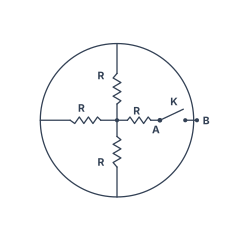
When key is open, the circuit reduces to a single resistor from A to the central node O, followed by three resistors in parallel from O to the ring (which is all one node including B). The equivalent resistance is .
The key insight here is that the conducting ring is a perfect conductor — it has zero resistance. That means every point on the ring is at the same electrical potential. So the top (T), bottom (Bot), left (L), and terminal B are all the same node. This is the heart of the problem.
When is open, the branch containing carries no current — it's just an open circuit. So current from A can only go through the resistor to the central node O. From O, there are three paths: through the three resistors to T, Bot, and L — but all three of those points are connected to the ring, which is node B. So those three resistors are in parallel between O and B.
Let's work through it step by step.
-
Identify the nodes with the ring closed.
The ring is a zero-resistance wire. Points T, Bot, L, and B are all shorted together. So they form a single electrical node — call it node B for convenience.
-
Trace the path from A to B with open.
Starting at A, the only way to reach B is:
A → resistor → central node O → then through any of the three resistors to the ring (node B).
The branch is open, so no current flows through it.
-
Find the equivalent resistance from O to B.
From O, three resistors each go to the ring (node B). Since all three share the same two nodes (O and B), they are in parallel.
The parallel combination of three equal resistors is:
- Add the series resistor from A to O. The resistor from A to O is in series with the parallel combination from O to B. So the total equivalent resistance between A and B is:
A common mistake is to think the ring introduces extra series paths or that the three resistors from O to the ring are in series with each other. But because the ring is a perfect conductor, all three connect to the same node — they are in parallel, not series.
Whenever you see a conducting ring or wire connecting multiple points in a circuit, treat all those points as a single node. This instantly simplifies the topology.
The equivalent resistance between A and B when key is open is , which corresponds to option (D).
Unlock everything free for 14 days
- Full step-by-step solutions
- Concept-first explanations
- Methods, shortcuts & mistakes
- PYQ mapping + timed mock tests
Full access for 14 days. No credit card required.