Q.(a)
🔒You're viewing a preview — the full solution, concept, methods & PYQ mapping are locked.
🔒 Start your 14-day free trial to unlock the full solution →Part (a)Concept understanding — Angular Magnification
What is Angular Magnification?
When you look at a tiny object — say a grain of salt — you hold it close to your eye to see it bigger. But there is a limit: bring it too close and it blurs. The closest distance at which your eye can focus comfortably is called the near point, conventionally taken as 25 cm for a normal eye. At that distance, the object subtends a certain angle at your eye. That angle determines how large it appears — not its physical size, but the fraction of your field of view it occupies.
Now imagine using a magnifying glass. The same grain of salt now looks much larger. Why? Because the lens lets you bring the object even closer than 25 cm while still seeing a clear, magnified image. That image is formed at a comfortable viewing distance, but the angle it subtends at your eye is far bigger than the angle the object would subtend at 25 cm without the lens.
Angular magnification is simply the ratio of these two angles:
Angular magnification M=θobjectθimage
where θimage is the angle subtended by the image when viewed through the instrument, and θobject is the angle subtended by the object when viewed with the naked eye at the near point (25 cm).
Why "Angular" and Not "Linear"?
A common confusion: a microscope or telescope does not give you a physically larger object — it gives you a larger apparent size. The image on your retina is bigger because the rays entering your eye are steeper. That steepness is measured by the angle. So magnification here is about angles, not actual lengths.
Angular magnification is dimensionless. It tells you how many times wider the image appears compared to the object seen directly at the near point.
A Concrete Example
Take a simple magnifier (a convex lens) of focal length f=5 cm. You place the object just inside the focal point so that a virtual, erect image forms at infinity (or at the near point). For the "image at infinity" case, the angle subtended by the image is θimage≈h/f, where h is the object height. The angle subtended by the object at the near point (25 cm) is θobject≈h/25.
Thus:
M=h/25h/f=f25
For f=5 cm, M=5. The image appears 5 times larger than the object seen at 25 cm.
For a magnifier, the formula M=1+f25 applies when the image is formed at the near point (25 cm) — giving slightly higher magnification than the infinity-focus case.
The Big Picture
Angular magnification is the language of all optical instruments:
- Simple magnifier: M≈25/f (image at infinity) …
Part (b)Concept understanding — Total Internal Reflection
Total Internal Reflection: When Light Decides to Stay Home
Imagine you're running on a beach toward the water. On sand, you run fast. The moment you hit the water, your speed drops — the water "resists" more. If you run at a shallow angle toward the waterline, your legs will suddenly slow down, and your body will twist. That twist is refraction — light bending when it changes speed between two media.
Now imagine the reverse: you're swimming in the water, heading toward the shore. You're moving slower in water, and you want to get out onto the fast sand. If you approach the shore at a very shallow angle — almost parallel to the beach — you might never make it out. The sudden speed-up as you hit the sand could "reflect" you back into the water. That's the intuition for total internal reflection.
The Core Idea
Light normally passes from one transparent medium to another (say, from water to air) and bends away from the normal — because it speeds up. But if the angle of incidence in the slower medium is large enough, the light can't escape. It gets completely reflected back inside the first medium. No light transmits. That's total internal reflection.
Total internal reflection (TIR) occurs only when light travels from a denser (slower) medium to a rarer (faster) medium, and the angle of incidence exceeds a critical value.
The Two Conditions (Memorise These)
For TIR to happen, both must be true:
-
Light must go from a denser medium to a rarer medium (e.g., glass → air, water → air, diamond → air).
Denser means higher refractive index (n). Light slows down in a denser medium.
-
Angle of incidence (i) must be greater than the critical angle (C).
The critical angle is the angle of incidence in the denser medium for which the angle of refraction in the rarer medium is exactly 90∘.
The Critical Angle — The Tipping Point
Look at the diagram in your mind: a ray in water heading toward the surface. As you increase the angle of incidence, the refracted ray in air bends more and more away from the normal. At some specific angle C, the refracted ray skims exactly along the surface — angle of refraction =90∘.
sinC=ndensernrarer
For water (n=1.33) to air (n=1.00):
sinC=1.331.00≈0.75⇒C≈48.6∘
So if you shine a light from water into air at an angle greater than about 49∘ from the normal, the light will not leave the water at all. It reflects back down — perfectly.
What Actually Happens at the Boundary?
- i<C: Most light refracts out; a little reflects (normal partial reflection).
- i=C: Refracted ray grazes the surface; transmitted intensity is nearly zero.
- i>C: No transmitted ray. All the light energy reflects back into the denser medium. The reflection is 100% — no absorption, no transmission.
TIR is not the same as ordinary reflection from a mirror. In TIR, there is no silvering or coating. The reflection happens because the wave cannot exist in the rarer medium — it's forced back. This gives perfect reflection with zero energy loss, unlike a metal mirror which absorbs some light.
--- …
Why this formula?
Total Internal Reflection: Why the Key Formulas Hold
Total Internal Reflection (TIR) is a fascinating optical phenomenon where light, instead of escaping from a denser medium into a rarer one, gets completely reflected back into the denser medium. Let's build the understanding from first principles.
1. The Foundation: Snell's Law
The entire story begins with Snell's Law:
n1sinθ1=n2sinθ2
Where:
- n1 = refractive index of the denser medium (e.g., glass, water)
- n2 = refractive index of the rarer medium (e.g., air)
- θ1 = angle of incidence (in denser medium)
- θ2 = angle of refraction (in rarer medium)
Key fact: n1>n2 (light travels from denser to rarer).
2. The Critical Angle: Where Refraction "Bends" to 90°
As θ1 increases, θ2 increases faster (because n1>n2). At some special angle, θ2 becomes exactly 90∘ — the refracted ray grazes the surface.
Set θ2=90∘ in Snell's Law:
n1sinθc=n2sin90∘
Since sin90∘=1:
sinθc=n1n2
Why this formula?
It's not arbitrary — it's the limit of Snell's Law. The critical angle θc is the largest incidence angle for which refraction is still possible. Beyond this, Snell's Law would demand sinθ2>1, which is impossible — no real angle satisfies it.
3. Beyond the Critical Angle: Why TIR Occurs
When θ1>θc:
- Snell's Law gives sinθ2=n2n1sinθ1>1
- No real θ2 exists
- Physics says: the wave cannot "fit" into the rarer medium
- Result: All energy is reflected back into the denser medium
This isn't a failure of Snell's Law — it's a physical boundary where the wave's behaviour changes from propagating to evanescent (decaying).
4. The Condition for TIR (Exam-Ready Summary)
For Total Internal Reflection to occur, both conditions must hold:
- Light travels from denser to rarer medium (n1>n2) …
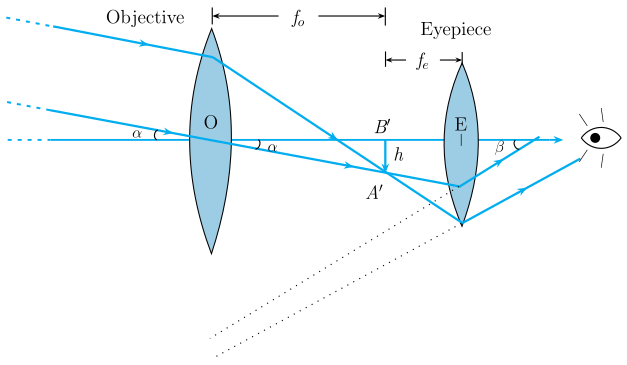
Part (a)
Astronomical telescope (normal adjustment): objective forms a real inverted image of a distant object at its focus, which is at the focus of the eyepiece, so the final image is at infinity; magnifying power M=fefo. Two-lens system: L1 (f=24, u=−36): v1=241−361=721⇒v=72 cm; m1=−3672=−2. For L2 (f=−18), object is 72−45=27 cm beyond it (virtual, u=+27): v1=−181+271=−541⇒v=−54 cm; m2=27−54=−2. Final image 54 cm to the left of L2; m=m1m2=4, height =4×1=4 cm (erect). …
Part (a): M=fefo; the two-lens combination forms a 4 cm erect image 54 cm from L2.
Part (b): optical fibre guides light by TIR; symmetric prism ⇒δm=60∘, n=3; immersing in water reduces δm.
Part (a)
- Astronomical refracting telescope (image at infinity). Parallel rays from a distant object are focused by the objective (focal length fo) to form a real, inverted image at its focal plane. This image is placed at the focus of the eyepiece (focal length fe), so the eyepiece sends out parallel rays and the final image is at infinity (normal adjustment). The magnifying power is the ratio of the angle subtended at the eye by the final image to that by the object:
M=αβ=fefo.
- Two-lens combination. L1: convex, f1=+24 cm, object u1=−36 cm:
This image is 72 cm right of L1, i.e. 72−45=27 cm beyond L2, so it is a virtual object for L2: u2=+27 cm, f2=−18 cm: v21=f21+u21=−181+271=54−3+2=−541⇒v2=−54 cm,m2=u2v2=27−54=−2. …
v11=f11+u11=241−361=723−2=721⇒v1=+72 cm,m1=u1v1=−3672=−2.
Showing the 12 most recent of 44 on this concept.
- CBSE 2026Set 55/3/11 markMCQQ.A telescope has an objective lens of focal length 144 cm and an eyepiece of focal length 6.0 cm. The magnifying power and the length of the telescope tube will be respectively : (A) 24, 150 cm (B) 42, 138 cm (C) 24, 138 cm (D) 42, 150 cm
›Reveal solutionSolution
For a telescope in normal adjustment, the magnifying power is the ratio of objective to eyepiece focal lengths (M=fo/fe), and the tube length is their sum (L=fo+fe). Here, M=144/6=24 and L=144+6=150 cm, so the correct option is (A).
The question gives you a telescope with an objective of focal length fo=144 cm and an eyepiece of focal length fe=6.0 cm. You need the magnifying power and the length of the telescope tube.
The key idea is that a telescope is used to view distant objects. Light from a faraway object arrives as nearly parallel rays. The objective lens forms a real, inverted image at its focal plane. The eyepiece then acts as a magnifier to view that image.
For relaxed viewing (normal adjustment), the eyepiece is adjusted so that the final image is at infinity. This means the image formed by the objective must lie exactly at the focal point of the eyepiece. So the distance between the two lenses — the tube length — is simply the sum of their focal lengths.
The magnifying power (or angular magnification) is defined as the ratio of the angle subtended at the eye by the final image to the angle subtended by the object when viewed directly. For a telescope in normal adjustment, this ratio simplifies beautifully to the ratio of the focal lengths.
For a telescope in normal adjustment:
M=fefoandL=fo+fe
Let's apply this directly.
- Magnifying power:
M=fefo=6.0144=24
- Tube length:
L=fo+fe=144+6.0=150 cm
So the magnifying power is 24 and the tube length is 150 cm. …
- CBSE 2026Set 55/3/11 markMCQQ.In which of the following does total internal reflection NOT occur ? (A) Twinkling of stars (B) Brilliance of diamonds (C) Optical fibre (D) Reflecting prism
›Reveal solutionSolution
Total internal reflection requires light to travel from a denser to a rarer medium at an angle greater than the critical angle. Twinkling of stars involves refraction through atmospheric layers of varying density, not TIR. The answer is (A).
Total internal reflection is a phenomenon that occurs when light traveling in a denser medium strikes the boundary with a rarer medium at an angle greater than the critical angle. At this point, instead of refracting into the second medium, all the light reflects back into the denser medium. The key conditions are: light must go from higher to lower refractive index, and the angle of incidence must exceed the critical angle θc=sin−1(n2/n1) where n1>n2.
Let's examine each option to see where this principle applies:
-
Twinkling of stars: Starlight enters Earth's atmosphere and passes through layers of air with slightly different temperatures and densities. As light moves through these layers, it undergoes refraction — bending at each boundary because the refractive index changes gradually. Sometimes light bends toward regions of higher density, sometimes toward lower density, but it continues to propagate through the atmosphere. The random fluctuations in atmospheric density cause the apparent position and brightness of stars to change rapidly, creating the twinkling effect. This is purely refraction, not total internal reflection.
-
Brilliance of diamonds: A diamond has a very high refractive index (n≈2.42). When light enters a diamond and strikes the internal faces, it often does so at angles greater than the critical angle (which is quite small, around 24.4° for diamond-air interface). The light then undergoes total internal reflection multiple times inside the diamond before emerging, creating the characteristic sparkle and brilliance. …
-
- CBSE 2026Set V11 markMCQQ.For total internal reflection of light :(a) light should be travelling from rarer medium to denser medium(b) light should be travelling from denser medium to rarer medium(c) light should be incident along the normal(d) angle of incidence should be equal to 90∘
›Reveal solutionSolution
(b) light should be travelling from denser medium to rarer medium …
- CBSE 2026Set DS1 markMCQQ.If critical angle in a medium be α, then for total internal reflection, the angle of incidence β should be:i) β<αii) β>αiii) β=αiv) β≤α
›Reveal solutionSolution
TIR occurs only for angles of incidence larger than the critical angle, so β>α.
Concept. When light travels from a denser to a rarer medium, at the critical angle α the refracted ray just grazes the surface (angle of refraction =90∘). If the angle of incidence is increased beyond this critical angle, refraction is no longer possible and the light is completely reflected back into the denser medium — this is total internal reflection.
…
- CBSE 2026Set ANNUAL1 markQ.When light passes from a denser medium to a rarer medium, and the angle of incidence equals the critical angle, what is the angle of refraction?
›Reveal solutionSolution
The critical angle is DEFINED as the angle of incidence at which the refracted ray just grazes the interface, making the angle of refraction exactly 90 degrees.
When light travels from a denser medium towards a rarer medium, it bends away from the normal. As the angle of incidence is increased, the angle of refraction increases faster and eventually reaches 90 degrees (the refracted ray travels right along the boundary between the two media) - the angle of incidence at which this happens is called the critical angle (theta_c). By …
- CBSE 2026Set ANNUAL1 markQ.Answer in one word/sentence: What is the phenomena that causes a bubble in water to shine brightly?
›Reveal solutionSolution
Air bubbles in water appear to shine brightly (like silver) due to total internal reflection of light at the water-air interface of the bubble.
Light travelling in the denser medium (water) strikes the surface of the air bubble (a rarer medium) at angles greater than the critical angle for the water-air interface. Since it cannot refract out, it is totally internal …
- CBSE 2025Set JS1 markQ.What do you mean by total internal reflection? Show it by drawing ray diagram.
›Reveal solutionSolution
When light travelling in a denser medium hits a rarer medium at an angle greater than the critical angle, it is fully reflected back — this is total internal reflection.
Definition. When light passes from an optically denser medium to an optically rarer medium, it bends away from the normal. As the angle of incidence increases, the refracted ray bends more, until at the critical angle θc the refracted ray grazes the surface (r=90∘). For any angle of incidence greater than θc, no refraction occurs and the light is completely reflected back into the denser medium. This is called total internal reflection (TIR).
Conditions.
- Light must travel from a denser to a rarer medium.
- The angle of incidence must exceed the critical angle: i>θc, where sinθc=n1 (n = refractive index of the denser medium relative to the rarer).
Ray diagram (description). For a ray striking the denser–rarer boundary at three increasing angles:
- i<θc: refracts into the rarer medium (bends away from normal).
- i=θc: refracted ray travels along the surface (90∘). …
- CBSE 2025Set D1 markMCQQ.If the critical angle for total internal reflection from any medium to vacuum is 30°, then the velocity of light in the medium is (A) 3 × 10^8 m/sec (B) 1.5 × 10^8 m/sec (C) 6 × 10^8 m/sec (D) 4.5 × 10^8 m/sec
›Reveal solutionSolution
From the critical angle, refractive index n = 1/sin C = 2; the speed of light in the medium is c/n = 1.5×10⁸ m/s.
The critical angle C for total internal reflection from a medium into vacuum is related to the refractive index n by
sinC=n1
With C = 30°:
n=sin30∘1=0.51=2
…
- CBSE 2025Set A1 markQ.Fill in the blank with appropriate word: In total internal reflection, refractive angle is ______, when incidence angle is equal to the critical angle.
›Reveal solutionSolution
At the critical angle, the refracted ray just grazes the boundary, so the angle of refraction is 90°.
The critical angle C is defined, for light travelling from a denser to a rarer medium, as that particular angle of incidence for which the angle of refraction becomes exactly 90°, i.e. the refracted ray travels along the boundary/interface separating the two media. By Snell's law, n1 sin C = n2 sin 90° = n2, which gives sin C = n2/n1. For any …
- CBSE 2025Set A1 markQ.Fill in the blank with appropriate word: Simple microscope is a converging lens of ______ focal length.
›Reveal solutionSolution
A simple microscope must have a short focal length to give useful magnification.
A simple microscope is just a single convex (converging) lens used to view a small object placed within its focal length, forming a magnified, virtual, erect image. Its angular magnification (when the image is formed at the near point D = 25 cm) is given by m = 1 + D/f. This shows that the magnification increases as the focal length f decre …
- CBSE 2025Set ANNUAL1 markQ.How is the critical angle related to the refractive index?
›Reveal solutionSolution
The critical angle is the angle of incidence (in the denser medium) at which the refracted ray just grazes the interface at 90 degrees, which by Snell's law gives sin(C) = 1/n.
Consider light travelling from a denser medium (refractive index n, relative to a rarer medium like air) toward the interface. By Snell's law, for the boundary case where the angle of refraction is exactly 90 degrees (refracted ray grazes along the surface):
n sin(C) = 1 x sin(90 degrees) = 1
sin(C) = 1/n
Equivalently, n = 1/sin(C) (or n = cosec C).
…
- CBSE 2025Set ANNUAL1 markQ.Write the reason for the shining of air bubbles in the water.
›Reveal solutionSolution
Light travelling from the denser medium (water) towards the rarer medium (air bubble) strikes the curved surface at an angle greater than the critical angle and undergoes total internal reflection, making the bubble appear bright/silvery.
Water is optically denser than air. When light travelling inside water falls on the curved surface of an air bubble, it is going from a denser medium (water) to a rarer medium (air).
For total internal reflection to occur, two conditions must be met:
- Light must travel from a denser medium to a rarer medium.
- The angle of incidence at the interface must be greater than the critical angle θc for the water–air pair (where sinθc=1/nwater). …
🎓Unlock everything free for 14 days
- ✓Full step-by-step solutions
- ✓Concept-first explanations
- ✓Methods, shortcuts & mistakes
- ✓PYQ mapping + timed mock tests
Full access for 14 days. No credit card required.