Q.A thin plano-convex lens and a thin equi-concave lens are kept coaxially in contact as shown in the figure. Assuming both the lenses are made of glass of refractive index , and is the radius of curvature of each curved surface, the focal length of the combination is : (A) (B) (C) (D)
You're viewing a preview — the full solution, concept, methods & PYQ mapping are locked.
Start your 14-day free trial to unlock the full solution →We calculate the focal lengths of the plano-convex and equi-concave lenses separately using the lens maker's formula, applying the correct sign conventions for radii of curvature. Then, we combine these focal lengths to find the equivalent focal length of the system. The focal length of the combination is .
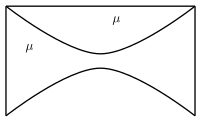
Concept and Intuition
To find the focal length of a combination of thin lenses kept in contact, we first need to determine the focal length of each individual lens. The fundamental tool for this is the Lens Maker's Formula.
Lens Maker's Formula
The focal length of a thin lens made of a material with refractive index (relative to the surrounding medium, usually air, for which ) is given by:
Here, is the radius of curvature of the first surface encountered by light, and is the radius of curvature of the second surface. The signs of and are crucial and follow a specific convention.
Sign Convention for Radii of Curvature
We will use the following convention for and in the lens maker's formula, assuming light travels from left to right:
- (First Surface):
- If the first surface is convex (bulges towards the right), is positive ().
- If the first surface is concave (bulges towards the left), is negative ().
- If the first surface is flat (plano), is infinite ().
- (Second Surface):
- If the second surface is convex (bulges towards the left), is negative ().
- If the second surface is concave (bulges towards the right), is positive ().
- If the second surface is flat (plano), is infinite ().
The sign convention for and is a common source of error. Always be consistent with the convention you choose. The one outlined above ensures that converging lenses have positive focal lengths and diverging lenses have negative focal lengths when .
Combination of Thin Lenses in Contact
When two thin lenses with focal lengths and are placed coaxially in contact, the focal length of the combination is given by:
Step-by-step Solution
-
Identify the properties of the plano-convex lens (Lens 1).
- Refractive index:
- First surface: Flat. According to our sign convention, .
- Second surface: Convex. It bulges towards the left (as seen from the second surface, or its center of curvature is to the left). According to our sign convention, .
-
Calculate the focal length of the plano-convex lens ().
Using the lens maker's formula:
Substitute the values for $R_1$ and $R_2$:
Therefore, the focal length of the plano-convex lens is:
This is a positive focal length, as expected for a converging lens.
3. Identify the properties of the equi-concave lens (Lens 2).
* Refractive index: …
Unlock everything free for 14 days
- Full step-by-step solutions
- Concept-first explanations
- Methods, shortcuts & mistakes
- PYQ mapping + timed mock tests
Full access for 14 days. No credit card required.