Q.(a) An electric field exists in a region of space. Draw three equipotential surfaces in the region.
You're viewing a preview — the full solution, concept, methods & PYQ mapping are locked.
Start your 14-day free trial to unlock the full solution →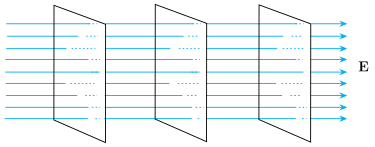
The key idea is that equipotential surfaces are always perpendicular to the electric field lines, and for a dipole at large distances, the potential falls off as and depends on the dipole moment. For part (a), the surfaces are planes perpendicular to the x-axis. For part (b), the potential at for is .
Part (a): Equipotential Surfaces for a Uniform Field
Concept first: An equipotential surface is a surface where the electric potential is constant everywhere. The electric field always points in the direction of the steepest decrease of potential, and it is always perpendicular to equipotential surfaces. If you move along an equipotential, you do no work against the field — the field does no work because your displacement is perpendicular to it.
Here, is uniform and points along the positive x-axis. That means the potential decreases as you move in the direction. Surfaces of constant potential must be perpendicular to the x-axis — they are planes parallel to the yz-plane.
-
Choose three different potentials. Let’s pick , , and , with . Since , a larger gives a smaller .
-
Draw them. In a 3D sketch (or even a 2D cross-section in the xy-plane), these are three parallel planes. In the xy-plane, they appear as three vertical lines (parallel to the y-axis) spaced equally apart if is constant. The plane with the highest potential is on the left (smaller ), and the lowest on the right.
A common shortcut: for a uniform field, the equipotential surfaces are equally spaced parallel planes. The spacing between surfaces differing by is .
Part (b): Potential of a Dipole at Large Distance
Concept first: Two equal and opposite charges separated by a small distance form an electric dipole. At points far away compared to the separation (), the individual charges look almost like they’re at the same location, but their opposite signs cause a partial cancellation of the terms. The leading term in the potential is not (that would be the monopole term, which is zero because total charge is zero) but , proportional to the dipole moment .
We want the potential at a point on the x-axis, to the right of both charges.
-
Write the exact potential. The potential at a point due to a point charge is . Here, we have two charges:
- Charge at : distance to is .
- Charge at : distance to is .
Since , both distances are positive: and . So the exact potential is:
…
Unlock everything free for 14 days
- Full step-by-step solutions
- Concept-first explanations
- Methods, shortcuts & mistakes
- PYQ mapping + timed mock tests
Full access for 14 days. No credit card required.